

organic pollutants rhodamine B and 4-nitrophenol (Gao et al. 2013). The degradation of pollutants was primarily through hydroxyl radical attack which was formed
during the reaction of reduced ferrous ions on the catalyst surface of the clay and
hydrogen peroxide in the solution. Apart from the abovementioned studies, few
naturally available clay minerals are also used as heterogeneous catalyst. Bel
Hadjltaief et al. (2014) prepared a novel heterogeneous catalyst by incorporating
iron species on the surface of natural Tunisian clay. The Fe-clay plate heterogeneous
catalyst showed a higher catalytic activity by attaining 100% removal of phenol in
60 mins with negligible loss in their activity at the end of five successive reaction
cycles under ultraviolet irradiation. Iron-impregnated pillared saponite clay was used
as a heterogeneous catalyst for Fenton by Herney-Ramirez et al. (2008) for the
degradation of orange II dye. They have observed that catalyst concentration and
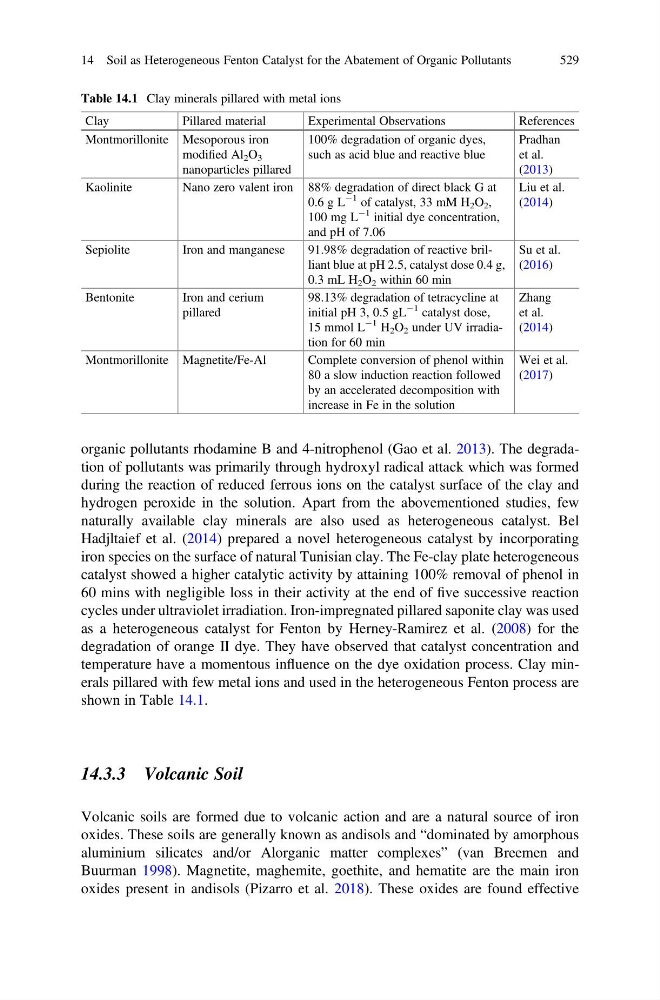
temperature have a momentous influence on the dye oxidation process. Clay minerals pillared with few metal ions and used in the heterogeneous Fenton process are
shown in Table 14.1.
14.3.3 Volcanic Soil
Volcanic soils are formed due to volcanic action and are a natural source of iron
oxides. These soils are generally known as andisols and “dominated by amorphous
aluminium silicates and/or Alorganic matter complexes” (van Breemen and
Buurman 1998). Magnetite, maghemite, goethite, and hematite are the main iron
oxides present in andisols (Pizarro et al. 2018). These oxides are found effective
Table 14.1 Clay minerals pillared with metal ions
Clay
Pillared material
Experimental Observations
References
Montmorillonite Mesoporous iron
modified Al 2 O 3
nanoparticles pillared
100% degradation of organic dyes,
such as acid blue and reactive blue
Pradhan
et al.
(2013)
Kaolinite
Nano zero valent iron 88% degradation of direct black G at
0.6 g L
À1 of catalyst, 33 mM H 2 O 2 ,
100 mg L
À1 initial dye concentration,
and pH of 7.06
Liu et al.
(2014)
Sepiolite
Iron and manganese
91.98% degradation of reactive brilliant blue at pH 2.5, catalyst dose 0.4 g,
0.3 mL H 2 O 2 within 60 min
Su et al.
(2016)
Bentonite
Iron and cerium
pillared
98.13% degradation of tetracycline at
initial pH 3, 0.5 gL
À1 catalyst dose,
15 mmol L
À1 H 2 O 2 under UV irradiation for 60 min
Zhang
et al.
(2014)
Montmorillonite Magnetite/Fe-Al
Complete conversion of phenol within
80 a slow induction reaction followed
by an accelerated decomposition with
increase in Fe in the solution
Wei et al.
(2017)
14 Soil as Heterogeneous Fenton Catalyst for the Abatement of Organic Pollutants
529
during the reaction of reduced ferrous ions on the catalyst surface of the clay and
hydrogen peroxide in the solution. Apart from the abovementioned studies, few
naturally available clay minerals are also used as heterogeneous catalyst. Bel
Hadjltaief et al. (2014) prepared a novel heterogeneous catalyst by incorporating
iron species on the surface of natural Tunisian clay. The Fe-clay plate heterogeneous
catalyst showed a higher catalytic activity by attaining 100% removal of phenol in
60 mins with negligible loss in their activity at the end of five successive reaction
cycles under ultraviolet irradiation. Iron-impregnated pillared saponite clay was used
as a heterogeneous catalyst for Fenton by Herney-Ramirez et al. (2008) for the
degradation of orange II dye. They have observed that catalyst concentration and
temperature have a momentous influence on the dye oxidation process. Clay minerals pillared with few metal ions and used in the heterogeneous Fenton process are
shown in Table 14.1.
14.3.3 Volcanic Soil
Volcanic soils are formed due to volcanic action and are a natural source of iron
oxides. These soils are generally known as andisols and “dominated by amorphous
aluminium silicates and/or Alorganic matter complexes” (van Breemen and
Buurman 1998). Magnetite, maghemite, goethite, and hematite are the main iron
oxides present in andisols (Pizarro et al. 2018). These oxides are found effective
Table 14.1 Clay minerals pillared with metal ions
Clay
Pillared material
Experimental Observations
References
Montmorillonite Mesoporous iron
modified Al 2 O 3
nanoparticles pillared
100% degradation of organic dyes,
such as acid blue and reactive blue
Pradhan
et al.
(2013)
Kaolinite
Nano zero valent iron 88% degradation of direct black G at
0.6 g L
À1 of catalyst, 33 mM H 2 O 2 ,
100 mg L
À1 initial dye concentration,
and pH of 7.06
Liu et al.
(2014)
Sepiolite
Iron and manganese
91.98% degradation of reactive brilliant blue at pH 2.5, catalyst dose 0.4 g,
0.3 mL H 2 O 2 within 60 min
Su et al.
(2016)
Bentonite
Iron and cerium
pillared
98.13% degradation of tetracycline at
initial pH 3, 0.5 gL
À1 catalyst dose,
15 mmol L
À1 H 2 O 2 under UV irradiation for 60 min
Zhang
et al.
(2014)
Montmorillonite Magnetite/Fe-Al
Complete conversion of phenol within
80 a slow induction reaction followed
by an accelerated decomposition with
increase in Fe in the solution
Wei et al.
(2017)
14 Soil as Heterogeneous Fenton Catalyst for the Abatement of Organic Pollutants
529