

material is carbon-based materials. There is a large number of reports for producing
carbon-based materials from various natural sources. The most investigated source
for this purpose is natural source, which includes leaf, flower, stem, seed, and fruit
(Mallampati and Valiyaveettil 2012). Cereal ashes, from barley, oat, triticale, and
wheat grains, have been used as adsorbents for the removal of organic pollutants,
such as benzene, phenol, tetrachloroethylene, and toluene. Barley cereal ash is
reported to remove benzene and toluene effectively, whereas wheat ash is found to
remove tetrachloroethylene and toluene (Ghiaci et al. 2008). In some reports,
synthetic organic chemicals have been also used as a source for preparing carbonbased materials. Carbon nanospheres with porous nature were synthesized by
hydrothermal method and have also been tested for the removal of phenol and
methylene blue as model source of organic pollutants. The triblock copolymers
were used as the source for preparing the carbon nanospheres in this work. These
carbon nanospheres show 98.9% adsorption for phenol and 100% adsorption for
methylene blue (Kundu et al. 2018).
MgAl-LDHs nanosheets exhibit an excellent adsorption capacity of
229.82 mgL
À1 for methyl orange (Li et al. 2016). In this work, MgAl-layered double
hydroxide nanosheets with surface area of 65.94 m
2 g
À1 were prepared by hydrothermal synthesis. Metal oxides are also being studied for the adsorptive removal of
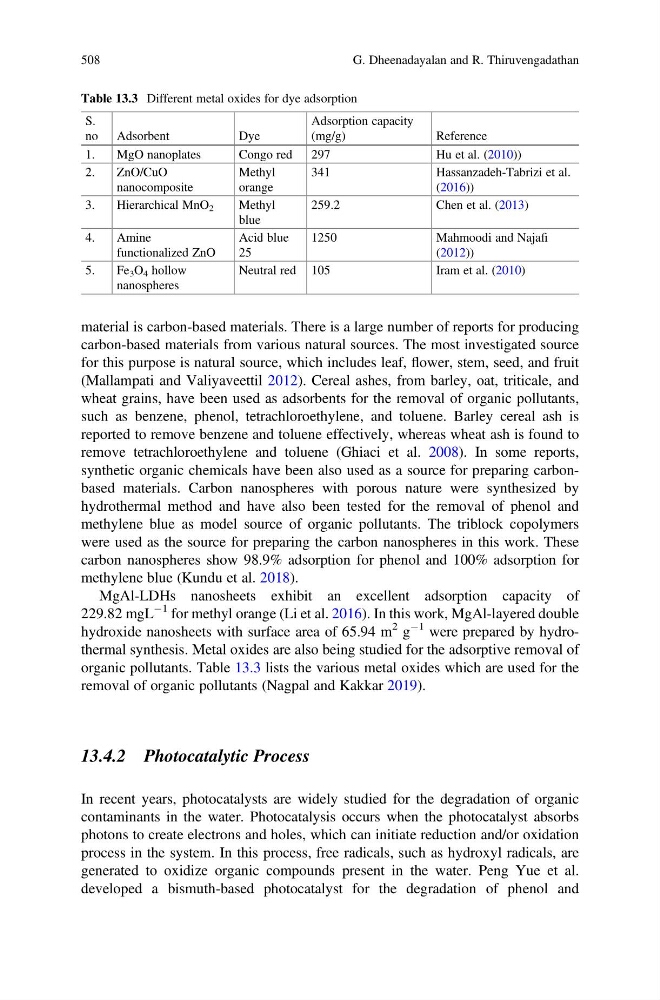
organic pollutants. Table 13.3 lists the various metal oxides which are used for the
removal of organic pollutants (Nagpal and Kakkar 2019).
13.4.2 Photocatalytic Process
In recent years, photocatalysts are widely studied for the degradation of organic
contaminants in the water. Photocatalysis occurs when the photocatalyst absorbs
photons to create electrons and holes, which can initiate reduction and/or oxidation
process in the system. In this process, free radicals, such as hydroxyl radicals, are
generated to oxidize organic compounds present in the water. Peng Yue et al.
developed a bismuth-based photocatalyst for the degradation of phenol and
Table 13.3 Different metal oxides for dye adsorption
S.
no Adsorbent
Dye
Adsorption capacity
(mg/g)
Reference
1.
MgO nanoplates
Congo red 297
Hu et al. (2010))
2.
ZnO/CuO
nanocomposite
Methyl
orange
341
Hassanzadeh-Tabrizi et al.
(2016))
3.
Hierarchical MnO 2
Methyl
blue
259.2
Chen et al. (2013)
4.
Amine
functionalized ZnO
Acid blue
25
1250
Mahmoodi and Najafi
(2012))
5.
Fe 3 O 4 hollow
nanospheres
Neutral red 105
Iram et al. (2010)
508
G. Dheenadayalan and R. Thiruvengadathan
carbon-based materials from various natural sources. The most investigated source
for this purpose is natural source, which includes leaf, flower, stem, seed, and fruit
(Mallampati and Valiyaveettil 2012). Cereal ashes, from barley, oat, triticale, and
wheat grains, have been used as adsorbents for the removal of organic pollutants,
such as benzene, phenol, tetrachloroethylene, and toluene. Barley cereal ash is
reported to remove benzene and toluene effectively, whereas wheat ash is found to
remove tetrachloroethylene and toluene (Ghiaci et al. 2008). In some reports,
synthetic organic chemicals have been also used as a source for preparing carbonbased materials. Carbon nanospheres with porous nature were synthesized by
hydrothermal method and have also been tested for the removal of phenol and
methylene blue as model source of organic pollutants. The triblock copolymers
were used as the source for preparing the carbon nanospheres in this work. These
carbon nanospheres show 98.9% adsorption for phenol and 100% adsorption for
methylene blue (Kundu et al. 2018).
MgAl-LDHs nanosheets exhibit an excellent adsorption capacity of
229.82 mgL
À1 for methyl orange (Li et al. 2016). In this work, MgAl-layered double
hydroxide nanosheets with surface area of 65.94 m
2 g
À1 were prepared by hydrothermal synthesis. Metal oxides are also being studied for the adsorptive removal of
organic pollutants. Table 13.3 lists the various metal oxides which are used for the
removal of organic pollutants (Nagpal and Kakkar 2019).
13.4.2 Photocatalytic Process
In recent years, photocatalysts are widely studied for the degradation of organic
contaminants in the water. Photocatalysis occurs when the photocatalyst absorbs
photons to create electrons and holes, which can initiate reduction and/or oxidation
process in the system. In this process, free radicals, such as hydroxyl radicals, are
generated to oxidize organic compounds present in the water. Peng Yue et al.
developed a bismuth-based photocatalyst for the degradation of phenol and
Table 13.3 Different metal oxides for dye adsorption
S.
no Adsorbent
Dye
Adsorption capacity
(mg/g)
Reference
1.
MgO nanoplates
Congo red 297
Hu et al. (2010))
2.
ZnO/CuO
nanocomposite
Methyl
orange
341
Hassanzadeh-Tabrizi et al.
(2016))
3.
Hierarchical MnO 2
Methyl
blue
259.2
Chen et al. (2013)
4.
Amine
functionalized ZnO
Acid blue
25
1250
Mahmoodi and Najafi
(2012))
5.
Fe 3 O 4 hollow
nanospheres
Neutral red 105
Iram et al. (2010)
508
G. Dheenadayalan and R. Thiruvengadathan