

Rhodamine B under visible light irradiation (Yue et al. 2019). In this study, BiPO4/
BiOCl 0.9 I 0.1 composite was prepared by varying the molar ratio of BiPO 4 and
BiOCl 0.9 I 0.1. 300 W Xe lamp was used as light source. 3% BiPO 4 /BiOCl 0.9 I 0.1
showed 52.9% removal for rhodamine B. In literature, several works have been
reported for the photocatalytic removal of dyes by using wide variety of
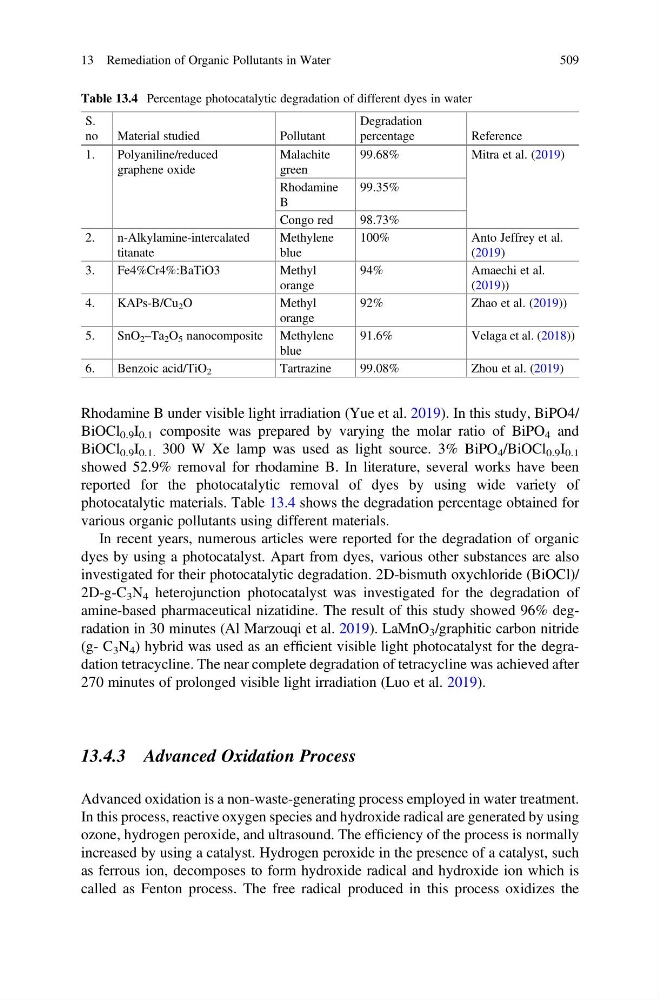
photocatalytic materials. Table 13.4 shows the degradation percentage obtained for
various organic pollutants using different materials.
In recent years, numerous articles were reported for the degradation of organic
dyes by using a photocatalyst. Apart from dyes, various other substances are also
investigated for their photocatalytic degradation. 2D-bismuth oxychloride (BiOCl)/
2D-g-C 3 N 4 heterojunction photocatalyst was investigated for the degradation of
amine-based pharmaceutical nizatidine. The result of this study showed 96% degradation in 30 minutes (Al Marzouqi et al. 2019). LaMnO 3 /graphitic carbon nitride
(g- C 3 N 4 ) hybrid was used as an efficient visible light photocatalyst for the degradation tetracycline. The near complete degradation of tetracycline was achieved after
270 minutes of prolonged visible light irradiation (Luo et al. 2019).
13.4.3 Advanced Oxidation Process
Advanced oxidation is a non-waste-generating process employed in water treatment.
In this process, reactive oxygen species and hydroxide radical are generated by using
ozone, hydrogen peroxide, and ultrasound. The efficiency of the process is normally
increased by using a catalyst. Hydrogen peroxide in the presence of a catalyst, such
as ferrous ion, decomposes to form hydroxide radical and hydroxide ion which is
called as Fenton process. The free radical produced in this process oxidizes the
Table 13.4 Percentage photocatalytic degradation of different dyes in water
S.
no
Material studied
Pollutant
Degradation
percentage
Reference
1.
Polyaniline/reduced
graphene oxide
Malachite
green
99.68%
Mitra et al. (2019)
Rhodamine
B
99.35%
Congo red
98.73%
2.
n-Alkylamine-intercalated
titanate
Methylene
blue
100%
Anto Jeffrey et al.
(2019)
3.
Fe4%Cr4%:BaTiO3
Methyl
orange
94%
Amaechi et al.
(2019))
4.
KAPs-B/Cu 2 O
Methyl
orange
92%
Zhao et al. (2019))
5.
SnO 2 –Ta 2 O 5 nanocomposite Methylene
blue
91.6%
Velaga et al. (2018))
6.
Benzoic acid/TiO 2
Tartrazine
99.08%
Zhou et al. (2019)
13 Remediation of Organic Pollutants in Water
509
BiOCl 0.9 I 0.1 composite was prepared by varying the molar ratio of BiPO 4 and
BiOCl 0.9 I 0.1. 300 W Xe lamp was used as light source. 3% BiPO 4 /BiOCl 0.9 I 0.1
showed 52.9% removal for rhodamine B. In literature, several works have been
reported for the photocatalytic removal of dyes by using wide variety of
photocatalytic materials. Table 13.4 shows the degradation percentage obtained for
various organic pollutants using different materials.
In recent years, numerous articles were reported for the degradation of organic
dyes by using a photocatalyst. Apart from dyes, various other substances are also
investigated for their photocatalytic degradation. 2D-bismuth oxychloride (BiOCl)/
2D-g-C 3 N 4 heterojunction photocatalyst was investigated for the degradation of
amine-based pharmaceutical nizatidine. The result of this study showed 96% degradation in 30 minutes (Al Marzouqi et al. 2019). LaMnO 3 /graphitic carbon nitride
(g- C 3 N 4 ) hybrid was used as an efficient visible light photocatalyst for the degradation tetracycline. The near complete degradation of tetracycline was achieved after
270 minutes of prolonged visible light irradiation (Luo et al. 2019).
13.4.3 Advanced Oxidation Process
Advanced oxidation is a non-waste-generating process employed in water treatment.
In this process, reactive oxygen species and hydroxide radical are generated by using
ozone, hydrogen peroxide, and ultrasound. The efficiency of the process is normally
increased by using a catalyst. Hydrogen peroxide in the presence of a catalyst, such
as ferrous ion, decomposes to form hydroxide radical and hydroxide ion which is
called as Fenton process. The free radical produced in this process oxidizes the
Table 13.4 Percentage photocatalytic degradation of different dyes in water
S.
no
Material studied
Pollutant
Degradation
percentage
Reference
1.
Polyaniline/reduced
graphene oxide
Malachite
green
99.68%
Mitra et al. (2019)
Rhodamine
B
99.35%
Congo red
98.73%
2.
n-Alkylamine-intercalated
titanate
Methylene
blue
100%
Anto Jeffrey et al.
(2019)
3.
Fe4%Cr4%:BaTiO3
Methyl
orange
94%
Amaechi et al.
(2019))
4.
KAPs-B/Cu 2 O
Methyl
orange
92%
Zhao et al. (2019))
5.
SnO 2 –Ta 2 O 5 nanocomposite Methylene
blue
91.6%
Velaga et al. (2018))
6.
Benzoic acid/TiO 2
Tartrazine
99.08%
Zhou et al. (2019)
13 Remediation of Organic Pollutants in Water
509