

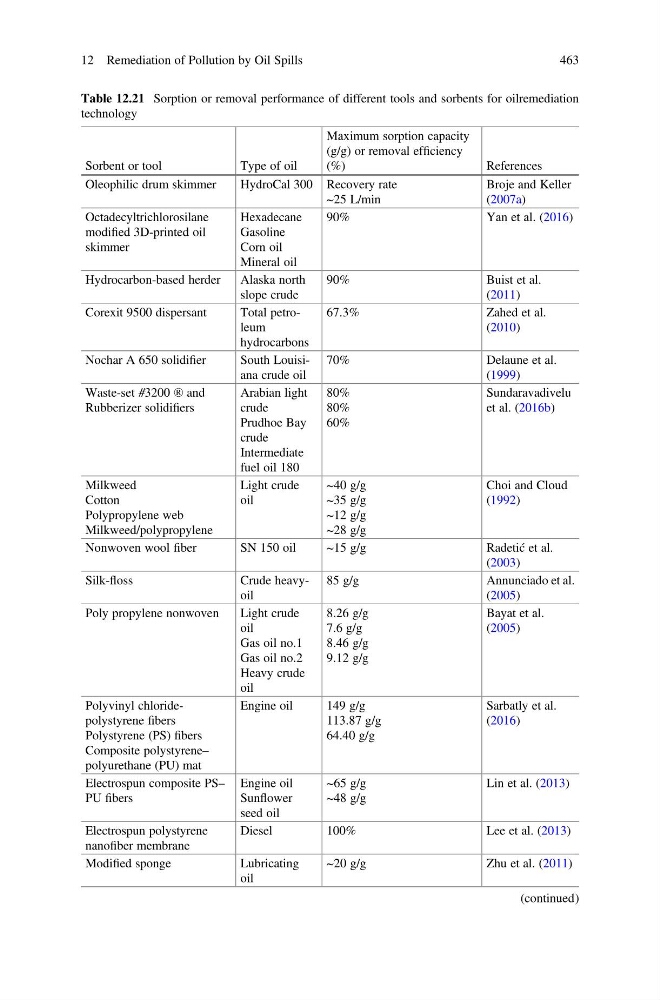
Table 12.21 Sorption or removal performance of different tools and sorbents for oilremediation
technology
Sorbent or tool
Type of oil
Maximum sorption capacity
(g/g) or removal efficiency
(%)
References
Oleophilic drum skimmer
HydroCal 300 Recovery rate
~25 L/min
Broje and Keller
(2007a)
Octadecyltrichlorosilane
modified 3D-printed oil
skimmer
Hexadecane
Gasoline
Corn oil
Mineral oil
90%
Yan et al. (2016)
Hydrocarbon-based herder
Alaska north
slope crude
90%
Buist et al.
(2011)
Corexit 9500 dispersant
Total petroleum
hydrocarbons
67.3%
Zahed et al.
(2010)
Nochar A 650 solidifier
South Louisiana crude oil
70%
Delaune et al.
(1999)
Waste-set #3200 ® and
Rubberizer solidifiers
Arabian light
crude
Prudhoe Bay
crude
Intermediate
fuel oil 180
80%
80%
60%
Sundaravadivelu
et al. (2016b)
Milkweed
Cotton
Polypropylene web
Milkweed/polypropylene
Light crude
oil
~40 g/g
~35 g/g
~12 g/g
~28 g/g
Choi and Cloud
(1992)
Nonwoven wool fiber
SN 150 oil
~15 g/g
Radetić et al.
(2003)
Silk-floss
Crude heavyoil
85 g/g
Annunciado et al.
(2005)
Poly propylene nonwoven
Light crude
oil
Gas oil no.1
Gas oil no.2
Heavy crude
oil
8.26 g/g
7.6 g/g
8.46 g/g
9.12 g/g
Bayat et al.
(2005)
Polyvinyl chloridepolystyrene fibers
Polystyrene (PS) fibers
Composite polystyrene–
polyurethane (PU) mat
Engine oil
149 g/g
113.87 g/g
64.40 g/g
Sarbatly et al.
(2016)
Electrospun composite PS–
PU fibers
Engine oil
Sunflower
seed oil
~65 g/g
~48 g/g
Lin et al. (2013)
Electrospun polystyrene
nanofiber membrane
Diesel
100%
Lee et al. (2013)
Modified sponge
Lubricating
oil
~20 g/g
Zhu et al. (2011)
(continued)
12 Remediation of Pollution by Oil Spills
463
technology
Sorbent or tool
Type of oil
Maximum sorption capacity
(g/g) or removal efficiency
(%)
References
Oleophilic drum skimmer
HydroCal 300 Recovery rate
~25 L/min
Broje and Keller
(2007a)
Octadecyltrichlorosilane
modified 3D-printed oil
skimmer
Hexadecane
Gasoline
Corn oil
Mineral oil
90%
Yan et al. (2016)
Hydrocarbon-based herder
Alaska north
slope crude
90%
Buist et al.
(2011)
Corexit 9500 dispersant
Total petroleum
hydrocarbons
67.3%
Zahed et al.
(2010)
Nochar A 650 solidifier
South Louisiana crude oil
70%
Delaune et al.
(1999)
Waste-set #3200 ® and
Rubberizer solidifiers
Arabian light
crude
Prudhoe Bay
crude
Intermediate
fuel oil 180
80%
80%
60%
Sundaravadivelu
et al. (2016b)
Milkweed
Cotton
Polypropylene web
Milkweed/polypropylene
Light crude
oil
~40 g/g
~35 g/g
~12 g/g
~28 g/g
Choi and Cloud
(1992)
Nonwoven wool fiber
SN 150 oil
~15 g/g
Radetić et al.
(2003)
Silk-floss
Crude heavyoil
85 g/g
Annunciado et al.
(2005)
Poly propylene nonwoven
Light crude
oil
Gas oil no.1
Gas oil no.2
Heavy crude
oil
8.26 g/g
7.6 g/g
8.46 g/g
9.12 g/g
Bayat et al.
(2005)
Polyvinyl chloridepolystyrene fibers
Polystyrene (PS) fibers
Composite polystyrene–
polyurethane (PU) mat
Engine oil
149 g/g
113.87 g/g
64.40 g/g
Sarbatly et al.
(2016)
Electrospun composite PS–
PU fibers
Engine oil
Sunflower
seed oil
~65 g/g
~48 g/g
Lin et al. (2013)
Electrospun polystyrene
nanofiber membrane
Diesel
100%
Lee et al. (2013)
Modified sponge
Lubricating
oil
~20 g/g
Zhu et al. (2011)
(continued)
12 Remediation of Pollution by Oil Spills
463