

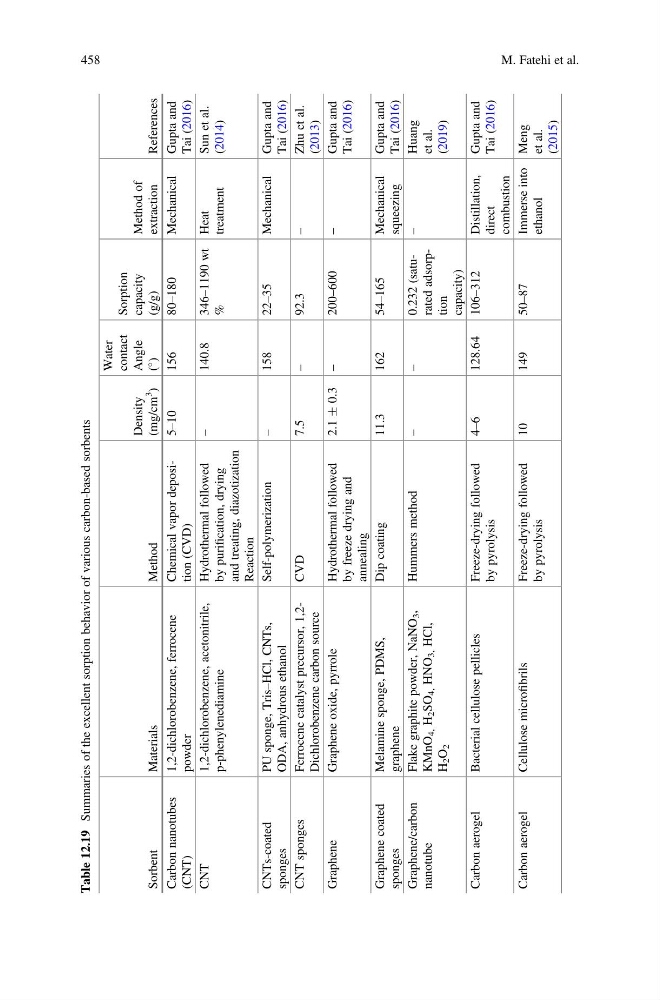
Table 12.19
Summaries of the excellent sorption behavior of various carbon-based sorbents
Sorbent
Materials
Method
Density
(mg/cm
3
)
Water
contact
Angle
(
)
Sorption
capacity
(g/g)
Method of
extraction
References
Carbon nanotubes
(CNT)
1,2-dichlorobenzene, ferrocene
powder
Chemical vapor deposition (CVD)
5–10
156
80–180
Mechanical
Gupta and
Tai (2016)
CNT
1,2-dichlorobenzene, acetonitrile,
p-phenylenediamine
Hydrothermal followed
by purification, drying
and treating, diazotization
Reaction
–
140.8
346–1190 wt
%
Heat
treatment
Sun et al.
(2014)
CNTs-coated
sponges
PU sponge, Tris–HCl, CNTs,
ODA, anhydrous ethanol
Self-polymerization
–
158
22–35
Mechanical
Gupta and
Tai (2016)
CNT sponges
Ferrocene catalyst precursor, 1,2Dichlorobenzene carbon source
CVD
7.5
–
92.3
–
Zhu et al.
(2013)
Graphene
Graphene oxide, pyrrole
Hydrothermal followed
by freeze drying and
annealing
2.1
Æ 0.3
–
200–600
–
Gupta and
Tai (2016)
Graphene coated
sponges
Melamine sponge, PDMS,
graphene
Dip coating
11.3
162
54–165
Mechanical
squeezing
Gupta and
Tai (2016)
Graphene/carbon
nanotube
Flake graphite powder, NaNO
3 ,
KMnO
4, H
2 SO
4, HNO
3, HCl,
H
2 O
2
Hummers method
–
–
0.232 (saturated adsorption
capacity)
–
Huang
et al.
(2019)
Carbon aerogel
Bacterial cellulose pellicles
Freeze-drying followed
by pyrolysis
4–6
128.64
106–312
Distillation,
direct
combustion
Gupta and
Tai (2016)
Carbon aerogel
Cellulose microfibrils
Freeze-drying followed
by pyrolysis
10
149
50–87
Immerse into
ethanol
Meng
et al.
(2015)
458
M. Fatehi et al.
Summaries of the excellent sorption behavior of various carbon-based sorbents
Sorbent
Materials
Method
Density
(mg/cm
3
)
Water
contact
Angle
(
)
Sorption
capacity
(g/g)
Method of
extraction
References
Carbon nanotubes
(CNT)
1,2-dichlorobenzene, ferrocene
powder
Chemical vapor deposition (CVD)
5–10
156
80–180
Mechanical
Gupta and
Tai (2016)
CNT
1,2-dichlorobenzene, acetonitrile,
p-phenylenediamine
Hydrothermal followed
by purification, drying
and treating, diazotization
Reaction
–
140.8
346–1190 wt
%
Heat
treatment
Sun et al.
(2014)
CNTs-coated
sponges
PU sponge, Tris–HCl, CNTs,
ODA, anhydrous ethanol
Self-polymerization
–
158
22–35
Mechanical
Gupta and
Tai (2016)
CNT sponges
Ferrocene catalyst precursor, 1,2Dichlorobenzene carbon source
CVD
7.5
–
92.3
–
Zhu et al.
(2013)
Graphene
Graphene oxide, pyrrole
Hydrothermal followed
by freeze drying and
annealing
2.1
Æ 0.3
–
200–600
–
Gupta and
Tai (2016)
Graphene coated
sponges
Melamine sponge, PDMS,
graphene
Dip coating
11.3
162
54–165
Mechanical
squeezing
Gupta and
Tai (2016)
Graphene/carbon
nanotube
Flake graphite powder, NaNO
3 ,
KMnO
4, H
2 SO
4, HNO
3, HCl,
H
2 O
2
Hummers method
–
–
0.232 (saturated adsorption
capacity)
–
Huang
et al.
(2019)
Carbon aerogel
Bacterial cellulose pellicles
Freeze-drying followed
by pyrolysis
4–6
128.64
106–312
Distillation,
direct
combustion
Gupta and
Tai (2016)
Carbon aerogel
Cellulose microfibrils
Freeze-drying followed
by pyrolysis
10
149
50–87
Immerse into
ethanol
Meng
et al.
(2015)
458
M. Fatehi et al.