

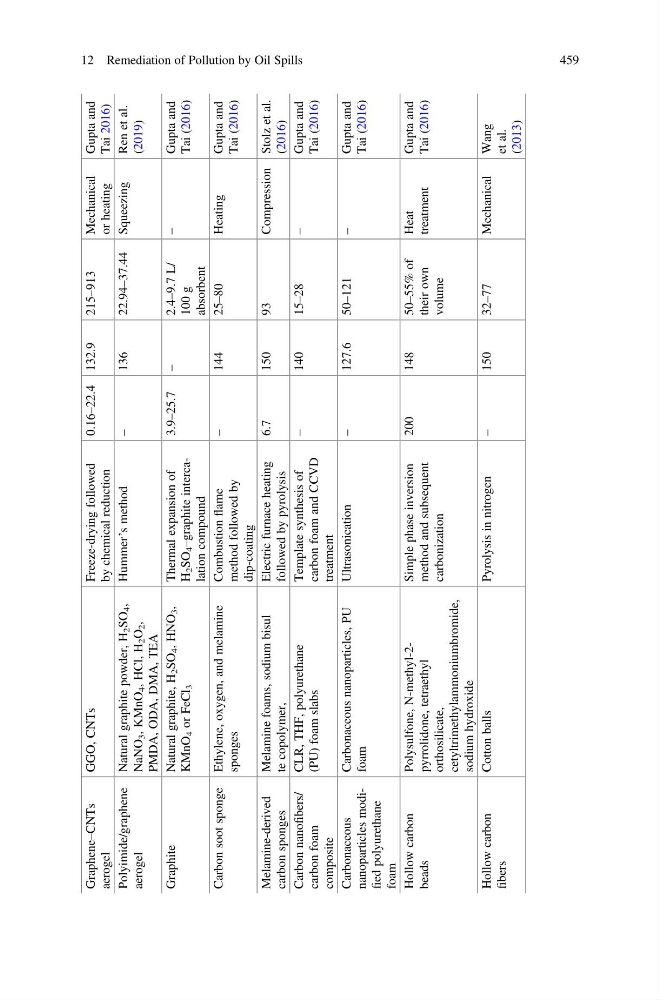
Graphene–CNTs
aerogel
GGO, CNTs
Freeze-drying followed
by chemical reduction
0.16–22.4 132.9
215–913
Mechanical
or heating
Gupta and
Tai 2016)
Polyimide/graphene
aerogel
Natural graphite powder, H
2 SO
4 ,
NaNO
3 , KMnO
4 , HCl, H
2 O
2 ,
PMDA, ODA, DMA, TEA
Hummer’s method
–
136
22.94–37.44 Squeezing
Ren et al.
(2019)
Graphite
Natural graphite, H
2 SO
4 , HNO
3 ,
KMnO
4 or FeCl
3
Thermal expansion of
H
2 SO
4
–graphite intercalation compound
3.9–25.7
–
2.4–9.7 L/
100 g
absorbent
–
Gupta and
Tai (2016)
Carbon soot sponge Ethylene, oxygen, and melamine
sponges
Combustion
flame
method followed by
dip-coating
–
144
25–80
Heating
Gupta and
Tai (2016)
Melamine-derived
carbon sponges
Melamine foams, sodium bisul
te copolymer,
Electric furnace heating
followed by pyrolysis
6.7
150
93
Compression Stolz et al.
(2016)
Carbon nanofibers/
carbon foam
composite
CLR, THF, polyurethane
(PU) foam slabs
Template synthesis of
carbon foam and CCVD
treatment
–
140
15–28
–
Gupta and
Tai (2016)
Carbonaceous
nanoparticles modified polyurethane
foam
Carbonaceous nanoparticles, PU
foam
Ultrasonication
–
127.6
50–121
–
Gupta and
Tai (2016)
Hollow carbon
beads
Polysulfone, N-methyl-2pyrrolidone, tetraethyl
orthosilicate,
cetyltrimethylammoniumbromide,
sodium hydroxide
Simple phase inversion
method and subsequent
carbonization
200
148
50–55% of
their own
volume
Heat
treatment
Gupta and
Tai (2016)
Hollow carbon
fibers
Cotton balls
Pyrolysis in nitrogen
–
150
32–77
Mechanical
Wang
et al.
(2013)
12 Remediation of Pollution by Oil Spills
459
aerogel
GGO, CNTs
Freeze-drying followed
by chemical reduction
0.16–22.4 132.9
215–913
Mechanical
or heating
Gupta and
Tai 2016)
Polyimide/graphene
aerogel
Natural graphite powder, H
2 SO
4 ,
NaNO
3 , KMnO
4 , HCl, H
2 O
2 ,
PMDA, ODA, DMA, TEA
Hummer’s method
–
136
22.94–37.44 Squeezing
Ren et al.
(2019)
Graphite
Natural graphite, H
2 SO
4 , HNO
3 ,
KMnO
4 or FeCl
3
Thermal expansion of
H
2 SO
4
–graphite intercalation compound
3.9–25.7
–
2.4–9.7 L/
100 g
absorbent
–
Gupta and
Tai (2016)
Carbon soot sponge Ethylene, oxygen, and melamine
sponges
Combustion
flame
method followed by
dip-coating
–
144
25–80
Heating
Gupta and
Tai (2016)
Melamine-derived
carbon sponges
Melamine foams, sodium bisul
te copolymer,
Electric furnace heating
followed by pyrolysis
6.7
150
93
Compression Stolz et al.
(2016)
Carbon nanofibers/
carbon foam
composite
CLR, THF, polyurethane
(PU) foam slabs
Template synthesis of
carbon foam and CCVD
treatment
–
140
15–28
–
Gupta and
Tai (2016)
Carbonaceous
nanoparticles modified polyurethane
foam
Carbonaceous nanoparticles, PU
foam
Ultrasonication
–
127.6
50–121
–
Gupta and
Tai (2016)
Hollow carbon
beads
Polysulfone, N-methyl-2pyrrolidone, tetraethyl
orthosilicate,
cetyltrimethylammoniumbromide,
sodium hydroxide
Simple phase inversion
method and subsequent
carbonization
200
148
50–55% of
their own
volume
Heat
treatment
Gupta and
Tai (2016)
Hollow carbon
fibers
Cotton balls
Pyrolysis in nitrogen
–
150
32–77
Mechanical
Wang
et al.
(2013)
12 Remediation of Pollution by Oil Spills
459