

sorption rate of oil A was similar to oil C but the maximum sorption capacity of oil C
was similar to oil B. These results showed the exfoliated graphite can be used as
effective oil sorbent.
In another study, Toyoda and Inagaki (2000) investigated the effect of bulk
density of oil on the sorption behavior of exfoliated graphite. The highest uptakes
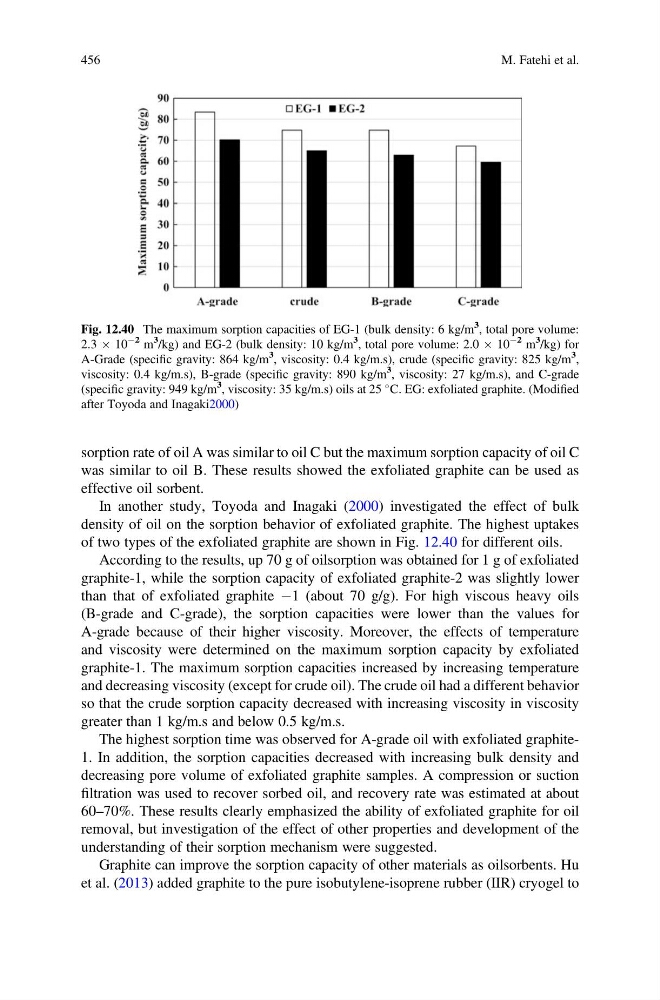
of two types of the exfoliated graphite are shown in Fig. 12.40 for different oils.
According to the results, up 70 g of oilsorption was obtained for 1 g of exfoliated
graphite-1, while the sorption capacity of exfoliated graphite-2 was slightly lower
than that of exfoliated graphite À1 (about 70 g/g). For high viscous heavy oils
(B-grade and C-grade), the sorption capacities were lower than the values for
A-grade because of their higher viscosity. Moreover, the effects of temperature
and viscosity were determined on the maximum sorption capacity by exfoliated
graphite-1. The maximum sorption capacities increased by increasing temperature
and decreasing viscosity (except for crude oil). The crude oil had a different behavior
so that the crude sorption capacity decreased with increasing viscosity in viscosity
greater than 1 kg/m.s and below 0.5 kg/m.s.
The highest sorption time was observed for A-grade oil with exfoliated graphite1. In addition, the sorption capacities decreased with increasing bulk density and
decreasing pore volume of exfoliated graphite samples. A compression or suction
filtration was used to recover sorbed oil, and recovery rate was estimated at about
60–70%. These results clearly emphasized the ability of exfoliated graphite for oil
removal, but investigation of the effect of other properties and development of the
understanding of their sorption mechanism were suggested.
Graphite can improve the sorption capacity of other materials as oilsorbents. Hu
et al. (2013) added graphite to the pure isobutylene-isoprene rubber (IIR) cryogel to
Fig. 12.40 The maximum sorption capacities of EG-1 (bulk density: 6 kg/m
3
, total pore volume:
2.3 Â 10
À2 m
3
/kg) and EG-2 (bulk density: 10 kg/m
3
, total pore volume: 2.0 Â 10
À2 m
3
/kg) for
A-Grade (specific gravity: 864 kg/m
3
, viscosity: 0.4 kg/m.s), crude (specific gravity: 825 kg/m
3
,
viscosity: 0.4 kg/m.s), B-grade (specific gravity: 890 kg/m
3
, viscosity: 27 kg/m.s), and C-grade
(specific gravity: 949 kg/m
3
, viscosity: 35 kg/m.s) oils at 25
C. EG: exfoliated graphite. (Modified
after Toyoda and Inagaki2000)
456
M. Fatehi et al.
was similar to oil B. These results showed the exfoliated graphite can be used as
effective oil sorbent.
In another study, Toyoda and Inagaki (2000) investigated the effect of bulk
density of oil on the sorption behavior of exfoliated graphite. The highest uptakes
of two types of the exfoliated graphite are shown in Fig. 12.40 for different oils.
According to the results, up 70 g of oilsorption was obtained for 1 g of exfoliated
graphite-1, while the sorption capacity of exfoliated graphite-2 was slightly lower
than that of exfoliated graphite À1 (about 70 g/g). For high viscous heavy oils
(B-grade and C-grade), the sorption capacities were lower than the values for
A-grade because of their higher viscosity. Moreover, the effects of temperature
and viscosity were determined on the maximum sorption capacity by exfoliated
graphite-1. The maximum sorption capacities increased by increasing temperature
and decreasing viscosity (except for crude oil). The crude oil had a different behavior
so that the crude sorption capacity decreased with increasing viscosity in viscosity
greater than 1 kg/m.s and below 0.5 kg/m.s.
The highest sorption time was observed for A-grade oil with exfoliated graphite1. In addition, the sorption capacities decreased with increasing bulk density and
decreasing pore volume of exfoliated graphite samples. A compression or suction
filtration was used to recover sorbed oil, and recovery rate was estimated at about
60–70%. These results clearly emphasized the ability of exfoliated graphite for oil
removal, but investigation of the effect of other properties and development of the
understanding of their sorption mechanism were suggested.
Graphite can improve the sorption capacity of other materials as oilsorbents. Hu
et al. (2013) added graphite to the pure isobutylene-isoprene rubber (IIR) cryogel to
Fig. 12.40 The maximum sorption capacities of EG-1 (bulk density: 6 kg/m
3
, total pore volume:
2.3 Â 10
À2 m
3
/kg) and EG-2 (bulk density: 10 kg/m
3
, total pore volume: 2.0 Â 10
À2 m
3
/kg) for
A-Grade (specific gravity: 864 kg/m
3
, viscosity: 0.4 kg/m.s), crude (specific gravity: 825 kg/m
3
,
viscosity: 0.4 kg/m.s), B-grade (specific gravity: 890 kg/m
3
, viscosity: 27 kg/m.s), and C-grade
(specific gravity: 949 kg/m
3
, viscosity: 35 kg/m.s) oils at 25
C. EG: exfoliated graphite. (Modified
after Toyoda and Inagaki2000)
456
M. Fatehi et al.