

According to the results, thermally reduced graphene hydrophobicity increased
by increasing the C/O ratio, while thermally reduced graphene sorption capacity
decreased by increasing bulk density. Furthermore, thermally reduced graphene
sorption capacity was higher for lower viscosity oil. Thermally reduced graphene
capacity also depends on the total pore volume. An increase in the total pore volume
increases the sorption capacity. The large pores (>50 nm) had a significant effect on
the increase in sorption capacity.
The results of recovery process with vacuum filtration showed that the filtration
time enhanced with increasing the number of recovery cycle and oil viscosity. In
addition, the sorption capacity decreased with recycling of the thermally reduced
graphene because of retaining or uncovering the amount of oil during recycling and
decreasing of pore volume during filtration and compression processes. A significant
reduction of sorption capacity was observed after the second cycle. During six
cycles, the sorption capacities of API crude oil are greater than those of API oil
because of its greater viscosity. Furthermore, some types of graphene with high
sorption capacity are reported, like spongy graphene with sorption capacity of 20–86
times its own weight and reduced graphene by natural phenolic acids with sorption
capacity of 15–61 times its own weight (Gupta and Tai 2016).
Graphite is fabricated with the accumulation of graphene sheet (ten or more) by
van de Waals forces. The exfoliated graphite fabricates with the graphite by chemical, mechanical, and thermal methods. The exfoliated graphite is a porous material
with higher volume, lower density, and higher specific surface area than graphite
(Chung 2016). Therefore, the exfoliated graphite can be selected as an oil sorbent.
Toyoda et al. (1998) found that exfoliated graphite was able to uptake the heavy
oil and it was collected from the water surface easily. The maximum sorption
capacity of exfoliated graphite for heavy oil was reported to be more than 80 times
its own weight. They also succeeded to recover about 80% of the sorbed oil. Three
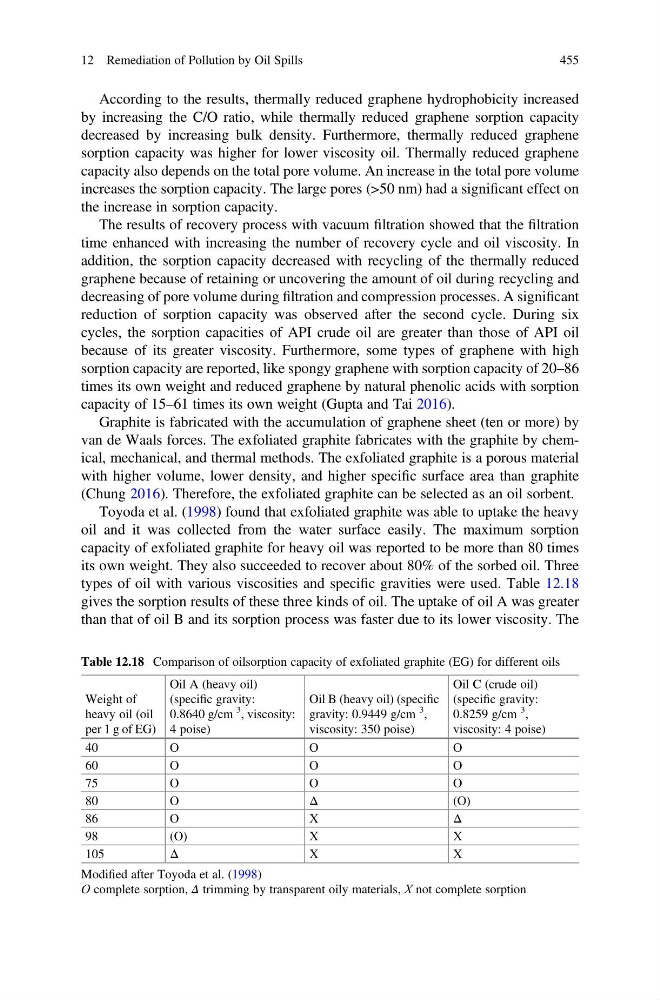
types of oil with various viscosities and specific gravities were used. Table 12.18
gives the sorption results of these three kinds of oil. The uptake of oil A was greater
than that of oil B and its sorption process was faster due to its lower viscosity. The
Table 12.18 Comparison of oilsorption capacity of exfoliated graphite (EG) for different oils
Weight of
heavy oil (oil
per 1 g of EG)
Oil A (heavy oil)
(specific gravity:
0.8640 g/cm
3
, viscosity:
4 poise)
Oil B (heavy oil) (specific
gravity: 0.9449 g/cm
3
,
viscosity: 350 poise)
Oil C (crude oil)
(specific gravity:
0.8259 g/cm
3
,
viscosity: 4 poise)
40
Ο
Ο
Ο
60
Ο
Ο
Ο
75
Ο
Ο
Ο
80
Ο
Δ
(Ο)
86
Ο
Χ
Δ
98
(Ο)
Χ
Χ
105
Δ
Χ
Χ
Modified after Toyoda et al. (1998)
Ο complete sorption, Δ trimming by transparent oily materials, Χ not complete sorption
12 Remediation of Pollution by Oil Spills
455
by increasing the C/O ratio, while thermally reduced graphene sorption capacity
decreased by increasing bulk density. Furthermore, thermally reduced graphene
sorption capacity was higher for lower viscosity oil. Thermally reduced graphene
capacity also depends on the total pore volume. An increase in the total pore volume
increases the sorption capacity. The large pores (>50 nm) had a significant effect on
the increase in sorption capacity.
The results of recovery process with vacuum filtration showed that the filtration
time enhanced with increasing the number of recovery cycle and oil viscosity. In
addition, the sorption capacity decreased with recycling of the thermally reduced
graphene because of retaining or uncovering the amount of oil during recycling and
decreasing of pore volume during filtration and compression processes. A significant
reduction of sorption capacity was observed after the second cycle. During six
cycles, the sorption capacities of API crude oil are greater than those of API oil
because of its greater viscosity. Furthermore, some types of graphene with high
sorption capacity are reported, like spongy graphene with sorption capacity of 20–86
times its own weight and reduced graphene by natural phenolic acids with sorption
capacity of 15–61 times its own weight (Gupta and Tai 2016).
Graphite is fabricated with the accumulation of graphene sheet (ten or more) by
van de Waals forces. The exfoliated graphite fabricates with the graphite by chemical, mechanical, and thermal methods. The exfoliated graphite is a porous material
with higher volume, lower density, and higher specific surface area than graphite
(Chung 2016). Therefore, the exfoliated graphite can be selected as an oil sorbent.
Toyoda et al. (1998) found that exfoliated graphite was able to uptake the heavy
oil and it was collected from the water surface easily. The maximum sorption
capacity of exfoliated graphite for heavy oil was reported to be more than 80 times
its own weight. They also succeeded to recover about 80% of the sorbed oil. Three
types of oil with various viscosities and specific gravities were used. Table 12.18
gives the sorption results of these three kinds of oil. The uptake of oil A was greater
than that of oil B and its sorption process was faster due to its lower viscosity. The
Table 12.18 Comparison of oilsorption capacity of exfoliated graphite (EG) for different oils
Weight of
heavy oil (oil
per 1 g of EG)
Oil A (heavy oil)
(specific gravity:
0.8640 g/cm
3
, viscosity:
4 poise)
Oil B (heavy oil) (specific
gravity: 0.9449 g/cm
3
,
viscosity: 350 poise)
Oil C (crude oil)
(specific gravity:
0.8259 g/cm
3
,
viscosity: 4 poise)
40
Ο
Ο
Ο
60
Ο
Ο
Ο
75
Ο
Ο
Ο
80
Ο
Δ
(Ο)
86
Ο
Χ
Δ
98
(Ο)
Χ
Χ
105
Δ
Χ
Χ
Modified after Toyoda et al. (1998)
Ο complete sorption, Δ trimming by transparent oily materials, Χ not complete sorption
12 Remediation of Pollution by Oil Spills
455