

structure of activated carbon. But the rates of adsorption are faster than that of
degradation, thus it is difficult to collect certain evidence about degradation process.
Graphene and graphite are the other carbon-based oilsorbents, which are classified as high sorption capacity sorbents. Graphene has a two-dimensional structure,
which can be fabricated by mechanical and chemical methods (Gupta and Tai 2016).
Different types of graphene adsorbents are reported, which have high adsorption
capacity.
Iqbal and Abdala (2013) investigated the ability of thermally reduced graphene
for oil removal process. They fabricated thermally reduced graphene by thermal
exfoliation of graphite oxide and used API crude oil and API oil as oil contaminant.
The sorption capacity, the oil recovery, and recyclability of these sorbents were
studied. The highest capacity (131 and 108 g/g for API crude and API oils) was
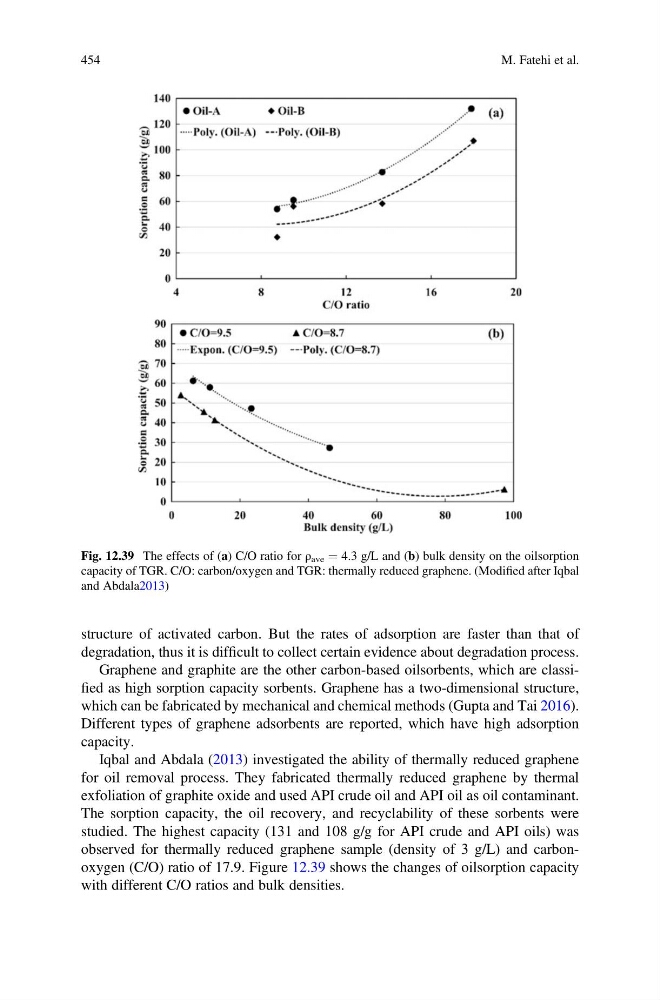
observed for thermally reduced graphene sample (density of 3 g/L) and carbonoxygen (C/O) ratio of 17.9. Figure 12.39 shows the changes of oilsorption capacity
with different C/O ratios and bulk densities.
Fig. 12.39 The effects of (a) C/O ratio for ρ ave ¼ 4.3 g/L and (b) bulk density on the oilsorption
capacity of TGR. C/O: carbon/oxygen and TGR: thermally reduced graphene. (Modified after Iqbal
and Abdala2013)
454
M. Fatehi et al.
degradation, thus it is difficult to collect certain evidence about degradation process.
Graphene and graphite are the other carbon-based oilsorbents, which are classified as high sorption capacity sorbents. Graphene has a two-dimensional structure,
which can be fabricated by mechanical and chemical methods (Gupta and Tai 2016).
Different types of graphene adsorbents are reported, which have high adsorption
capacity.
Iqbal and Abdala (2013) investigated the ability of thermally reduced graphene
for oil removal process. They fabricated thermally reduced graphene by thermal
exfoliation of graphite oxide and used API crude oil and API oil as oil contaminant.
The sorption capacity, the oil recovery, and recyclability of these sorbents were
studied. The highest capacity (131 and 108 g/g for API crude and API oils) was
observed for thermally reduced graphene sample (density of 3 g/L) and carbonoxygen (C/O) ratio of 17.9. Figure 12.39 shows the changes of oilsorption capacity
with different C/O ratios and bulk densities.
Fig. 12.39 The effects of (a) C/O ratio for ρ ave ¼ 4.3 g/L and (b) bulk density on the oilsorption
capacity of TGR. C/O: carbon/oxygen and TGR: thermally reduced graphene. (Modified after Iqbal
and Abdala2013)
454
M. Fatehi et al.