

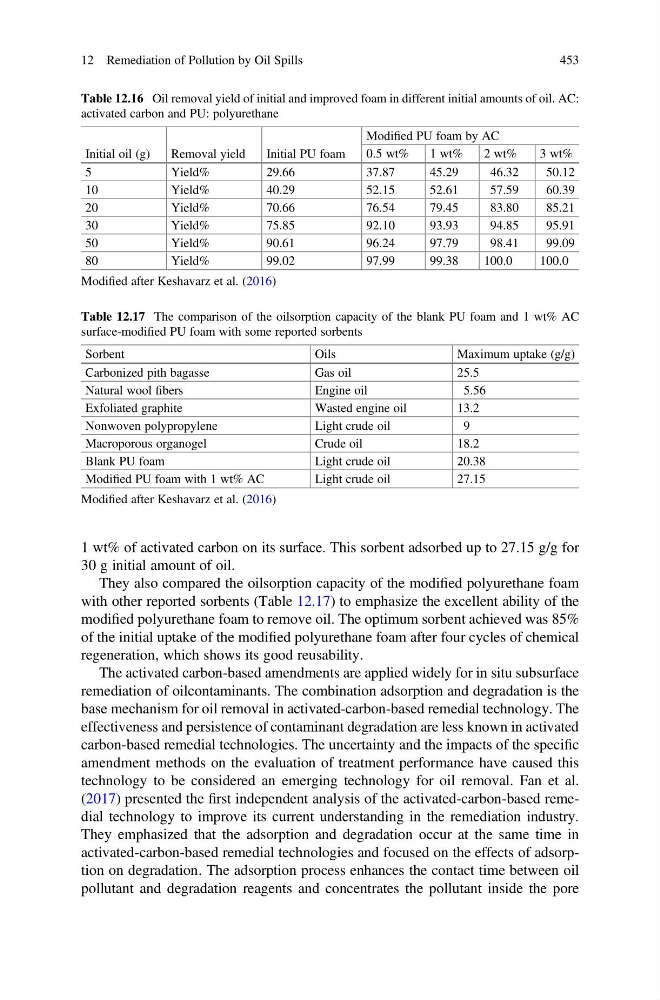
1 wt% of activated carbon on its surface. This sorbent adsorbed up to 27.15 g/g for
30 g initial amount of oil.
They also compared the oilsorption capacity of the modified polyurethane foam
with other reported sorbents (Table 12.17) to emphasize the excellent ability of the
modified polyurethane foam to remove oil. The optimum sorbent achieved was 85%
of the initial uptake of the modified polyurethane foam after four cycles of chemical
regeneration, which shows its good reusability.
The activated carbon-based amendments are applied widely for in situ subsurface
remediation of oilcontaminants. The combination adsorption and degradation is the
base mechanism for oil removal in activated-carbon-based remedial technology. The
effectiveness and persistence of contaminant degradation are less known in activated
carbon-based remedial technologies. The uncertainty and the impacts of the specific
amendment methods on the evaluation of treatment performance have caused this
technology to be considered an emerging technology for oil removal. Fan et al.
(2017) presented the first independent analysis of the activated-carbon-based remedial technology to improve its current understanding in the remediation industry.
They emphasized that the adsorption and degradation occur at the same time in
activated-carbon-based remedial technologies and focused on the effects of adsorption on degradation. The adsorption process enhances the contact time between oil
pollutant and degradation reagents and concentrates the pollutant inside the pore
Table 12.16 Oil removal yield of initial and improved foam in different initial amounts of oil. AC:
activated carbon and PU: polyurethane
Initial oil (g)
Removal yield
Initial PU foam
Modified PU foam by AC
0.5 wt%
1 wt%
2 wt%
3 wt%
5
Yield%
29.66
37.87
45.29
46.32
50.12
10
Yield%
40.29
52.15
52.61
57.59
60.39
20
Yield%
70.66
76.54
79.45
83.80
85.21
30
Yield%
75.85
92.10
93.93
94.85
95.91
50
Yield%
90.61
96.24
97.79
98.41
99.09
80
Yield%
99.02
97.99
99.38
100.0
100.0
Modified after Keshavarz et al. (2016)
Table 12.17 The comparison of the oilsorption capacity of the blank PU foam and 1 wt% AC
surface-modified PU foam with some reported sorbents
Sorbent
Oils
Maximum uptake (g/g)
Carbonized pith bagasse
Gas oil
25.5
Natural wool fibers
Engine oil
5.56
Exfoliated graphite
Wasted engine oil
13.2
Nonwoven polypropylene
Light crude oil
9
Macroporous organogel
Crude oil
18.2
Blank PU foam
Light crude oil
20.38
Modified PU foam with 1 wt% AC
Light crude oil
27.15
Modified after Keshavarz et al. (2016)
12 Remediation of Pollution by Oil Spills
453
30 g initial amount of oil.
They also compared the oilsorption capacity of the modified polyurethane foam
with other reported sorbents (Table 12.17) to emphasize the excellent ability of the
modified polyurethane foam to remove oil. The optimum sorbent achieved was 85%
of the initial uptake of the modified polyurethane foam after four cycles of chemical
regeneration, which shows its good reusability.
The activated carbon-based amendments are applied widely for in situ subsurface
remediation of oilcontaminants. The combination adsorption and degradation is the
base mechanism for oil removal in activated-carbon-based remedial technology. The
effectiveness and persistence of contaminant degradation are less known in activated
carbon-based remedial technologies. The uncertainty and the impacts of the specific
amendment methods on the evaluation of treatment performance have caused this
technology to be considered an emerging technology for oil removal. Fan et al.
(2017) presented the first independent analysis of the activated-carbon-based remedial technology to improve its current understanding in the remediation industry.
They emphasized that the adsorption and degradation occur at the same time in
activated-carbon-based remedial technologies and focused on the effects of adsorption on degradation. The adsorption process enhances the contact time between oil
pollutant and degradation reagents and concentrates the pollutant inside the pore
Table 12.16 Oil removal yield of initial and improved foam in different initial amounts of oil. AC:
activated carbon and PU: polyurethane
Initial oil (g)
Removal yield
Initial PU foam
Modified PU foam by AC
0.5 wt%
1 wt%
2 wt%
3 wt%
5
Yield%
29.66
37.87
45.29
46.32
50.12
10
Yield%
40.29
52.15
52.61
57.59
60.39
20
Yield%
70.66
76.54
79.45
83.80
85.21
30
Yield%
75.85
92.10
93.93
94.85
95.91
50
Yield%
90.61
96.24
97.79
98.41
99.09
80
Yield%
99.02
97.99
99.38
100.0
100.0
Modified after Keshavarz et al. (2016)
Table 12.17 The comparison of the oilsorption capacity of the blank PU foam and 1 wt% AC
surface-modified PU foam with some reported sorbents
Sorbent
Oils
Maximum uptake (g/g)
Carbonized pith bagasse
Gas oil
25.5
Natural wool fibers
Engine oil
5.56
Exfoliated graphite
Wasted engine oil
13.2
Nonwoven polypropylene
Light crude oil
9
Macroporous organogel
Crude oil
18.2
Blank PU foam
Light crude oil
20.38
Modified PU foam with 1 wt% AC
Light crude oil
27.15
Modified after Keshavarz et al. (2016)
12 Remediation of Pollution by Oil Spills
453