

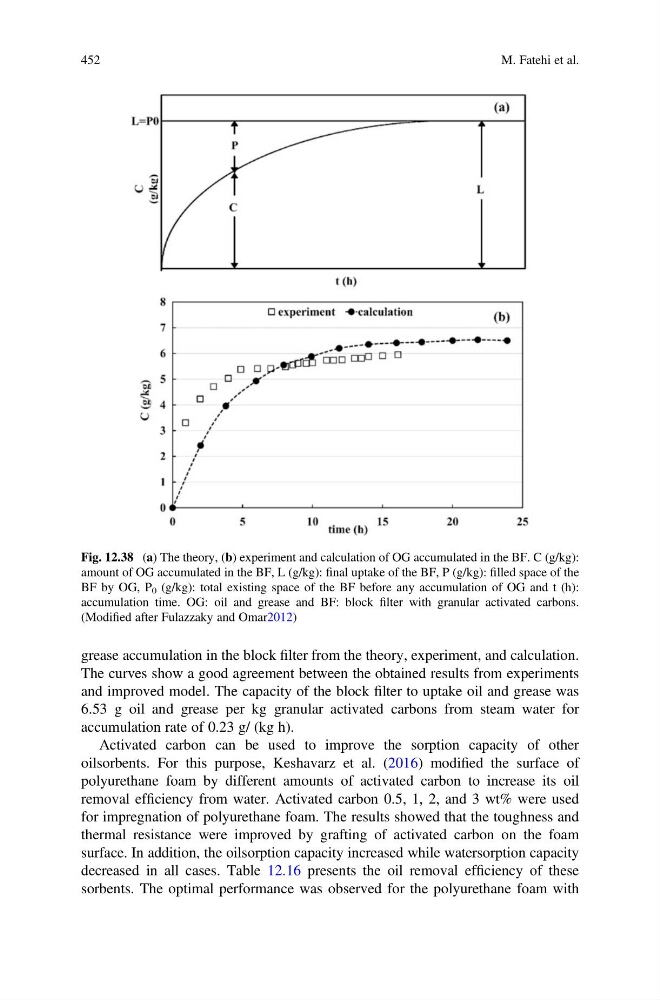
grease accumulation in the block filter from the theory, experiment, and calculation.
The curves show a good agreement between the obtained results from experiments
and improved model. The capacity of the block filter to uptake oil and grease was
6.53 g oil and grease per kg granular activated carbons from steam water for
accumulation rate of 0.23 g/ (kg h).
Activated carbon can be used to improve the sorption capacity of other
oilsorbents. For this purpose, Keshavarz et al. (2016) modified the surface of
polyurethane foam by different amounts of activated carbon to increase its oil
removal efficiency from water. Activated carbon 0.5, 1, 2, and 3 wt% were used
for impregnation of polyurethane foam. The results showed that the toughness and
thermal resistance were improved by grafting of activated carbon on the foam
surface. In addition, the oilsorption capacity increased while watersorption capacity
decreased in all cases. Table 12.16 presents the oil removal efficiency of these
sorbents. The optimal performance was observed for the polyurethane foam with
Fig. 12.38 (a) The theory, (b) experiment and calculation of OG accumulated in the BF. C (g/kg):
amount of OG accumulated in the BF, L (g/kg): final uptake of the BF, P (g/kg): filled space of the
BF by OG, P 0 (g/kg): total existing space of the BF before any accumulation of OG and t (h):
accumulation time. OG: oil and grease and BF: block filter with granular activated carbons.
(Modified after Fulazzaky and Omar2012)
452
M. Fatehi et al.
The curves show a good agreement between the obtained results from experiments
and improved model. The capacity of the block filter to uptake oil and grease was
6.53 g oil and grease per kg granular activated carbons from steam water for
accumulation rate of 0.23 g/ (kg h).
Activated carbon can be used to improve the sorption capacity of other
oilsorbents. For this purpose, Keshavarz et al. (2016) modified the surface of
polyurethane foam by different amounts of activated carbon to increase its oil
removal efficiency from water. Activated carbon 0.5, 1, 2, and 3 wt% were used
for impregnation of polyurethane foam. The results showed that the toughness and
thermal resistance were improved by grafting of activated carbon on the foam
surface. In addition, the oilsorption capacity increased while watersorption capacity
decreased in all cases. Table 12.16 presents the oil removal efficiency of these
sorbents. The optimal performance was observed for the polyurethane foam with
Fig. 12.38 (a) The theory, (b) experiment and calculation of OG accumulated in the BF. C (g/kg):
amount of OG accumulated in the BF, L (g/kg): final uptake of the BF, P (g/kg): filled space of the
BF by OG, P 0 (g/kg): total existing space of the BF before any accumulation of OG and t (h):
accumulation time. OG: oil and grease and BF: block filter with granular activated carbons.
(Modified after Fulazzaky and Omar2012)
452
M. Fatehi et al.