

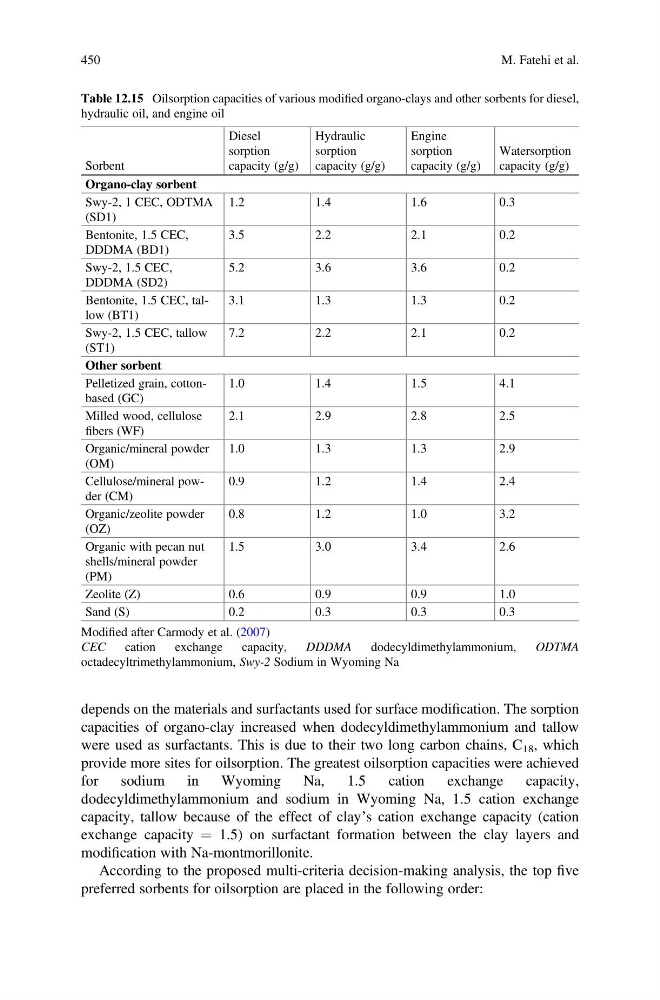
depends on the materials and surfactants used for surface modification. The sorption
capacities of organo-clay increased when dodecyldimethylammonium and tallow
were used as surfactants. This is due to their two long carbon chains, C 18 , which
provide more sites for oilsorption. The greatest oilsorption capacities were achieved
for
sodium
in
Wyoming
Na,
1.5
cation
exchange
capacity,
dodecyldimethylammonium and sodium in Wyoming Na, 1.5 cation exchange
capacity, tallow because of the effect of clay’s cation exchange capacity (cation
exchange capacity ¼ 1.5) on surfactant formation between the clay layers and
modification with Na-montmorillonite.
According to the proposed multi-criteria decision-making analysis, the top five
preferred sorbents for oilsorption are placed in the following order:
Table 12.15 Oilsorption capacities of various modified organo-clays and other sorbents for diesel,
hydraulic oil, and engine oil
Sorbent
Diesel
sorption
capacity (g/g)
Hydraulic
sorption
capacity (g/g)
Engine
sorption
capacity (g/g)
Watersorption
capacity (g/g)
Organo-clay sorbent
Swy-2, 1 CEC, ODTMA
(SD1)
1.2
1.4
1.6
0.3
Bentonite, 1.5 CEC,
DDDMA (BD1)
3.5
2.2
2.1
0.2
Swy-2, 1.5 CEC,
DDDMA (SD2)
5.2
3.6
3.6
0.2
Bentonite, 1.5 CEC, tallow (BT1)
3.1
1.3
1.3
0.2
Swy-2, 1.5 CEC, tallow
(ST1)
7.2
2.2
2.1
0.2
Other sorbent
Pelletized grain, cottonbased (GC)
1.0
1.4
1.5
4.1
Milled wood, cellulose
fibers (WF)
2.1
2.9
2.8
2.5
Organic/mineral powder
(OM)
1.0
1.3
1.3
2.9
Cellulose/mineral powder (CM)
0.9
1.2
1.4
2.4
Organic/zeolite powder
(OZ)
0.8
1.2
1.0
3.2
Organic with pecan nut
shells/mineral powder
(PM)
1.5
3.0
3.4
2.6
Zeolite (Z)
0.6
0.9
0.9
1.0
Sand (S)
0.2
0.3
0.3
0.3
Modified after Carmody et al. (2007)
CEC
cation
exchange
capacity,
DDDMA
dodecyldimethylammonium,
ODTMA
octadecyltrimethylammonium, Swy-2 Sodium in Wyoming Na
450
M. Fatehi et al.
capacities of organo-clay increased when dodecyldimethylammonium and tallow
were used as surfactants. This is due to their two long carbon chains, C 18 , which
provide more sites for oilsorption. The greatest oilsorption capacities were achieved
for
sodium
in
Wyoming
Na,
1.5
cation
exchange
capacity,
dodecyldimethylammonium and sodium in Wyoming Na, 1.5 cation exchange
capacity, tallow because of the effect of clay’s cation exchange capacity (cation
exchange capacity ¼ 1.5) on surfactant formation between the clay layers and
modification with Na-montmorillonite.
According to the proposed multi-criteria decision-making analysis, the top five
preferred sorbents for oilsorption are placed in the following order:
Table 12.15 Oilsorption capacities of various modified organo-clays and other sorbents for diesel,
hydraulic oil, and engine oil
Sorbent
Diesel
sorption
capacity (g/g)
Hydraulic
sorption
capacity (g/g)
Engine
sorption
capacity (g/g)
Watersorption
capacity (g/g)
Organo-clay sorbent
Swy-2, 1 CEC, ODTMA
(SD1)
1.2
1.4
1.6
0.3
Bentonite, 1.5 CEC,
DDDMA (BD1)
3.5
2.2
2.1
0.2
Swy-2, 1.5 CEC,
DDDMA (SD2)
5.2
3.6
3.6
0.2
Bentonite, 1.5 CEC, tallow (BT1)
3.1
1.3
1.3
0.2
Swy-2, 1.5 CEC, tallow
(ST1)
7.2
2.2
2.1
0.2
Other sorbent
Pelletized grain, cottonbased (GC)
1.0
1.4
1.5
4.1
Milled wood, cellulose
fibers (WF)
2.1
2.9
2.8
2.5
Organic/mineral powder
(OM)
1.0
1.3
1.3
2.9
Cellulose/mineral powder (CM)
0.9
1.2
1.4
2.4
Organic/zeolite powder
(OZ)
0.8
1.2
1.0
3.2
Organic with pecan nut
shells/mineral powder
(PM)
1.5
3.0
3.4
2.6
Zeolite (Z)
0.6
0.9
0.9
1.0
Sand (S)
0.2
0.3
0.3
0.3
Modified after Carmody et al. (2007)
CEC
cation
exchange
capacity,
DDDMA
dodecyldimethylammonium,
ODTMA
octadecyltrimethylammonium, Swy-2 Sodium in Wyoming Na
450
M. Fatehi et al.