

sample expanded in the presence of water (due to its free CaO content) and then
trapped oil in its structure; as a result, the sample showed better sorption behavior
than the Si-rich sample. Moreover, modified Ca-rich sample had no notable difference with nonmodified Ca-rich sample in oilsorption performance. Table 12.14
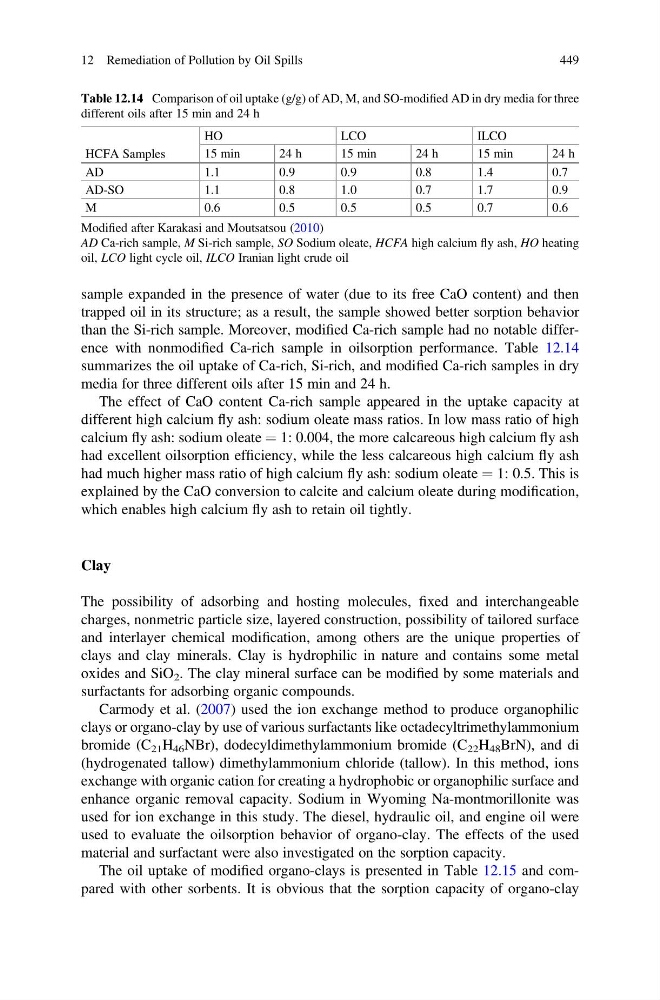
summarizes the oil uptake of Ca-rich, Si-rich, and modified Ca-rich samples in dry
media for three different oils after 15 min and 24 h.
The effect of CaO content Ca-rich sample appeared in the uptake capacity at
different high calcium fly ash: sodium oleate mass ratios. In low mass ratio of high
calcium fly ash: sodium oleate ¼ 1: 0.004, the more calcareous high calcium fly ash
had excellent oilsorption efficiency, while the less calcareous high calcium fly ash
had much higher mass ratio of high calcium fly ash: sodium oleate ¼ 1: 0.5. This is
explained by the CaO conversion to calcite and calcium oleate during modification,
which enables high calcium fly ash to retain oil tightly.
Clay
The possibility of adsorbing and hosting molecules, fixed and interchangeable
charges, nonmetric particle size, layered construction, possibility of tailored surface
and interlayer chemical modification, among others are the unique properties of
clays and clay minerals. Clay is hydrophilic in nature and contains some metal
oxides and SiO 2 . The clay mineral surface can be modified by some materials and
surfactants for adsorbing organic compounds.
Carmody et al. (2007) used the ion exchange method to produce organophilic
clays or organo-clay by use of various surfactants like octadecyltrimethylammonium
bromide (C 21 H 46 NBr), dodecyldimethylammonium bromide (C 22 H 48 BrN), and di
(hydrogenated tallow) dimethylammonium chloride (tallow). In this method, ions
exchange with organic cation for creating a hydrophobic or organophilic surface and
enhance organic removal capacity. Sodium in Wyoming Na-montmorillonite was
used for ion exchange in this study. The diesel, hydraulic oil, and engine oil were
used to evaluate the oilsorption behavior of organo-clay. The effects of the used
material and surfactant were also investigated on the sorption capacity.
The oil uptake of modified organo-clays is presented in Table 12.15 and compared with other sorbents. It is obvious that the sorption capacity of organo-clay
Table 12.14 Comparison of oil uptake (g/g) of AD, M, and SO-modified AD in dry media for three
different oils after 15 min and 24 h
HCFA Samples
HO
LCO
ILCO
15 min
24 h
15 min
24 h
15 min
24 h
AD
1.1
0.9
0.9
0.8
1.4
0.7
AD-SO
1.1
0.8
1.0
0.7
1.7
0.9
M
0.6
0.5
0.5
0.5
0.7
0.6
Modified after Karakasi and Moutsatsou (2010)
AD Ca-rich sample, M Si-rich sample, SO Sodium oleate, HCFA high calcium fly ash, HO heating
oil, LCO light cycle oil, ILCO Iranian light crude oil
12 Remediation of Pollution by Oil Spills
449
trapped oil in its structure; as a result, the sample showed better sorption behavior
than the Si-rich sample. Moreover, modified Ca-rich sample had no notable difference with nonmodified Ca-rich sample in oilsorption performance. Table 12.14
summarizes the oil uptake of Ca-rich, Si-rich, and modified Ca-rich samples in dry
media for three different oils after 15 min and 24 h.
The effect of CaO content Ca-rich sample appeared in the uptake capacity at
different high calcium fly ash: sodium oleate mass ratios. In low mass ratio of high
calcium fly ash: sodium oleate ¼ 1: 0.004, the more calcareous high calcium fly ash
had excellent oilsorption efficiency, while the less calcareous high calcium fly ash
had much higher mass ratio of high calcium fly ash: sodium oleate ¼ 1: 0.5. This is
explained by the CaO conversion to calcite and calcium oleate during modification,
which enables high calcium fly ash to retain oil tightly.
Clay
The possibility of adsorbing and hosting molecules, fixed and interchangeable
charges, nonmetric particle size, layered construction, possibility of tailored surface
and interlayer chemical modification, among others are the unique properties of
clays and clay minerals. Clay is hydrophilic in nature and contains some metal
oxides and SiO 2 . The clay mineral surface can be modified by some materials and
surfactants for adsorbing organic compounds.
Carmody et al. (2007) used the ion exchange method to produce organophilic
clays or organo-clay by use of various surfactants like octadecyltrimethylammonium
bromide (C 21 H 46 NBr), dodecyldimethylammonium bromide (C 22 H 48 BrN), and di
(hydrogenated tallow) dimethylammonium chloride (tallow). In this method, ions
exchange with organic cation for creating a hydrophobic or organophilic surface and
enhance organic removal capacity. Sodium in Wyoming Na-montmorillonite was
used for ion exchange in this study. The diesel, hydraulic oil, and engine oil were
used to evaluate the oilsorption behavior of organo-clay. The effects of the used
material and surfactant were also investigated on the sorption capacity.
The oil uptake of modified organo-clays is presented in Table 12.15 and compared with other sorbents. It is obvious that the sorption capacity of organo-clay
Table 12.14 Comparison of oil uptake (g/g) of AD, M, and SO-modified AD in dry media for three
different oils after 15 min and 24 h
HCFA Samples
HO
LCO
ILCO
15 min
24 h
15 min
24 h
15 min
24 h
AD
1.1
0.9
0.9
0.8
1.4
0.7
AD-SO
1.1
0.8
1.0
0.7
1.7
0.9
M
0.6
0.5
0.5
0.5
0.7
0.6
Modified after Karakasi and Moutsatsou (2010)
AD Ca-rich sample, M Si-rich sample, SO Sodium oleate, HCFA high calcium fly ash, HO heating
oil, LCO light cycle oil, ILCO Iranian light crude oil
12 Remediation of Pollution by Oil Spills
449