

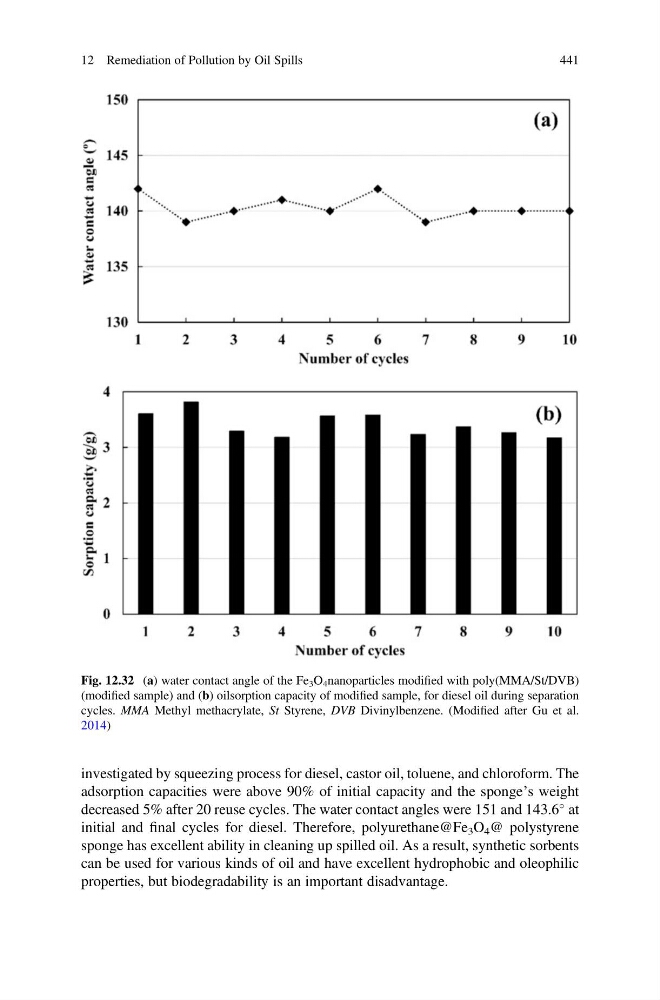
investigated by squeezing process for diesel, castor oil, toluene, and chloroform. The
adsorption capacities were above 90% of initial capacity and the sponge’s weight
decreased 5% after 20 reuse cycles. The water contact angles were 151 and 143.6
at
initial and final cycles for diesel. Therefore, polyurethane@Fe 3 O 4 @ polystyrene
sponge has excellent ability in cleaning up spilled oil. As a result, synthetic sorbents
can be used for various kinds of oil and have excellent hydrophobic and oleophilic
properties, but biodegradability is an important disadvantage.
Fig. 12.32 (a) water contact angle of the Fe 3 O 4 nanoparticles modified with poly(MMA/St/DVB)
(modified sample) and (b) oilsorption capacity of modified sample, for diesel oil during separation
cycles. MMA Methyl methacrylate, St Styrene, DVB Divinylbenzene. (Modified after Gu et al.
2014)
12 Remediation of Pollution by Oil Spills
441
adsorption capacities were above 90% of initial capacity and the sponge’s weight
decreased 5% after 20 reuse cycles. The water contact angles were 151 and 143.6
at
initial and final cycles for diesel. Therefore, polyurethane@Fe 3 O 4 @ polystyrene
sponge has excellent ability in cleaning up spilled oil. As a result, synthetic sorbents
can be used for various kinds of oil and have excellent hydrophobic and oleophilic
properties, but biodegradability is an important disadvantage.
Fig. 12.32 (a) water contact angle of the Fe 3 O 4 nanoparticles modified with poly(MMA/St/DVB)
(modified sample) and (b) oilsorption capacity of modified sample, for diesel oil during separation
cycles. MMA Methyl methacrylate, St Styrene, DVB Divinylbenzene. (Modified after Gu et al.
2014)
12 Remediation of Pollution by Oil Spills
441