

12.5.3 Inorganic Products
Inorganic materials are not able to sorb oil in the natural form. Hence, their structure
should be improved to fabricate hydrophobic sorbents.
Perlite
One mineral porous material is perlite with porosity of about 45–55%. If this
material is quickly heated at 700–1200
C, its volume will increase to 8–15 times.
(a)
(b)
(c)
(d)
PU sponge
PU@Fe3O4 sponge
PU@Fe3O4@PS sponge
Fe3O4 nanoparticles
Dip-coating
Phenylethylene
SIPGP
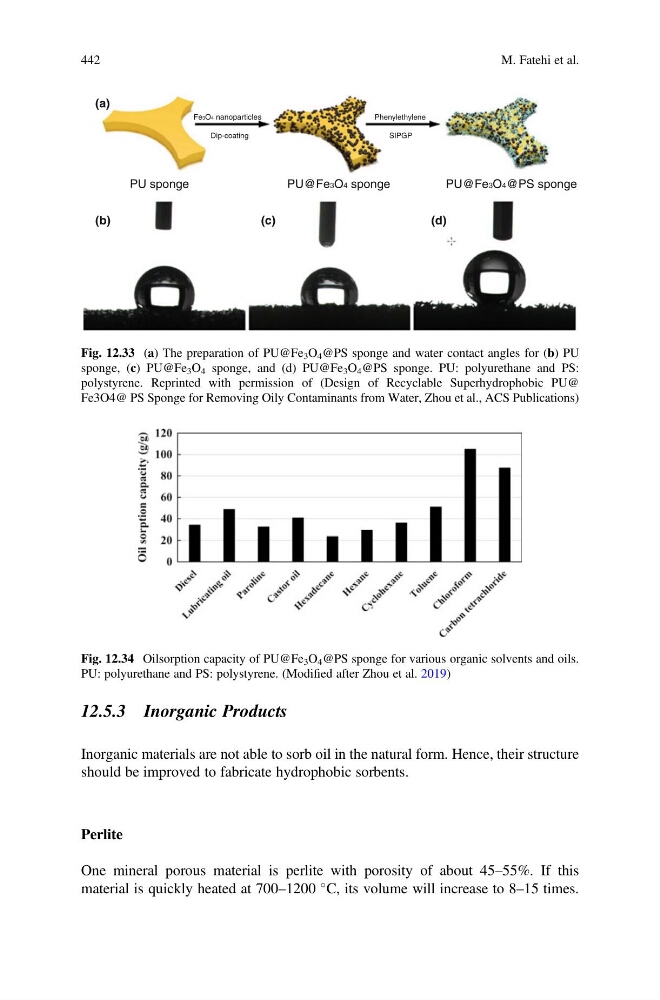
Fig. 12.33 (a) The preparation of PU@Fe 3 O 4 @PS sponge and water contact angles for (b) PU
sponge, (c) PU@Fe 3 O 4 sponge, and (d) PU@Fe 3 O 4 @PS sponge. PU: polyurethane and PS:
polystyrene. Reprinted with permission of (Design of Recyclable Superhydrophobic PU@
Fe3O4@ PS Sponge for Removing Oily Contaminants from Water, Zhou et al., ACS Publications)
Fig. 12.34 Oilsorption capacity of PU@Fe 3 O 4 @PS sponge for various organic solvents and oils.
PU: polyurethane and PS: polystyrene. (Modified after Zhou et al. 2019)
442
M. Fatehi et al.
Inorganic materials are not able to sorb oil in the natural form. Hence, their structure
should be improved to fabricate hydrophobic sorbents.
Perlite
One mineral porous material is perlite with porosity of about 45–55%. If this
material is quickly heated at 700–1200
C, its volume will increase to 8–15 times.
(a)
(b)
(c)
(d)
PU sponge
PU@Fe3O4 sponge
PU@Fe3O4@PS sponge
Fe3O4 nanoparticles
Dip-coating
Phenylethylene
SIPGP
Fig. 12.33 (a) The preparation of PU@Fe 3 O 4 @PS sponge and water contact angles for (b) PU
sponge, (c) PU@Fe 3 O 4 sponge, and (d) PU@Fe 3 O 4 @PS sponge. PU: polyurethane and PS:
polystyrene. Reprinted with permission of (Design of Recyclable Superhydrophobic PU@
Fe3O4@ PS Sponge for Removing Oily Contaminants from Water, Zhou et al., ACS Publications)
Fig. 12.34 Oilsorption capacity of PU@Fe 3 O 4 @PS sponge for various organic solvents and oils.
PU: polyurethane and PS: polystyrene. (Modified after Zhou et al. 2019)
442
M. Fatehi et al.