

because of the effect of roll milling on deformation of their stiff structure. These
samples had highest oleophilicity, so their desorption efficiencies are low compared
to the other samples.
The highest sorption capacity was reported for as-prepared samples in ethanol/
methyltrimethoxysilane molar ratio of 10 in acidic conditions (a-2) followed by (b-2)
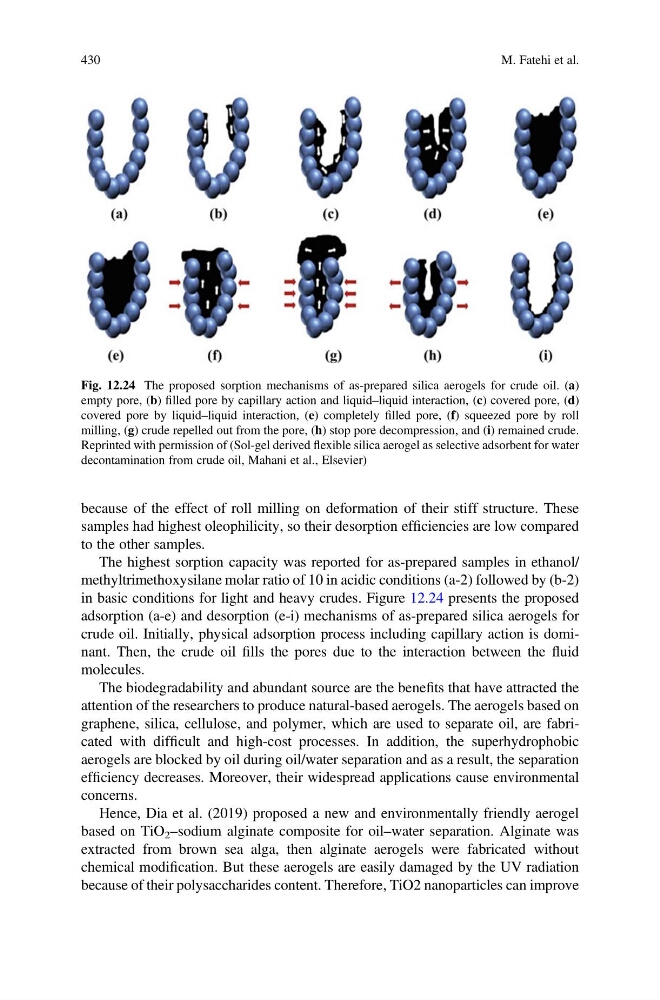
in basic conditions for light and heavy crudes. Figure 12.24 presents the proposed
adsorption (a-e) and desorption (e-i) mechanisms of as-prepared silica aerogels for
crude oil. Initially, physical adsorption process including capillary action is dominant. Then, the crude oil fills the pores due to the interaction between the fluid
molecules.
The biodegradability and abundant source are the benefits that have attracted the
attention of the researchers to produce natural-based aerogels. The aerogels based on
graphene, silica, cellulose, and polymer, which are used to separate oil, are fabricated with difficult and high-cost processes. In addition, the superhydrophobic
aerogels are blocked by oil during oil/water separation and as a result, the separation
efficiency decreases. Moreover, their widespread applications cause environmental
concerns.
Hence, Dia et al. (2019) proposed a new and environmentally friendly aerogel
based on TiO 2 –sodium alginate composite for oil–water separation. Alginate was
extracted from brown sea alga, then alginate aerogels were fabricated without
chemical modification. But these aerogels are easily damaged by the UV radiation
because of their polysaccharides content. Therefore, TiO2 nanoparticles can improve
Fig. 12.24 The proposed sorption mechanisms of as-prepared silica aerogels for crude oil. (a)
empty pore, (b) filled pore by capillary action and liquid–liquid interaction, (c) covered pore, (d)
covered pore by liquid–liquid interaction, (e) completely filled pore, (f) squeezed pore by roll
milling, (g) crude repelled out from the pore, (h) stop pore decompression, and (i) remained crude.
Reprinted with permission of (Sol-gel derived flexible silica aerogel as selective adsorbent for water
decontamination from crude oil, Mahani et al., Elsevier)
430
M. Fatehi et al.
samples had highest oleophilicity, so their desorption efficiencies are low compared
to the other samples.
The highest sorption capacity was reported for as-prepared samples in ethanol/
methyltrimethoxysilane molar ratio of 10 in acidic conditions (a-2) followed by (b-2)
in basic conditions for light and heavy crudes. Figure 12.24 presents the proposed
adsorption (a-e) and desorption (e-i) mechanisms of as-prepared silica aerogels for
crude oil. Initially, physical adsorption process including capillary action is dominant. Then, the crude oil fills the pores due to the interaction between the fluid
molecules.
The biodegradability and abundant source are the benefits that have attracted the
attention of the researchers to produce natural-based aerogels. The aerogels based on
graphene, silica, cellulose, and polymer, which are used to separate oil, are fabricated with difficult and high-cost processes. In addition, the superhydrophobic
aerogels are blocked by oil during oil/water separation and as a result, the separation
efficiency decreases. Moreover, their widespread applications cause environmental
concerns.
Hence, Dia et al. (2019) proposed a new and environmentally friendly aerogel
based on TiO 2 –sodium alginate composite for oil–water separation. Alginate was
extracted from brown sea alga, then alginate aerogels were fabricated without
chemical modification. But these aerogels are easily damaged by the UV radiation
because of their polysaccharides content. Therefore, TiO2 nanoparticles can improve
Fig. 12.24 The proposed sorption mechanisms of as-prepared silica aerogels for crude oil. (a)
empty pore, (b) filled pore by capillary action and liquid–liquid interaction, (c) covered pore, (d)
covered pore by liquid–liquid interaction, (e) completely filled pore, (f) squeezed pore by roll
milling, (g) crude repelled out from the pore, (h) stop pore decompression, and (i) remained crude.
Reprinted with permission of (Sol-gel derived flexible silica aerogel as selective adsorbent for water
decontamination from crude oil, Mahani et al., Elsevier)
430
M. Fatehi et al.