

the UV-aging resistance of alginate aerogels due to their photocatalysis property. In
the work of Dia et al. (2019), the TiO 2 –sodium alginate aerogel was produced by
ionic cross-linking and freeze-drying methods. TiO 2 nanoparticles were dispersed on
hydrophilic alginate matrix to make it oleophobic underwater.
The morphology results of sodium alginate and TiO 2 –sodium alginate aerogels
showed three-dimensional network structures of these aerogels. The pore size range
of 40–150 μm for both aerogels indicated their excellent oil/water separation ability
and the TiO 2 –sodium alginate aerogel surface was rougher than the sodium alginate
aerogel surface.
The results of measuring contact angles for oil and water droplets on the sodium
alginate aerogel and TiO 2 –sodium alginate surfaces in air indicated that both
aerogels were superamphiphilic. This is a result of the presence of hydroxyl groups
on the rough and porous structures of both aerogels. After that the underwater oil
contact angles were investigated by water-soaked aerogels. The underwater oil
contact angles of TiO 2 –sodium alginate aerogel were greater than those of sodium
alginate aerogel. The lowest underwater oil contact angles of above solvents were
123.1 and 137.2
for sodium alginate and TiO 2 –sodium alginate aerogels,
respectively.
These results revealed that alginate aerogel possesses excellent water storage
capacity and the TiO 2 nanoparticles could improve the underwater oleophobicity of
this type of aerogel. Moreover, water-soaked alginate aerogel could store more water
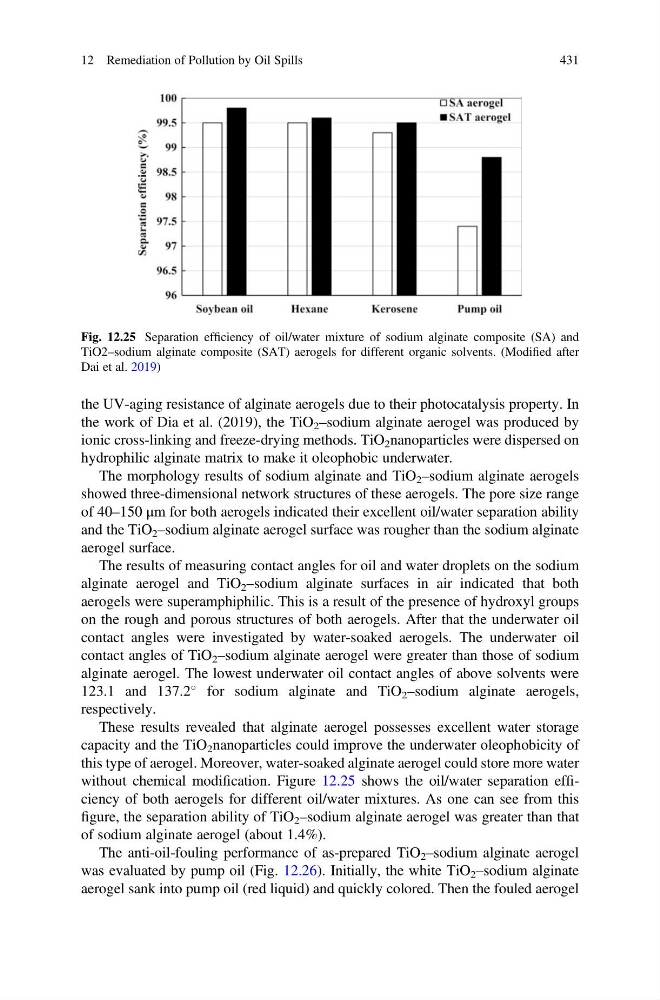
without chemical modification. Figure 12.25 shows the oil/water separation efficiency of both aerogels for different oil/water mixtures. As one can see from this
figure, the separation ability of TiO 2 –sodium alginate aerogel was greater than that
of sodium alginate aerogel (about 1.4%).
The anti-oil-fouling performance of as-prepared TiO 2 –sodium alginate aerogel
was evaluated by pump oil (Fig. 12.26). Initially, the white TiO 2 –sodium alginate
aerogel sank into pump oil (red liquid) and quickly colored. Then the fouled aerogel
Fig. 12.25 Separation efficiency of oil/water mixture of sodium alginate composite (SA) and
TiO2–sodium alginate composite (SAT) aerogels for different organic solvents. (Modified after
Dai et al. 2019)
12 Remediation of Pollution by Oil Spills
431
the work of Dia et al. (2019), the TiO 2 –sodium alginate aerogel was produced by
ionic cross-linking and freeze-drying methods. TiO 2 nanoparticles were dispersed on
hydrophilic alginate matrix to make it oleophobic underwater.
The morphology results of sodium alginate and TiO 2 –sodium alginate aerogels
showed three-dimensional network structures of these aerogels. The pore size range
of 40–150 μm for both aerogels indicated their excellent oil/water separation ability
and the TiO 2 –sodium alginate aerogel surface was rougher than the sodium alginate
aerogel surface.
The results of measuring contact angles for oil and water droplets on the sodium
alginate aerogel and TiO 2 –sodium alginate surfaces in air indicated that both
aerogels were superamphiphilic. This is a result of the presence of hydroxyl groups
on the rough and porous structures of both aerogels. After that the underwater oil
contact angles were investigated by water-soaked aerogels. The underwater oil
contact angles of TiO 2 –sodium alginate aerogel were greater than those of sodium
alginate aerogel. The lowest underwater oil contact angles of above solvents were
123.1 and 137.2
for sodium alginate and TiO 2 –sodium alginate aerogels,
respectively.
These results revealed that alginate aerogel possesses excellent water storage
capacity and the TiO 2 nanoparticles could improve the underwater oleophobicity of
this type of aerogel. Moreover, water-soaked alginate aerogel could store more water
without chemical modification. Figure 12.25 shows the oil/water separation efficiency of both aerogels for different oil/water mixtures. As one can see from this
figure, the separation ability of TiO 2 –sodium alginate aerogel was greater than that
of sodium alginate aerogel (about 1.4%).
The anti-oil-fouling performance of as-prepared TiO 2 –sodium alginate aerogel
was evaluated by pump oil (Fig. 12.26). Initially, the white TiO 2 –sodium alginate
aerogel sank into pump oil (red liquid) and quickly colored. Then the fouled aerogel
Fig. 12.25 Separation efficiency of oil/water mixture of sodium alginate composite (SA) and
TiO2–sodium alginate composite (SAT) aerogels for different organic solvents. (Modified after
Dai et al. 2019)
12 Remediation of Pollution by Oil Spills
431