

The surface roughness of the fibers has an influence on the oiladsorption capacity
based on its effects on the pore, the pore size distribution, and the contact angles of
oil and water. Fibers with hierarchical roughness have low oil contact angles and
high water angles. Nevertheless, surface roughness of fibers has less impact than
pore size of fiber. Therefore, oilsorption capacity of small-diameter porous fibers
with smooth surface are greater than that of large-diameter porous fibers with rough
surface.
Small-diameter and high porosity also reduce fiber’s density, which favors the
buoyancy property. High buoyancy, low density, small diameter, and high porosity
provide a high oilsorption capacity for the fibers. The oil retention behavior of the
fibers depends on the porosity. The oil retention of high porosity fibers is less than
that of lower porosity fibers. The fibers with different porosity structures have
different oilsorption kinetics.
Whole oilsorption process depends on contact time, except oilsorption process of
nonporous fibers (which is a constant process). For natural corn fibers, the kinetics of
the oilsorption process has a second-order equation. There is not enough information
about the oilsorption kinetics of various fibers and needs more study. Tearing,
deterioration, and crushing influence the number of effective reuse cycles of fibers.
Compression techniques are widely used for oil removal from the fibers. But
irreversible changing and undermining of their inner structure decreases the
oilsorption capacity. For instance, the oilsorption capacity of polystyrene–polyurethane decreased after two reuses. Therefore, tensile strength of the fibers is
important.
Some studies have confirmed that the combined fibers had better sorption performance. Polystyrene–polyurethane fiber exhibits excellent reusability due to its
resiliency and strength. In addition, durability at the pressure applied during the
reuse process is an important characteristic because of its influence on the
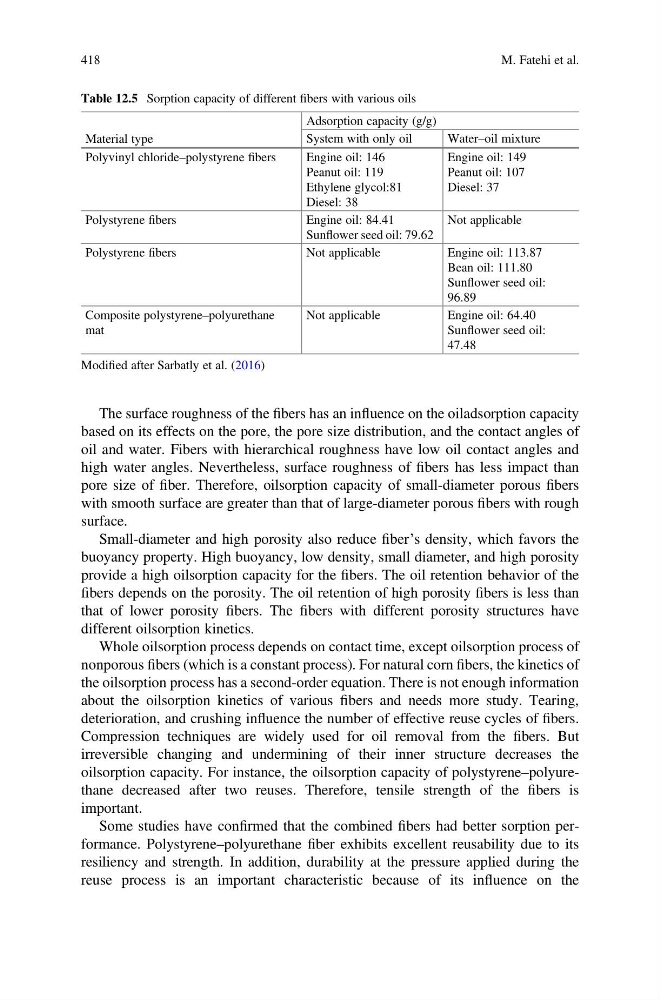
Table 12.5 Sorption capacity of different fibers with various oils
Material type
Adsorption capacity (g/g)
System with only oil
Water–oil mixture
Polyvinyl chloride–polystyrene fibers
Engine oil: 146
Peanut oil: 119
Ethylene glycol:81
Diesel: 38
Engine oil: 149
Peanut oil: 107
Diesel: 37
Polystyrene fibers
Engine oil: 84.41
Sunflower seed oil: 79.62
Not applicable
Polystyrene fibers
Not applicable
Engine oil: 113.87
Bean oil: 111.80
Sunflower seed oil:
96.89
Composite polystyrene–polyurethane
mat
Not applicable
Engine oil: 64.40
Sunflower seed oil:
47.48
Modified after Sarbatly et al. (2016)
418
M. Fatehi et al.
based on its effects on the pore, the pore size distribution, and the contact angles of
oil and water. Fibers with hierarchical roughness have low oil contact angles and
high water angles. Nevertheless, surface roughness of fibers has less impact than
pore size of fiber. Therefore, oilsorption capacity of small-diameter porous fibers
with smooth surface are greater than that of large-diameter porous fibers with rough
surface.
Small-diameter and high porosity also reduce fiber’s density, which favors the
buoyancy property. High buoyancy, low density, small diameter, and high porosity
provide a high oilsorption capacity for the fibers. The oil retention behavior of the
fibers depends on the porosity. The oil retention of high porosity fibers is less than
that of lower porosity fibers. The fibers with different porosity structures have
different oilsorption kinetics.
Whole oilsorption process depends on contact time, except oilsorption process of
nonporous fibers (which is a constant process). For natural corn fibers, the kinetics of
the oilsorption process has a second-order equation. There is not enough information
about the oilsorption kinetics of various fibers and needs more study. Tearing,
deterioration, and crushing influence the number of effective reuse cycles of fibers.
Compression techniques are widely used for oil removal from the fibers. But
irreversible changing and undermining of their inner structure decreases the
oilsorption capacity. For instance, the oilsorption capacity of polystyrene–polyurethane decreased after two reuses. Therefore, tensile strength of the fibers is
important.
Some studies have confirmed that the combined fibers had better sorption performance. Polystyrene–polyurethane fiber exhibits excellent reusability due to its
resiliency and strength. In addition, durability at the pressure applied during the
reuse process is an important characteristic because of its influence on the
Table 12.5 Sorption capacity of different fibers with various oils
Material type
Adsorption capacity (g/g)
System with only oil
Water–oil mixture
Polyvinyl chloride–polystyrene fibers
Engine oil: 146
Peanut oil: 119
Ethylene glycol:81
Diesel: 38
Engine oil: 149
Peanut oil: 107
Diesel: 37
Polystyrene fibers
Engine oil: 84.41
Sunflower seed oil: 79.62
Not applicable
Polystyrene fibers
Not applicable
Engine oil: 113.87
Bean oil: 111.80
Sunflower seed oil:
96.89
Composite polystyrene–polyurethane
mat
Not applicable
Engine oil: 64.40
Sunflower seed oil:
47.48
Modified after Sarbatly et al. (2016)
418
M. Fatehi et al.