

diameter increases, the sorption rate decreases because of the large void space
between fibers. Also, hydrophobicity and oleophilicity characteristics of surface
are determined by the surface tension. The favored solid surface for oilsorption
has the surface energy similar to that of oil.
Adsorption and capillary action control the oilsorption mechanism of the fibers.
Capillary mechanism traps oil on the its surface physically (adsorption) and fills the
void spaces between fibers with the van der Waals forces. Table 12.5 presents the
sorption capacity of different fibers with various oils. The sorption performance of
these sorbents is affected by oil viscosity, surface tension of fabric sorbents, specific
surface area, floatability, oil retention time, contact angle of sorbent, viscosity of the
spinning solution, kinetic of oilsorption, and pH of environment. Table 12.6 summarizes the effective factors on the oil removal efficiency.
The high viscous oil may have two opposite effects on the oilsorption capacity of
fibers. The adsorption of oil increases by adhering the oil to the surface of fiber,
whereas the capillary of the oil becomes difficult due to the high viscosity. Additionally, oil thickness has positive effects on the sorption performance. The acceptable oil-water selectivity decreases the water collection and mass of sorbents in the
oil spill site. The oil selection of fabric sorbents can be changed by specific surface
area. Moreover, the high porous structure increases the oilsorption capacity by
retaining the oil in the voids of fibers.
⁄
ä
Fig. 12.14 (continued) (c) The centrifugal spinning device for preparation of polyacrylonitrile
(PAN)/ poly-methyl methacrylate (PMMA) precursor and porous carbon nanofibers (PNFs).
Reprinted with permission of (Centrifugal spinning: a novel approach to fabricate porous carbon
fibers as binder-free electrodes for electric double-layer capacitors, Lu et al. 2015, Elsevier)
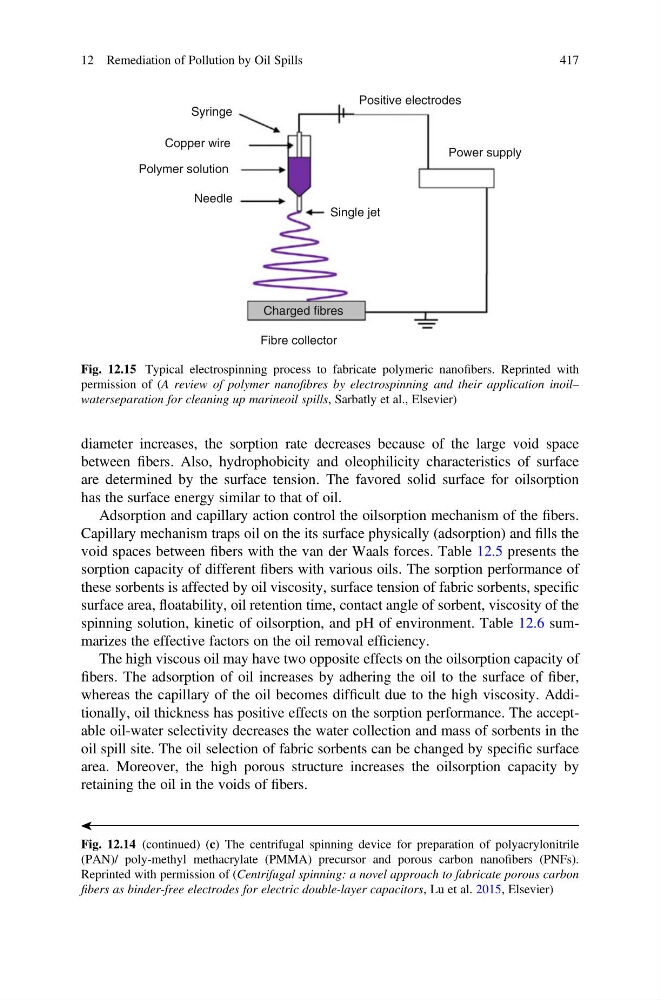
Syringe
Positive electrodes
Copper wire
Polymer solution
Needle
Single jet
Power supply
Fibre collector
Charged fibres
Fig. 12.15 Typical electrospinning process to fabricate polymeric nanofibers. Reprinted with
permission of (A review of polymer nanofibres by electrospinning and their application inoil–
waterseparation for cleaning up marineoil spills, Sarbatly et al., Elsevier)
12 Remediation of Pollution by Oil Spills
417
between fibers. Also, hydrophobicity and oleophilicity characteristics of surface
are determined by the surface tension. The favored solid surface for oilsorption
has the surface energy similar to that of oil.
Adsorption and capillary action control the oilsorption mechanism of the fibers.
Capillary mechanism traps oil on the its surface physically (adsorption) and fills the
void spaces between fibers with the van der Waals forces. Table 12.5 presents the
sorption capacity of different fibers with various oils. The sorption performance of
these sorbents is affected by oil viscosity, surface tension of fabric sorbents, specific
surface area, floatability, oil retention time, contact angle of sorbent, viscosity of the
spinning solution, kinetic of oilsorption, and pH of environment. Table 12.6 summarizes the effective factors on the oil removal efficiency.
The high viscous oil may have two opposite effects on the oilsorption capacity of
fibers. The adsorption of oil increases by adhering the oil to the surface of fiber,
whereas the capillary of the oil becomes difficult due to the high viscosity. Additionally, oil thickness has positive effects on the sorption performance. The acceptable oil-water selectivity decreases the water collection and mass of sorbents in the
oil spill site. The oil selection of fabric sorbents can be changed by specific surface
area. Moreover, the high porous structure increases the oilsorption capacity by
retaining the oil in the voids of fibers.
⁄
ä
Fig. 12.14 (continued) (c) The centrifugal spinning device for preparation of polyacrylonitrile
(PAN)/ poly-methyl methacrylate (PMMA) precursor and porous carbon nanofibers (PNFs).
Reprinted with permission of (Centrifugal spinning: a novel approach to fabricate porous carbon
fibers as binder-free electrodes for electric double-layer capacitors, Lu et al. 2015, Elsevier)
Syringe
Positive electrodes
Copper wire
Polymer solution
Needle
Single jet
Power supply
Fibre collector
Charged fibres
Fig. 12.15 Typical electrospinning process to fabricate polymeric nanofibers. Reprinted with
permission of (A review of polymer nanofibres by electrospinning and their application inoil–
waterseparation for cleaning up marineoil spills, Sarbatly et al., Elsevier)
12 Remediation of Pollution by Oil Spills
417