

Hydrophobicity, specific gravity, and buoyancy of sorbents are the effective
parameters on the oilsorption capacity. The various vegetable firers are taken into
consideration because of favorable sorption, oleophilic properties, affordable, low
density, and environment friendly. For this purpose, leaves residues, wood shavings,
sisal, coir fiber, Luffa aegyptiaca and silk-floss were evaluated by Annunciado et al.
(2005). For sorption experiments, they used mixture of crude oil and water
(deionized and marine) and experiments were performed with and without agitation.
The evaluation of water uptake was performed by weight difference and distillation
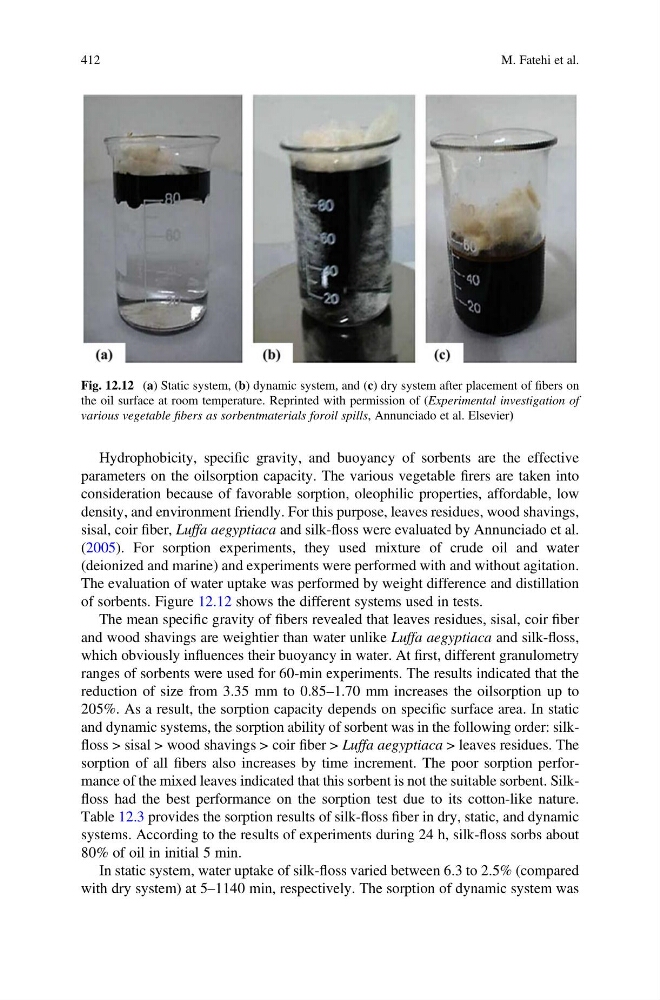
of sorbents. Figure 12.12 shows the different systems used in tests.
The mean specific gravity of fibers revealed that leaves residues, sisal, coir fiber
and wood shavings are weightier than water unlike Luffa aegyptiaca and silk-floss,
which obviously influences their buoyancy in water. At first, different granulometry
ranges of sorbents were used for 60-min experiments. The results indicated that the
reduction of size from 3.35 mm to 0.85–1.70 mm increases the oilsorption up to
205%. As a result, the sorption capacity depends on specific surface area. In static
and dynamic systems, the sorption ability of sorbent was in the following order: silkfloss > sisal > wood shavings > coir fiber > Luffa aegyptiaca > leaves residues. The
sorption of all fibers also increases by time increment. The poor sorption performance of the mixed leaves indicated that this sorbent is not the suitable sorbent. Silkfloss had the best performance on the sorption test due to its cotton-like nature.
Table 12.3 provides the sorption results of silk-floss fiber in dry, static, and dynamic
systems. According to the results of experiments during 24 h, silk-floss sorbs about
80% of oil in initial 5 min.
In static system, water uptake of silk-floss varied between 6.3 to 2.5% (compared
with dry system) at 5–1140 min, respectively. The sorption of dynamic system was
Fig. 12.12 (a) Static system, (b) dynamic system, and (c) dry system after placement of fibers on
the oil surface at room temperature. Reprinted with permission of (Experimental investigation of
various vegetable fibers as sorbentmaterials foroil spills, Annunciado et al. Elsevier)
412
M. Fatehi et al.
parameters on the oilsorption capacity. The various vegetable firers are taken into
consideration because of favorable sorption, oleophilic properties, affordable, low
density, and environment friendly. For this purpose, leaves residues, wood shavings,
sisal, coir fiber, Luffa aegyptiaca and silk-floss were evaluated by Annunciado et al.
(2005). For sorption experiments, they used mixture of crude oil and water
(deionized and marine) and experiments were performed with and without agitation.
The evaluation of water uptake was performed by weight difference and distillation
of sorbents. Figure 12.12 shows the different systems used in tests.
The mean specific gravity of fibers revealed that leaves residues, sisal, coir fiber
and wood shavings are weightier than water unlike Luffa aegyptiaca and silk-floss,
which obviously influences their buoyancy in water. At first, different granulometry
ranges of sorbents were used for 60-min experiments. The results indicated that the
reduction of size from 3.35 mm to 0.85–1.70 mm increases the oilsorption up to
205%. As a result, the sorption capacity depends on specific surface area. In static
and dynamic systems, the sorption ability of sorbent was in the following order: silkfloss > sisal > wood shavings > coir fiber > Luffa aegyptiaca > leaves residues. The
sorption of all fibers also increases by time increment. The poor sorption performance of the mixed leaves indicated that this sorbent is not the suitable sorbent. Silkfloss had the best performance on the sorption test due to its cotton-like nature.
Table 12.3 provides the sorption results of silk-floss fiber in dry, static, and dynamic
systems. According to the results of experiments during 24 h, silk-floss sorbs about
80% of oil in initial 5 min.
In static system, water uptake of silk-floss varied between 6.3 to 2.5% (compared
with dry system) at 5–1140 min, respectively. The sorption of dynamic system was
Fig. 12.12 (a) Static system, (b) dynamic system, and (c) dry system after placement of fibers on
the oil surface at room temperature. Reprinted with permission of (Experimental investigation of
various vegetable fibers as sorbentmaterials foroil spills, Annunciado et al. Elsevier)
412
M. Fatehi et al.