

lower than dry system before 60 min, but after that the sorption was higher. The
agitation and frequent water–fiber contact can be the reason of this sorption behavior. Therefore, water and agitation can decrease the oilsorption capacity. In
deionized and marine water, silk-floss showed the highest hydrophobicity (around
98%) and sisal and Luffa aegyptiaca had the opposite behavior (0% hydrophobicity).
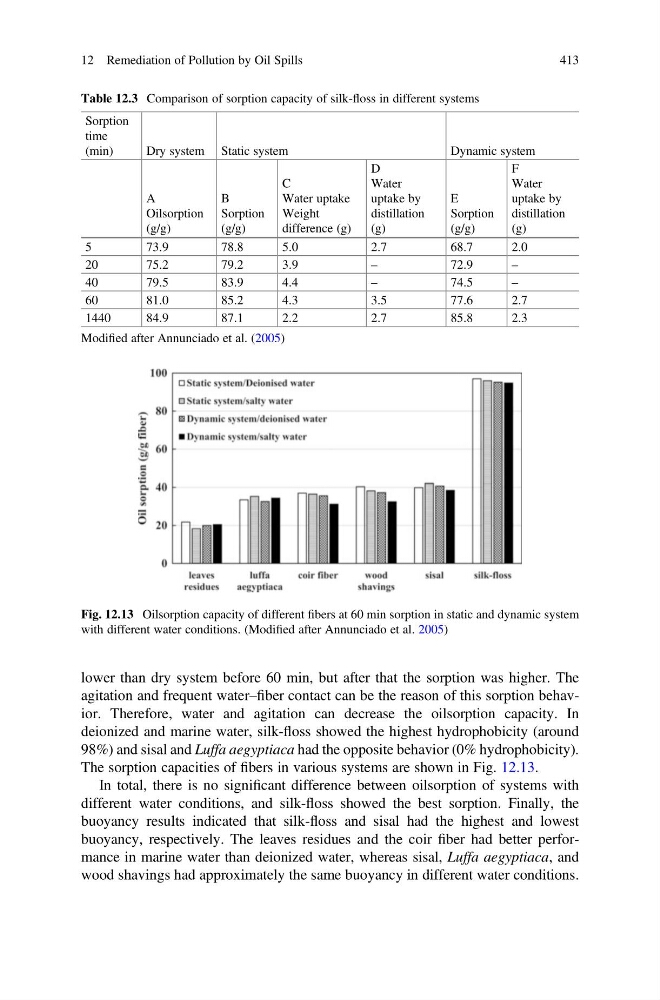
The sorption capacities of fibers in various systems are shown in Fig. 12.13.
In total, there is no significant difference between oilsorption of systems with
different water conditions, and silk-floss showed the best sorption. Finally, the
buoyancy results indicated that silk-floss and sisal had the highest and lowest
buoyancy, respectively. The leaves residues and the coir fiber had better performance in marine water than deionized water, whereas sisal, Luffa aegyptiaca, and
wood shavings had approximately the same buoyancy in different water conditions.
Table 12.3 Comparison of sorption capacity of silk-floss in different systems
Sorption
time
(min)
Dry system Static system
Dynamic system
A
Oilsorption
(g/g)
B
Sorption
(g/g)
C
Water uptake
Weight
difference (g)
D
Water
uptake by
distillation
(g)
E
Sorption
(g/g)
F
Water
uptake by
distillation
(g)
5
73.9
78.8
5.0
2.7
68.7
2.0
20
75.2
79.2
3.9
–
72.9
–
40
79.5
83.9
4.4
–
74.5
–
60
81.0
85.2
4.3
3.5
77.6
2.7
1440
84.9
87.1
2.2
2.7
85.8
2.3
Modified after Annunciado et al. (2005)
Fig. 12.13 Oilsorption capacity of different fibers at 60 min sorption in static and dynamic system
with different water conditions. (Modified after Annunciado et al. 2005)
12 Remediation of Pollution by Oil Spills
413
agitation and frequent water–fiber contact can be the reason of this sorption behavior. Therefore, water and agitation can decrease the oilsorption capacity. In
deionized and marine water, silk-floss showed the highest hydrophobicity (around
98%) and sisal and Luffa aegyptiaca had the opposite behavior (0% hydrophobicity).
The sorption capacities of fibers in various systems are shown in Fig. 12.13.
In total, there is no significant difference between oilsorption of systems with
different water conditions, and silk-floss showed the best sorption. Finally, the
buoyancy results indicated that silk-floss and sisal had the highest and lowest
buoyancy, respectively. The leaves residues and the coir fiber had better performance in marine water than deionized water, whereas sisal, Luffa aegyptiaca, and
wood shavings had approximately the same buoyancy in different water conditions.
Table 12.3 Comparison of sorption capacity of silk-floss in different systems
Sorption
time
(min)
Dry system Static system
Dynamic system
A
Oilsorption
(g/g)
B
Sorption
(g/g)
C
Water uptake
Weight
difference (g)
D
Water
uptake by
distillation
(g)
E
Sorption
(g/g)
F
Water
uptake by
distillation
(g)
5
73.9
78.8
5.0
2.7
68.7
2.0
20
75.2
79.2
3.9
–
72.9
–
40
79.5
83.9
4.4
–
74.5
–
60
81.0
85.2
4.3
3.5
77.6
2.7
1440
84.9
87.1
2.2
2.7
85.8
2.3
Modified after Annunciado et al. (2005)
Fig. 12.13 Oilsorption capacity of different fibers at 60 min sorption in static and dynamic system
with different water conditions. (Modified after Annunciado et al. 2005)
12 Remediation of Pollution by Oil Spills
413