

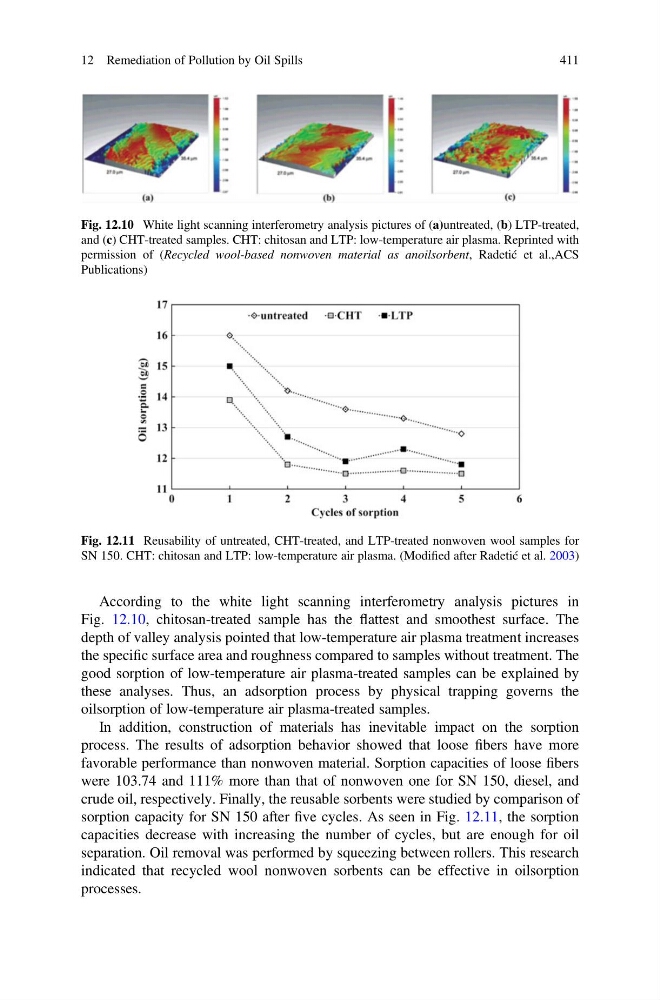
According to the white light scanning interferometry analysis pictures in
Fig. 12.10, chitosan-treated sample has the flattest and smoothest surface. The
depth of valley analysis pointed that low-temperature air plasma treatment increases
the specific surface area and roughness compared to samples without treatment. The
good sorption of low-temperature air plasma-treated samples can be explained by
these analyses. Thus, an adsorption process by physical trapping governs the
oilsorption of low-temperature air plasma-treated samples.
In addition, construction of materials has inevitable impact on the sorption
process. The results of adsorption behavior showed that loose fibers have more
favorable performance than nonwoven material. Sorption capacities of loose fibers
were 103.74 and 111% more than that of nonwoven one for SN 150, diesel, and
crude oil, respectively. Finally, the reusable sorbents were studied by comparison of
sorption capacity for SN 150 after five cycles. As seen in Fig. 12.11, the sorption
capacities decrease with increasing the number of cycles, but are enough for oil
separation. Oil removal was performed by squeezing between rollers. This research
indicated that recycled wool nonwoven sorbents can be effective in oilsorption
processes.
Fig. 12.10 White light scanning interferometry analysis pictures of (a)untreated, (b) LTP-treated,
and (c) CHT-treated samples. CHT: chitosan and LTP: low-temperature air plasma. Reprinted with
permission of (Recycled wool-based nonwoven material as anoilsorbent, Radetić et al.,ACS
Publications)
Fig. 12.11 Reusability of untreated, CHT-treated, and LTP-treated nonwoven wool samples for
SN 150. CHT: chitosan and LTP: low-temperature air plasma. (Modified after Radetić et al. 2003)
12 Remediation of Pollution by Oil Spills
411
Fig. 12.10, chitosan-treated sample has the flattest and smoothest surface. The
depth of valley analysis pointed that low-temperature air plasma treatment increases
the specific surface area and roughness compared to samples without treatment. The
good sorption of low-temperature air plasma-treated samples can be explained by
these analyses. Thus, an adsorption process by physical trapping governs the
oilsorption of low-temperature air plasma-treated samples.
In addition, construction of materials has inevitable impact on the sorption
process. The results of adsorption behavior showed that loose fibers have more
favorable performance than nonwoven material. Sorption capacities of loose fibers
were 103.74 and 111% more than that of nonwoven one for SN 150, diesel, and
crude oil, respectively. Finally, the reusable sorbents were studied by comparison of
sorption capacity for SN 150 after five cycles. As seen in Fig. 12.11, the sorption
capacities decrease with increasing the number of cycles, but are enough for oil
separation. Oil removal was performed by squeezing between rollers. This research
indicated that recycled wool nonwoven sorbents can be effective in oilsorption
processes.
Fig. 12.10 White light scanning interferometry analysis pictures of (a)untreated, (b) LTP-treated,
and (c) CHT-treated samples. CHT: chitosan and LTP: low-temperature air plasma. Reprinted with
permission of (Recycled wool-based nonwoven material as anoilsorbent, Radetić et al.,ACS
Publications)
Fig. 12.11 Reusability of untreated, CHT-treated, and LTP-treated nonwoven wool samples for
SN 150. CHT: chitosan and LTP: low-temperature air plasma. (Modified after Radetić et al. 2003)
12 Remediation of Pollution by Oil Spills
411