

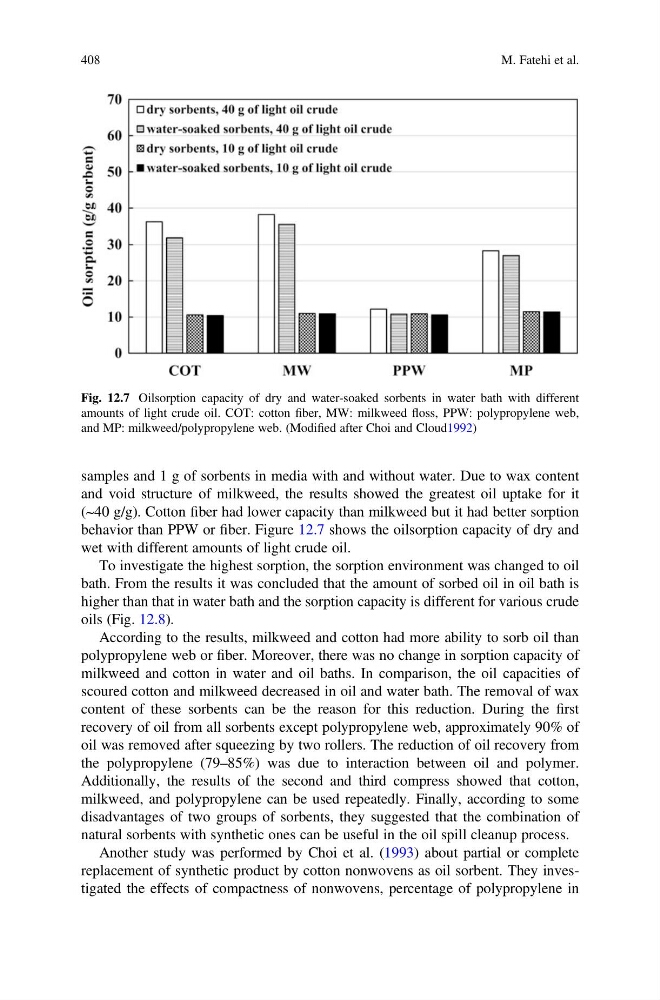
samples and 1 g of sorbents in media with and without water. Due to wax content
and void structure of milkweed, the results showed the greatest oil uptake for it
(~40 g/g). Cotton fiber had lower capacity than milkweed but it had better sorption
behavior than PPW or fiber. Figure 12.7 shows the oilsorption capacity of dry and
wet with different amounts of light crude oil.
To investigate the highest sorption, the sorption environment was changed to oil
bath. From the results it was concluded that the amount of sorbed oil in oil bath is
higher than that in water bath and the sorption capacity is different for various crude
oils (Fig. 12.8).
According to the results, milkweed and cotton had more ability to sorb oil than
polypropylene web or fiber. Moreover, there was no change in sorption capacity of
milkweed and cotton in water and oil baths. In comparison, the oil capacities of
scoured cotton and milkweed decreased in oil and water bath. The removal of wax
content of these sorbents can be the reason for this reduction. During the first
recovery of oil from all sorbents except polypropylene web, approximately 90% of
oil was removed after squeezing by two rollers. The reduction of oil recovery from
the polypropylene (79–85%) was due to interaction between oil and polymer.
Additionally, the results of the second and third compress showed that cotton,
milkweed, and polypropylene can be used repeatedly. Finally, according to some
disadvantages of two groups of sorbents, they suggested that the combination of
natural sorbents with synthetic ones can be useful in the oil spill cleanup process.
Another study was performed by Choi et al. (1993) about partial or complete
replacement of synthetic product by cotton nonwovens as oil sorbent. They investigated the effects of compactness of nonwovens, percentage of polypropylene in
Fig. 12.7 Oilsorption capacity of dry and water-soaked sorbents in water bath with different
amounts of light crude oil. COT: cotton fiber, MW: milkweed floss, PPW: polypropylene web,
and MP: milkweed/polypropylene web. (Modified after Choi and Cloud1992)
408
M. Fatehi et al.
and void structure of milkweed, the results showed the greatest oil uptake for it
(~40 g/g). Cotton fiber had lower capacity than milkweed but it had better sorption
behavior than PPW or fiber. Figure 12.7 shows the oilsorption capacity of dry and
wet with different amounts of light crude oil.
To investigate the highest sorption, the sorption environment was changed to oil
bath. From the results it was concluded that the amount of sorbed oil in oil bath is
higher than that in water bath and the sorption capacity is different for various crude
oils (Fig. 12.8).
According to the results, milkweed and cotton had more ability to sorb oil than
polypropylene web or fiber. Moreover, there was no change in sorption capacity of
milkweed and cotton in water and oil baths. In comparison, the oil capacities of
scoured cotton and milkweed decreased in oil and water bath. The removal of wax
content of these sorbents can be the reason for this reduction. During the first
recovery of oil from all sorbents except polypropylene web, approximately 90% of
oil was removed after squeezing by two rollers. The reduction of oil recovery from
the polypropylene (79–85%) was due to interaction between oil and polymer.
Additionally, the results of the second and third compress showed that cotton,
milkweed, and polypropylene can be used repeatedly. Finally, according to some
disadvantages of two groups of sorbents, they suggested that the combination of
natural sorbents with synthetic ones can be useful in the oil spill cleanup process.
Another study was performed by Choi et al. (1993) about partial or complete
replacement of synthetic product by cotton nonwovens as oil sorbent. They investigated the effects of compactness of nonwovens, percentage of polypropylene in
Fig. 12.7 Oilsorption capacity of dry and water-soaked sorbents in water bath with different
amounts of light crude oil. COT: cotton fiber, MW: milkweed floss, PPW: polypropylene web,
and MP: milkweed/polypropylene web. (Modified after Choi and Cloud1992)
408
M. Fatehi et al.