

blend of cotton/polypropylene and the number of reuse on oil sorption capacity.
They also presented detail information about sorption mechanism and kinetics of
desorption for these sorbents. They found that cotton fiber sorb oil by adsorption and
capillary in lumen, while there was no adsorption phenomenon for polypropylene,
and capillary bridges between fibers controlled the oilsorption. The results showed
that the amount of watersorption for 100% polypropylene nonwoven was higher
than cotton-containing nonwovens (100, 80, 65, and 50% cotton). These sorbents
were used several times to determine reusability. Initially, cotton had the greatest
oilsorption capacity. But during reuse, it had poor performance with respect to the
polypropylene. The results showed that as the amount of cotton increases in the
nonwoven, watersorption increases during reuse.
The gravity desorption behaviors of 100% polypropylene and 100% cotton
nonwoven were investigated during 5 min. For these sorbents, the rate of desorption
was faster during the initial 2 min and changed with increasing the number of passes.
The higher number of passes diminished the rate of desorption of cotton fiber and
had no significant effect on the polypropylene nonwoven. In conclusion, Choi et al.
(1993) emphasized that the cotton-containing nonwovens can be used instead of a
synthetic sorbent like polypropylene.
Straw is also one of the natural sorbents that can be used for oil containment and
cleanup of water. Monohydroxy alcohols, esters, and long chain fatty acids of wax
layer of straw makes it hydrophobic. Adsorption and absorption are two main
mechanisms for oilsorption by straw that depend on specifications of surface of
stalk and leaf, respectively. The oleophilic property of straw was investigated by
Witka-Jezewska et al. (2003) who analyzed contact angles. The contact angles of dry
and wet barley straw were measured for water and decane. The results showed that
dry straw remained oleophilic and absorbed oil, being in direct contact. Moreover,
the contact angle of oil on wet straw was above 150
, which emphasized the
oleophilic property of straw in aqueous environment. After 2 weeks, the
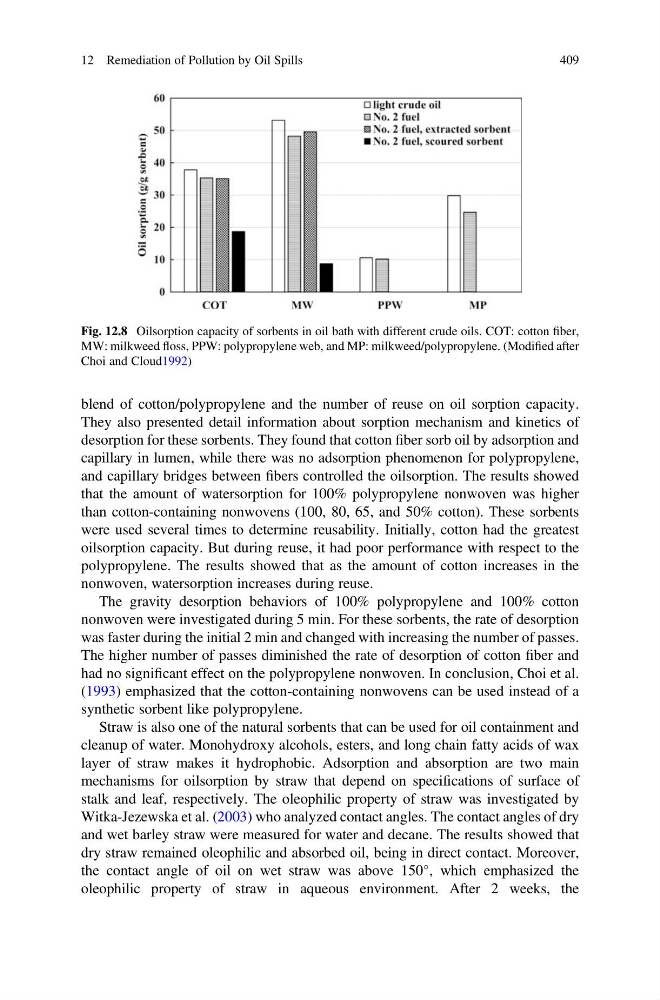
Fig. 12.8 Oilsorption capacity of sorbents in oil bath with different crude oils. COT: cotton fiber,
MW: milkweed floss, PPW: polypropylene web, and MP: milkweed/polypropylene. (Modified after
Choi and Cloud1992)
12 Remediation of Pollution by Oil Spills
409
They also presented detail information about sorption mechanism and kinetics of
desorption for these sorbents. They found that cotton fiber sorb oil by adsorption and
capillary in lumen, while there was no adsorption phenomenon for polypropylene,
and capillary bridges between fibers controlled the oilsorption. The results showed
that the amount of watersorption for 100% polypropylene nonwoven was higher
than cotton-containing nonwovens (100, 80, 65, and 50% cotton). These sorbents
were used several times to determine reusability. Initially, cotton had the greatest
oilsorption capacity. But during reuse, it had poor performance with respect to the
polypropylene. The results showed that as the amount of cotton increases in the
nonwoven, watersorption increases during reuse.
The gravity desorption behaviors of 100% polypropylene and 100% cotton
nonwoven were investigated during 5 min. For these sorbents, the rate of desorption
was faster during the initial 2 min and changed with increasing the number of passes.
The higher number of passes diminished the rate of desorption of cotton fiber and
had no significant effect on the polypropylene nonwoven. In conclusion, Choi et al.
(1993) emphasized that the cotton-containing nonwovens can be used instead of a
synthetic sorbent like polypropylene.
Straw is also one of the natural sorbents that can be used for oil containment and
cleanup of water. Monohydroxy alcohols, esters, and long chain fatty acids of wax
layer of straw makes it hydrophobic. Adsorption and absorption are two main
mechanisms for oilsorption by straw that depend on specifications of surface of
stalk and leaf, respectively. The oleophilic property of straw was investigated by
Witka-Jezewska et al. (2003) who analyzed contact angles. The contact angles of dry
and wet barley straw were measured for water and decane. The results showed that
dry straw remained oleophilic and absorbed oil, being in direct contact. Moreover,
the contact angle of oil on wet straw was above 150
, which emphasized the
oleophilic property of straw in aqueous environment. After 2 weeks, the
Fig. 12.8 Oilsorption capacity of sorbents in oil bath with different crude oils. COT: cotton fiber,
MW: milkweed floss, PPW: polypropylene web, and MP: milkweed/polypropylene. (Modified after
Choi and Cloud1992)
12 Remediation of Pollution by Oil Spills
409