

Institute separator. The American Petroleum Institute separator is a gravity separation device specifically designed using Stokes’ Law principle. This device works
based on the specific gravity difference between the oil and wastewater. The design
of the American Petroleum Institute separator follows exactly the standards
published by American Petroleum Institute. Dispersed oil has oil droplet sizes
ranging between 20 and 150 μm. Under this category, the oils are stable in terms
of electrostatic without any influence of emulsifying agents. These oils can be
removed using the flotation method. Emulsified oil mixture has the oil droplet
sizes smaller than 20 μm. This oil mixture is chemically stable in the presence of
the emulsifying agent. Besides, an oil–water mixture with the droplet sizes smaller
than 5 μm is categorized as a soluble oil mixture. The soluble oil mixtures are
commonly referred as the light end of the spectrum of compounds, such as xylene
and toluene (Mohammed and Al-Gurany 2010). Due to the tiny size, the soluble oil
can be effectively removed by carbon membrane filtration or adsorption.
The presence of oily wastewater can be sketched back to the municipal and
industrial sources. This contaminated water is produced from a broad array of
industries, such as oil processing, mechanical, textile, maritime transport, petrochemical and metallurgic industries (Ibrahim et al. 2009). On top of that, municipal
sources such as oil-used food preparation, disposal of oil-contaminated garbage and
oil-contaminated cleaning also contribute to the generation of the oily wastewater
(Chen et al. 2000). The common constituents of the oily wastewater are lubricants,
cutting fluids, light hydrocarbon such as kerosene and gasoline, heavy hydrocarbon,
crude oil, as well as grease. The concentration of the contaminants and oil droplet
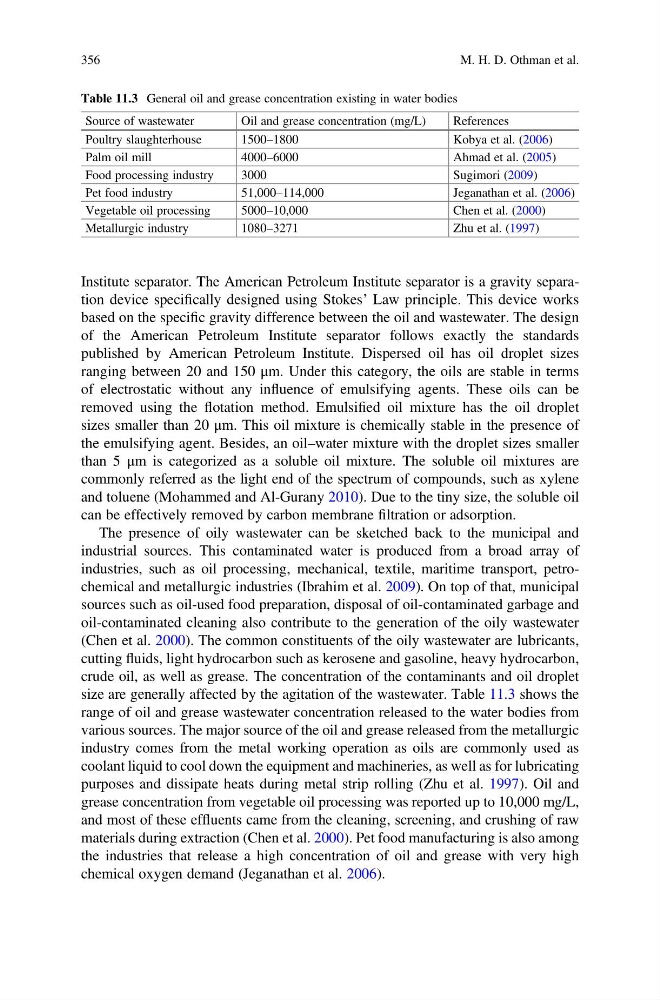
size are generally affected by the agitation of the wastewater. Table 11.3 shows the
range of oil and grease wastewater concentration released to the water bodies from
various sources. The major source of the oil and grease released from the metallurgic
industry comes from the metal working operation as oils are commonly used as
coolant liquid to cool down the equipment and machineries, as well as for lubricating
purposes and dissipate heats during metal strip rolling (Zhu et al. 1997). Oil and
grease concentration from vegetable oil processing was reported up to 10,000 mg/L,
and most of these effluents came from the cleaning, screening, and crushing of raw
materials during extraction (Chen et al. 2000). Pet food manufacturing is also among
the industries that release a high concentration of oil and grease with very high
chemical oxygen demand (Jeganathan et al. 2006).
Table 11.3 General oil and grease concentration existing in water bodies
Source of wastewater
Oil and grease concentration (mg/L)
References
Poultry slaughterhouse
1500–1800
Kobya et al. (2006)
Palm oil mill
4000–6000
Ahmad et al. (2005)
Food processing industry
3000
Sugimori (2009)
Pet food industry
51,000–114,000
Jeganathan et al. (2006)
Vegetable oil processing
5000–10,000
Chen et al. (2000)
Metallurgic industry
1080–3271
Zhu et al. (1997)
356
M. H. D. Othman et al.
based on the specific gravity difference between the oil and wastewater. The design
of the American Petroleum Institute separator follows exactly the standards
published by American Petroleum Institute. Dispersed oil has oil droplet sizes
ranging between 20 and 150 μm. Under this category, the oils are stable in terms
of electrostatic without any influence of emulsifying agents. These oils can be
removed using the flotation method. Emulsified oil mixture has the oil droplet
sizes smaller than 20 μm. This oil mixture is chemically stable in the presence of
the emulsifying agent. Besides, an oil–water mixture with the droplet sizes smaller
than 5 μm is categorized as a soluble oil mixture. The soluble oil mixtures are
commonly referred as the light end of the spectrum of compounds, such as xylene
and toluene (Mohammed and Al-Gurany 2010). Due to the tiny size, the soluble oil
can be effectively removed by carbon membrane filtration or adsorption.
The presence of oily wastewater can be sketched back to the municipal and
industrial sources. This contaminated water is produced from a broad array of
industries, such as oil processing, mechanical, textile, maritime transport, petrochemical and metallurgic industries (Ibrahim et al. 2009). On top of that, municipal
sources such as oil-used food preparation, disposal of oil-contaminated garbage and
oil-contaminated cleaning also contribute to the generation of the oily wastewater
(Chen et al. 2000). The common constituents of the oily wastewater are lubricants,
cutting fluids, light hydrocarbon such as kerosene and gasoline, heavy hydrocarbon,
crude oil, as well as grease. The concentration of the contaminants and oil droplet
size are generally affected by the agitation of the wastewater. Table 11.3 shows the
range of oil and grease wastewater concentration released to the water bodies from
various sources. The major source of the oil and grease released from the metallurgic
industry comes from the metal working operation as oils are commonly used as
coolant liquid to cool down the equipment and machineries, as well as for lubricating
purposes and dissipate heats during metal strip rolling (Zhu et al. 1997). Oil and
grease concentration from vegetable oil processing was reported up to 10,000 mg/L,
and most of these effluents came from the cleaning, screening, and crushing of raw
materials during extraction (Chen et al. 2000). Pet food manufacturing is also among
the industries that release a high concentration of oil and grease with very high
chemical oxygen demand (Jeganathan et al. 2006).
Table 11.3 General oil and grease concentration existing in water bodies
Source of wastewater
Oil and grease concentration (mg/L)
References
Poultry slaughterhouse
1500–1800
Kobya et al. (2006)
Palm oil mill
4000–6000
Ahmad et al. (2005)
Food processing industry
3000
Sugimori (2009)
Pet food industry
51,000–114,000
Jeganathan et al. (2006)
Vegetable oil processing
5000–10,000
Chen et al. (2000)
Metallurgic industry
1080–3271
Zhu et al. (1997)
356
M. H. D. Othman et al.