

in nature which can be extracted by certain solvents (Gunstone 2004). On the other
hand, oils can be defined as the mixture of high molecular weight naphthene,
aromatic hydrocarbon, asphaltene, or paraffins (Alade et al. 2011). There are five
categories of oils as tabulated in Table 11.2.
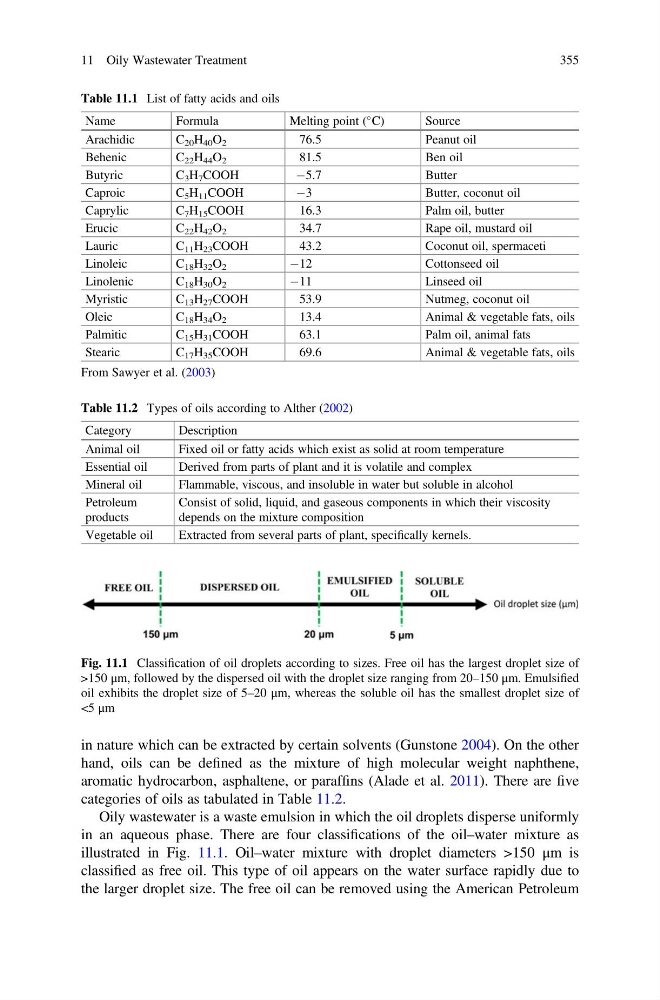
Oily wastewater is a waste emulsion in which the oil droplets disperse uniformly
in an aqueous phase. There are four classifications of the oil–water mixture as
illustrated in Fig. 11.1. Oil–water mixture with droplet diameters >150 μm is
classified as free oil. This type of oil appears on the water surface rapidly due to
the larger droplet size. The free oil can be removed using the American Petroleum
Table 11.1 List of fatty acids and oils
Name
Formula
Melting point (
C)
Source
Arachidic
C 20 H 40 O 2
76.5
Peanut oil
Behenic
C 22 H 44 O 2
81.5
Ben oil
Butyric
C 3 H 7 COOH
À5.7
Butter
Caproic
C 5 H 11 COOH
À3
Butter, coconut oil
Caprylic
C 7 H 15 COOH
16.3
Palm oil, butter
Erucic
C 22 H 42 O 2
34.7
Rape oil, mustard oil
Lauric
C 11 H 23 COOH
43.2
Coconut oil, spermaceti
Linoleic
C 18 H 32 O 2
À12
Cottonseed oil
Linolenic
C 18 H 30 O 2
À11
Linseed oil
Myristic
C 13 H 27 COOH
53.9
Nutmeg, coconut oil
Oleic
C 18 H 34 O 2
13.4
Animal & vegetable fats, oils
Palmitic
C 15 H 31 COOH
63.1
Palm oil, animal fats
Stearic
C 17 H 35 COOH
69.6
Animal & vegetable fats, oils
From Sawyer et al. (2003)
Table 11.2 Types of oils according to Alther (2002)
Category
Description
Animal oil
Fixed oil or fatty acids which exist as solid at room temperature
Essential oil
Derived from parts of plant and it is volatile and complex
Mineral oil
Flammable, viscous, and insoluble in water but soluble in alcohol
Petroleum
products
Consist of solid, liquid, and gaseous components in which their viscosity
depends on the mixture composition
Vegetable oil
Extracted from several parts of plant, specifically kernels.
Fig. 11.1 Classification of oil droplets according to sizes. Free oil has the largest droplet size of
>150 μm, followed by the dispersed oil with the droplet size ranging from 20–150 μm. Emulsified
oil exhibits the droplet size of 5–20 μm, whereas the soluble oil has the smallest droplet size of
<5 μm
11 Oily Wastewater Treatment
355
hand, oils can be defined as the mixture of high molecular weight naphthene,
aromatic hydrocarbon, asphaltene, or paraffins (Alade et al. 2011). There are five
categories of oils as tabulated in Table 11.2.
Oily wastewater is a waste emulsion in which the oil droplets disperse uniformly
in an aqueous phase. There are four classifications of the oil–water mixture as
illustrated in Fig. 11.1. Oil–water mixture with droplet diameters >150 μm is
classified as free oil. This type of oil appears on the water surface rapidly due to
the larger droplet size. The free oil can be removed using the American Petroleum
Table 11.1 List of fatty acids and oils
Name
Formula
Melting point (
C)
Source
Arachidic
C 20 H 40 O 2
76.5
Peanut oil
Behenic
C 22 H 44 O 2
81.5
Ben oil
Butyric
C 3 H 7 COOH
À5.7
Butter
Caproic
C 5 H 11 COOH
À3
Butter, coconut oil
Caprylic
C 7 H 15 COOH
16.3
Palm oil, butter
Erucic
C 22 H 42 O 2
34.7
Rape oil, mustard oil
Lauric
C 11 H 23 COOH
43.2
Coconut oil, spermaceti
Linoleic
C 18 H 32 O 2
À12
Cottonseed oil
Linolenic
C 18 H 30 O 2
À11
Linseed oil
Myristic
C 13 H 27 COOH
53.9
Nutmeg, coconut oil
Oleic
C 18 H 34 O 2
13.4
Animal & vegetable fats, oils
Palmitic
C 15 H 31 COOH
63.1
Palm oil, animal fats
Stearic
C 17 H 35 COOH
69.6
Animal & vegetable fats, oils
From Sawyer et al. (2003)
Table 11.2 Types of oils according to Alther (2002)
Category
Description
Animal oil
Fixed oil or fatty acids which exist as solid at room temperature
Essential oil
Derived from parts of plant and it is volatile and complex
Mineral oil
Flammable, viscous, and insoluble in water but soluble in alcohol
Petroleum
products
Consist of solid, liquid, and gaseous components in which their viscosity
depends on the mixture composition
Vegetable oil
Extracted from several parts of plant, specifically kernels.
Fig. 11.1 Classification of oil droplets according to sizes. Free oil has the largest droplet size of
>150 μm, followed by the dispersed oil with the droplet size ranging from 20–150 μm. Emulsified
oil exhibits the droplet size of 5–20 μm, whereas the soluble oil has the smallest droplet size of
<5 μm
11 Oily Wastewater Treatment
355