

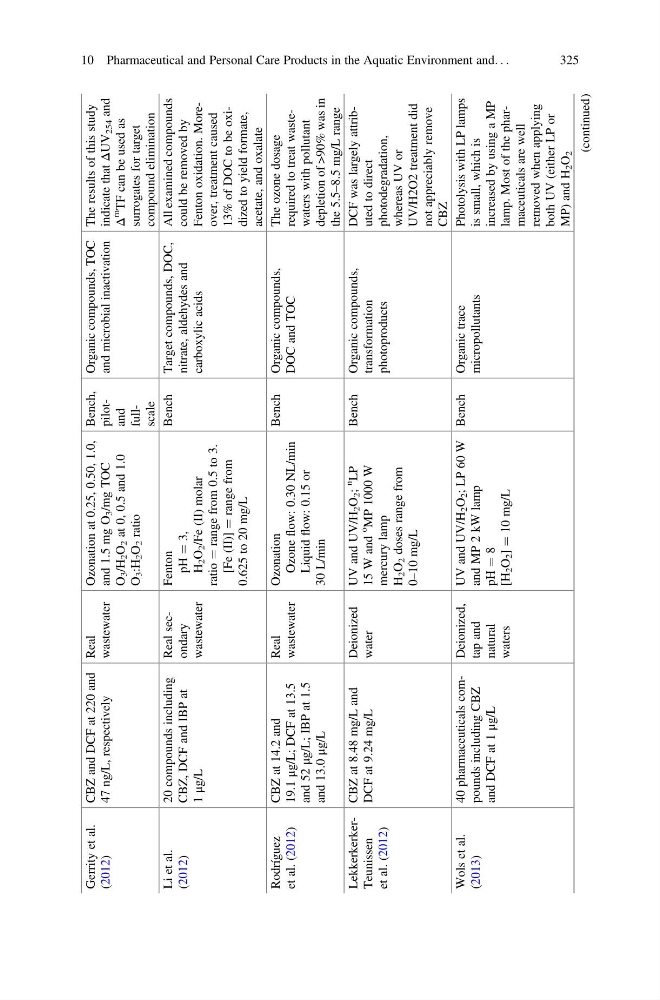
Gerrity et al.
(2012)
CBZ and DCF at 220 and
47 ng/L, respectively
Real
wastewater
Ozonation at 0.25, 0.50, 1.0,
and 1.5 mg O
3 /mg TOC
O
3 /H
2 O
2 at 0, 0.5 and 1.0
O
3 :H
2 O
2 ratio
Bench,
pilotand
fullscale
Organic compounds, TOC
and microbial inactivation
The results of this study
indicate that
ΔUV 254 and
Δ
m
TF can be used as
surrogates for target
compound elimination
Li et al.
(2012)
20 compounds including
CBZ, DCF and IBP at
1
μg/L
Real secondary
wastewater
Fenton
pH
¼ 3,
H
2 O
2 /Fe (II) molar
ratio
¼ range from 0.5 to 3.
[Fe (II)]
¼ range from
0.625 to 20 mg/L
Bench
Target compounds, DOC,
nitrate, aldehydes and
carboxylic acids
All examined compounds
could be removed by
Fenton oxidation. Moreover, treatment caused
13% of DOC to be oxidized to yield formate,
acetate, and oxalate
Rodríguez
et al. (2012)
CBZ at 14.2 and
19.1
μg/L; DCF at 13.5
and 52
μg/L; IBP at 1.5
and 13.0
μg/L
Real
wastewater
Ozonation
Ozone
flow: 0.30 NL/min
Liquid
flow: 0.15 or
30 L/min
Bench
Organic compounds,
DOC and TOC
The ozone dosage
required to treat wastewaters with pollutant
depletion of >90% was in
the 5.5–8.5 mg/L range
LekkerkerkerTeunissen
et al. (2012)
CBZ at 8.48 mg/L and
DCF at 9.24 mg/L
Deionized
water
UV and UV/H
2 O
2 ;
n
LP
15 W and
o
MP 1000 W
mercury lamp
H
2 O
2 doses range from
0–10 mg/L
Bench
Organic compounds,
transformation
photoproducts
DCF was largely attributed to direct
photodegradation,
whereas UV or
UV/H2O2 treatment did
not appreciably remove
CBZ
Wols et al.
(2013)
40 pharmaceuticals compounds including CBZ
and DCF at 1
μg/L
Deionized,
tap and
natural
waters
UV and UV/H
2 O
2 ; LP 60 W
and MP 2 kW lamp
pH
¼ 8
[H
2 O
2 ]
¼ 10 mg/L
Bench
Organic trace
micropollutants
Photolysis with LP lamps
is small, which is
increased by using a MP
lamp. Most of the pharmaceuticals are well
removed when applying
both UV (either LP or
MP) and H
2 O
2
(continued)
10 Pharmaceutical and Personal Care Products in the Aquatic Environment and. . .
325
(2012)
CBZ and DCF at 220 and
47 ng/L, respectively
Real
wastewater
Ozonation at 0.25, 0.50, 1.0,
and 1.5 mg O
3 /mg TOC
O
3 /H
2 O
2 at 0, 0.5 and 1.0
O
3 :H
2 O
2 ratio
Bench,
pilotand
fullscale
Organic compounds, TOC
and microbial inactivation
The results of this study
indicate that
ΔUV 254 and
Δ
m
TF can be used as
surrogates for target
compound elimination
Li et al.
(2012)
20 compounds including
CBZ, DCF and IBP at
1
μg/L
Real secondary
wastewater
Fenton
pH
¼ 3,
H
2 O
2 /Fe (II) molar
ratio
¼ range from 0.5 to 3.
[Fe (II)]
¼ range from
0.625 to 20 mg/L
Bench
Target compounds, DOC,
nitrate, aldehydes and
carboxylic acids
All examined compounds
could be removed by
Fenton oxidation. Moreover, treatment caused
13% of DOC to be oxidized to yield formate,
acetate, and oxalate
Rodríguez
et al. (2012)
CBZ at 14.2 and
19.1
μg/L; DCF at 13.5
and 52
μg/L; IBP at 1.5
and 13.0
μg/L
Real
wastewater
Ozonation
Ozone
flow: 0.30 NL/min
Liquid
flow: 0.15 or
30 L/min
Bench
Organic compounds,
DOC and TOC
The ozone dosage
required to treat wastewaters with pollutant
depletion of >90% was in
the 5.5–8.5 mg/L range
LekkerkerkerTeunissen
et al. (2012)
CBZ at 8.48 mg/L and
DCF at 9.24 mg/L
Deionized
water
UV and UV/H
2 O
2 ;
n
LP
15 W and
o
MP 1000 W
mercury lamp
H
2 O
2 doses range from
0–10 mg/L
Bench
Organic compounds,
transformation
photoproducts
DCF was largely attributed to direct
photodegradation,
whereas UV or
UV/H2O2 treatment did
not appreciably remove
CBZ
Wols et al.
(2013)
40 pharmaceuticals compounds including CBZ
and DCF at 1
μg/L
Deionized,
tap and
natural
waters
UV and UV/H
2 O
2 ; LP 60 W
and MP 2 kW lamp
pH
¼ 8
[H
2 O
2 ]
¼ 10 mg/L
Bench
Organic trace
micropollutants
Photolysis with LP lamps
is small, which is
increased by using a MP
lamp. Most of the pharmaceuticals are well
removed when applying
both UV (either LP or
MP) and H
2 O
2
(continued)
10 Pharmaceutical and Personal Care Products in the Aquatic Environment and. . .
325