

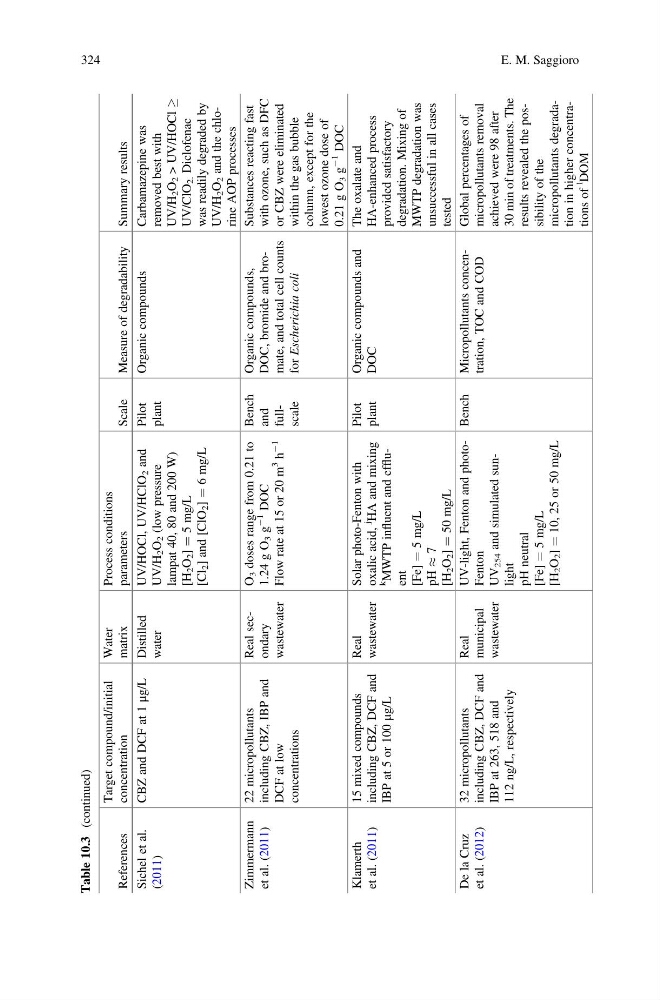
Table 10.3
(continued)
References
Target compound/initial
concentration
Water
matrix
Process conditions
parameters
Scale
Measure of degradability
Summary results
Sichel et al.
(2011)
CBZ and DCF at 1
μg/L
Distilled
water
UV/HOCl, UV/HClO
2 and
UV/H
2 O
2 (low pressure
lampat 40, 80 and 200 W)
[H
2 O
2 ]
¼ 5 mg/L
[Cl
2 ] and [ClO
2 ]
¼ 6 mg/L
Pilot
plant
Organic compounds
Carbamazepine was
removed best with
UV/H
2 O
2 > UV/HOCl
!
UV/ClO
2. Diclofenac
was readily degraded by
UV/H
2 O
2 and the chlorine AOP processes
Zimmermann
et al. (2011)
22 micropollutants
including CBZ, IBP and
DCF at low
concentrations
Real secondary
wastewater
O
3 doses range from 0.21 to
1.24 g O
3 g
À1
DOC
Flow rate at 15 or 20 m
3
h
À1
Bench
and
fullscale
Organic compounds,
DOC, bromide and bromate, and total cell counts
for Escherichia coli
Substances reacting fast
with ozone, such as DFC
or CBZ were eliminated
within the gas bubble
column, except for the
lowest ozone dose of
0.21 g O
3 g
À1
DOC
Klamerth
et al. (2011)
15 mixed compounds
including CBZ, DCF and
IBP at 5 or 100
μg/L
Real
wastewater
Solar photo-Fenton with
oxalic acid,
j
HA and mixing
k
MWTP influent and effluent
[Fe]
¼ 5 mg/L
pH
% 7
[H
2 O
2 ]
¼ 50 mg/L
Pilot
plant
Organic compounds and
DOC
The oxalate and
HA-enhanced process
provided satisfactory
degradation. Mixing of
MWTP degradation was
unsuccessful in all cases
tested
De la Cruz
et al. (2012)
32 micropollutants
including CBZ, DCF and
IBP at 263, 518 and
112 ng/L, respectively
Real
municipal
wastewater
UV-light, Fenton and photoFenton
UV
254 and simulated sunlight
pH neutral
[Fe]
¼ 5 mg/L
[H
2 O
2 ]
¼ 10, 25 or 50 mg/L
Bench
Micropollutants concentration, TOC and COD
Global percentages of
micropollutants removal
achieved were 98 after
30 min of treatments. The
results revealed the possibility of the
micropollutants degradation in higher concentrations of
l
DOM
324
E. M. Saggioro
(continued)
References
Target compound/initial
concentration
Water
matrix
Process conditions
parameters
Scale
Measure of degradability
Summary results
Sichel et al.
(2011)
CBZ and DCF at 1
μg/L
Distilled
water
UV/HOCl, UV/HClO
2 and
UV/H
2 O
2 (low pressure
lampat 40, 80 and 200 W)
[H
2 O
2 ]
¼ 5 mg/L
[Cl
2 ] and [ClO
2 ]
¼ 6 mg/L
Pilot
plant
Organic compounds
Carbamazepine was
removed best with
UV/H
2 O
2 > UV/HOCl
!
UV/ClO
2. Diclofenac
was readily degraded by
UV/H
2 O
2 and the chlorine AOP processes
Zimmermann
et al. (2011)
22 micropollutants
including CBZ, IBP and
DCF at low
concentrations
Real secondary
wastewater
O
3 doses range from 0.21 to
1.24 g O
3 g
À1
DOC
Flow rate at 15 or 20 m
3
h
À1
Bench
and
fullscale
Organic compounds,
DOC, bromide and bromate, and total cell counts
for Escherichia coli
Substances reacting fast
with ozone, such as DFC
or CBZ were eliminated
within the gas bubble
column, except for the
lowest ozone dose of
0.21 g O
3 g
À1
DOC
Klamerth
et al. (2011)
15 mixed compounds
including CBZ, DCF and
IBP at 5 or 100
μg/L
Real
wastewater
Solar photo-Fenton with
oxalic acid,
j
HA and mixing
k
MWTP influent and effluent
[Fe]
¼ 5 mg/L
pH
% 7
[H
2 O
2 ]
¼ 50 mg/L
Pilot
plant
Organic compounds and
DOC
The oxalate and
HA-enhanced process
provided satisfactory
degradation. Mixing of
MWTP degradation was
unsuccessful in all cases
tested
De la Cruz
et al. (2012)
32 micropollutants
including CBZ, DCF and
IBP at 263, 518 and
112 ng/L, respectively
Real
municipal
wastewater
UV-light, Fenton and photoFenton
UV
254 and simulated sunlight
pH neutral
[Fe]
¼ 5 mg/L
[H
2 O
2 ]
¼ 10, 25 or 50 mg/L
Bench
Micropollutants concentration, TOC and COD
Global percentages of
micropollutants removal
achieved were 98 after
30 min of treatments. The
results revealed the possibility of the
micropollutants degradation in higher concentrations of
l
DOM
324
E. M. Saggioro