

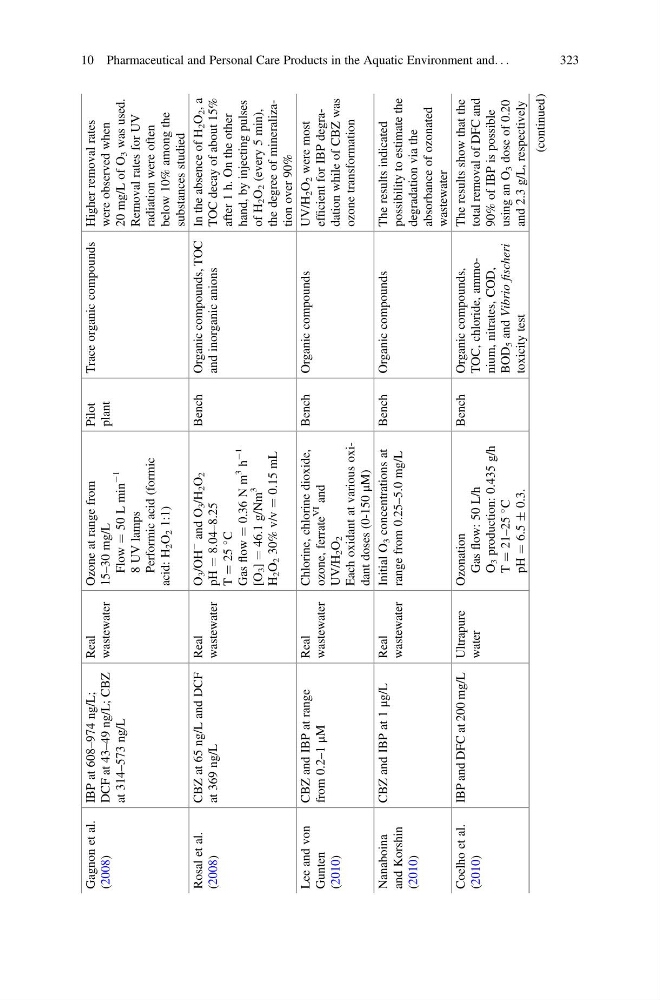
Gagnon et al.
(2008)
IBP at 608–974 ng/L;
DCF at 43–49 ng/L; CBZ
at 314–573 ng/L
Real
wastewater
Ozone at range from
15–30 mg/L
Flow
¼ 50 L min
À1
8 UV lamps
Performic acid (formic
acid: H
2 O
2 1:1)
Pilot
plant
Trace organic compounds Higher removal rates
were observed when
20 mg/L of O
3 was used.
Removal rates for UV
radiation were often
below 10% among the
substances studied
Rosal et al.
(2008)
CBZ at 65 ng/L and DCF
at 369 ng/L
Real
wastewater
O
3 /OH
À
and O
3 /H
2 O
2
pH
¼ 8.04–8.25
T
¼ 25
C
Gas
flow ¼ 0.36 N m
3
h
À1
[O
3 ]
¼ 46.1 g/Nm
3
H
2 O
2 30% v/v
¼ 0.15 mL
Bench
Organic compounds, TOC
and inorganic anions
In the absence of H
2 O
2 , a
TOC decay of about 15%
after 1 h. On the other
hand, by injecting pulses
of H
2 O
2 (every 5 min),
the degree of mineralization over 90%
Lee and von
Gunten
(2010)
CBZ and IBP at range
from 0.2–1
μM
Real
wastewater
Chlorine, chlorine dioxide,
ozone, ferrate
VI
and
UV/H
2 O
2
Each oxidant at various oxidant doses (0-150
μM)
Bench
Organic compounds
UV/H
2 O
2 were most
efficient for IBP degradation while of CBZ was
ozone transformation
Nanaboina
and Korshin
(2010)
CBZ and IBP at 1
μg/L
Real
wastewater
Initial O
3 concentrations at
range from 0.25–5.0 mg/L
Bench
Organic compounds
The results indicated
possibility to estimate the
degradation via the
absorbance of ozonated
wastewater
Coelho et al.
(2010)
IBP and DFC at 200 mg/L Ultrapure
water
Ozonation
Gas
flow: 50 L/h
O
3 production: 0.435 g/h
T
¼ 21–25
C
pH
¼ 6.5
Æ 0.3.
Bench
Organic compounds,
TOC, chloride, ammonium, nitrates, COD,
BOD
5 and Vibrio
fischeri
toxicity test
The results show that the
total removal of DFC and
90% of IBP is possible
using an O
3 dose of 0.20
and 2.3 g/L, respectively
(continued)
10 Pharmaceutical and Personal Care Products in the Aquatic Environment and. . .
323
(2008)
IBP at 608–974 ng/L;
DCF at 43–49 ng/L; CBZ
at 314–573 ng/L
Real
wastewater
Ozone at range from
15–30 mg/L
Flow
¼ 50 L min
À1
8 UV lamps
Performic acid (formic
acid: H
2 O
2 1:1)
Pilot
plant
Trace organic compounds Higher removal rates
were observed when
20 mg/L of O
3 was used.
Removal rates for UV
radiation were often
below 10% among the
substances studied
Rosal et al.
(2008)
CBZ at 65 ng/L and DCF
at 369 ng/L
Real
wastewater
O
3 /OH
À
and O
3 /H
2 O
2
pH
¼ 8.04–8.25
T
¼ 25
C
Gas
flow ¼ 0.36 N m
3
h
À1
[O
3 ]
¼ 46.1 g/Nm
3
H
2 O
2 30% v/v
¼ 0.15 mL
Bench
Organic compounds, TOC
and inorganic anions
In the absence of H
2 O
2 , a
TOC decay of about 15%
after 1 h. On the other
hand, by injecting pulses
of H
2 O
2 (every 5 min),
the degree of mineralization over 90%
Lee and von
Gunten
(2010)
CBZ and IBP at range
from 0.2–1
μM
Real
wastewater
Chlorine, chlorine dioxide,
ozone, ferrate
VI
and
UV/H
2 O
2
Each oxidant at various oxidant doses (0-150
μM)
Bench
Organic compounds
UV/H
2 O
2 were most
efficient for IBP degradation while of CBZ was
ozone transformation
Nanaboina
and Korshin
(2010)
CBZ and IBP at 1
μg/L
Real
wastewater
Initial O
3 concentrations at
range from 0.25–5.0 mg/L
Bench
Organic compounds
The results indicated
possibility to estimate the
degradation via the
absorbance of ozonated
wastewater
Coelho et al.
(2010)
IBP and DFC at 200 mg/L Ultrapure
water
Ozonation
Gas
flow: 50 L/h
O
3 production: 0.435 g/h
T
¼ 21–25
C
pH
¼ 6.5
Æ 0.3.
Bench
Organic compounds,
TOC, chloride, ammonium, nitrates, COD,
BOD
5 and Vibrio
fischeri
toxicity test
The results show that the
total removal of DFC and
90% of IBP is possible
using an O
3 dose of 0.20
and 2.3 g/L, respectively
(continued)
10 Pharmaceutical and Personal Care Products in the Aquatic Environment and. . .
323