

to the disappearance of triclosan. Using the same approach, Peng et al. (2016)
evaluated the optimum parameters such as temperature, pH, and hydrogen peroxide
and Cu
2+ concentrations of a Fenton-like Cu
2+ /hydrogen peroxide system. Triclosan
degradation rate constants follow pseudo-first-order kinetics, and quantitative
structure-activity relationship predicts the degradation of other chlorinated compounds containing a benzene ring structure.
Furthermore, the Fenton process, when applied irradiation at wavelengths higher
than 300 nm, is known as the photo-Fenton process. The degradation rate of organic
compounds using Fenton reagents is strongly accelerated by irradiation (e.g., photolysis of Fe
+3 allowing for Fe
+2 regeneration). Son et al. (2010) investigated
triclosan degradation under the Fenton reaction using only ultraviolet-C and a
combined Fenton/ultraviolet-C system. The results revealed that triclosan was
completely degraded after 90 min under ultraviolet-C and after 30 min in the Fe
+2 /
ultraviolet-C system. The use of ultraviolet-C instead of hydrogen peroxide displays
advantages, as it is not necessary to adjust the system to low pH and there is no use of
expensive reagents, such as hydrogen peroxide. Klamerth et al. (2010a,b) conducted
2 studies with 15 mixed contaminants at low concentrations in a solar pilot plant
Photo-Fenton reaction. First, the authors used a real wastewater effluent with total
volume of 250 L under several Photo-Fenton conditions. Subsequently, they
conducted a second study using three different water matrices, with a total volume
of 35 L under mild Photo-Fenton conditions, and performed toxicity testing using
Vibrio fischeri. The authors concluded that pharmaceuticals and personal care
products can be successfully degraded by applying the Photo-Fenton process at a
Fenton-like oxidation
Hydroxylation with
dechlorination
HO ·
HO ·
Primary products from triclosan
oxidation
EC 50 = 0.25 mg/L
EC 50 = 4.9 mg/L
EC 50 = 15.3 mg/L
OH
OH
O
O
CI
a tt a c k
o f o r th
o - p o s it io
n
a tt a c k
o f p a r a - p o s it io
n
CI
CI
CI
CI
CI
CI
CI
OH
OH
OH
OH
HO
HO
+
+
OH
Hydroxylation without
dechlorination
3,5-dichlorobenzene-1,2-diol
(ortho-hydroxylation)
4,6-dichlorobenzene-1,3-diol
(meta-hydroxylation)
4-chlorocathecol
2,4-dichlorophenol
CI
p-hydroquinone
Ecotoxicity decreased
(Vibrio fischeri)
CI
CI
CI
CI
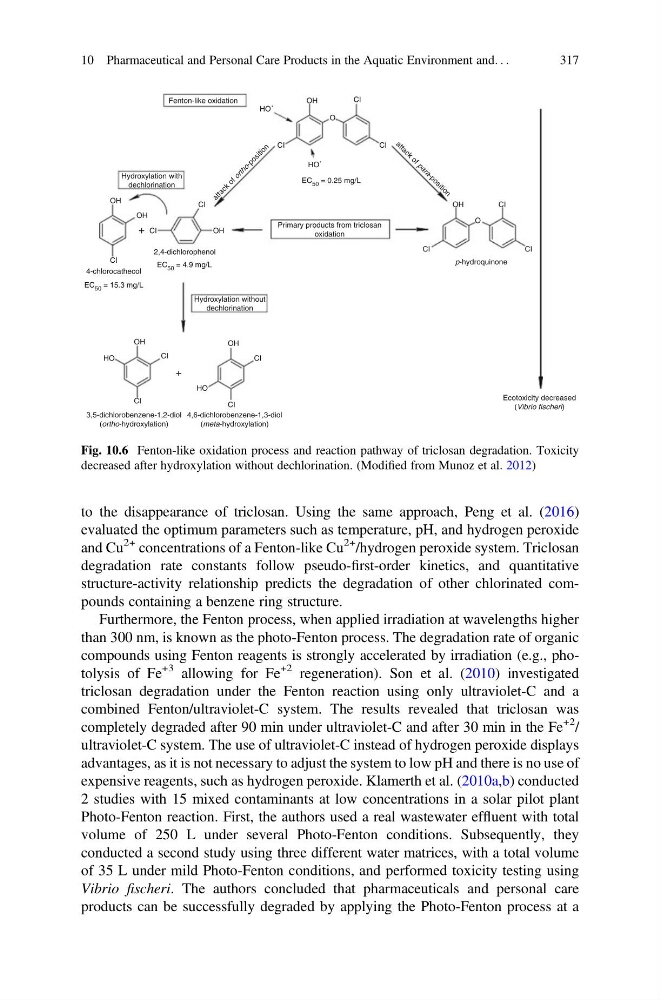
Fig. 10.6 Fenton-like oxidation process and reaction pathway of triclosan degradation. Toxicity
decreased after hydroxylation without dechlorination. (Modified from Munoz et al. 2012)
10 Pharmaceutical and Personal Care Products in the Aquatic Environment and. . .
317
evaluated the optimum parameters such as temperature, pH, and hydrogen peroxide
and Cu
2+ concentrations of a Fenton-like Cu
2+ /hydrogen peroxide system. Triclosan
degradation rate constants follow pseudo-first-order kinetics, and quantitative
structure-activity relationship predicts the degradation of other chlorinated compounds containing a benzene ring structure.
Furthermore, the Fenton process, when applied irradiation at wavelengths higher
than 300 nm, is known as the photo-Fenton process. The degradation rate of organic
compounds using Fenton reagents is strongly accelerated by irradiation (e.g., photolysis of Fe
+3 allowing for Fe
+2 regeneration). Son et al. (2010) investigated
triclosan degradation under the Fenton reaction using only ultraviolet-C and a
combined Fenton/ultraviolet-C system. The results revealed that triclosan was
completely degraded after 90 min under ultraviolet-C and after 30 min in the Fe
+2 /
ultraviolet-C system. The use of ultraviolet-C instead of hydrogen peroxide displays
advantages, as it is not necessary to adjust the system to low pH and there is no use of
expensive reagents, such as hydrogen peroxide. Klamerth et al. (2010a,b) conducted
2 studies with 15 mixed contaminants at low concentrations in a solar pilot plant
Photo-Fenton reaction. First, the authors used a real wastewater effluent with total
volume of 250 L under several Photo-Fenton conditions. Subsequently, they
conducted a second study using three different water matrices, with a total volume
of 35 L under mild Photo-Fenton conditions, and performed toxicity testing using
Vibrio fischeri. The authors concluded that pharmaceuticals and personal care
products can be successfully degraded by applying the Photo-Fenton process at a
Fenton-like oxidation
Hydroxylation with
dechlorination
HO ·
HO ·
Primary products from triclosan
oxidation
EC 50 = 0.25 mg/L
EC 50 = 4.9 mg/L
EC 50 = 15.3 mg/L
OH
OH
O
O
CI
a tt a c k
o f o r th
o - p o s it io
n
a tt a c k
o f p a r a - p o s it io
n
CI
CI
CI
CI
CI
CI
CI
OH
OH
OH
OH
HO
HO
+
+
OH
Hydroxylation without
dechlorination
3,5-dichlorobenzene-1,2-diol
(ortho-hydroxylation)
4,6-dichlorobenzene-1,3-diol
(meta-hydroxylation)
4-chlorocathecol
2,4-dichlorophenol
CI
p-hydroquinone
Ecotoxicity decreased
(Vibrio fischeri)
CI
CI
CI
CI
Fig. 10.6 Fenton-like oxidation process and reaction pathway of triclosan degradation. Toxicity
decreased after hydroxylation without dechlorination. (Modified from Munoz et al. 2012)
10 Pharmaceutical and Personal Care Products in the Aquatic Environment and. . .
317