

low iron concentrations and moderate hydrogen peroxide doses (iron/hydrogen
peroxide ratio 5:50 mg L
À1 ). At the other hand, the toxicity increased during
phodegradation process in wastewater, demonstrating several toxic intermediates.
Thus, the authors stressed the importance to perform toxicity evaluation during
photodegradation process as an alternative tool to evaluate the potential reuse of
wastewater treated.
Recently, studies have applied ultraviolet/chlorine as advanced oxidation processes, exploring the production of
● OH radicals from the photolysis of free
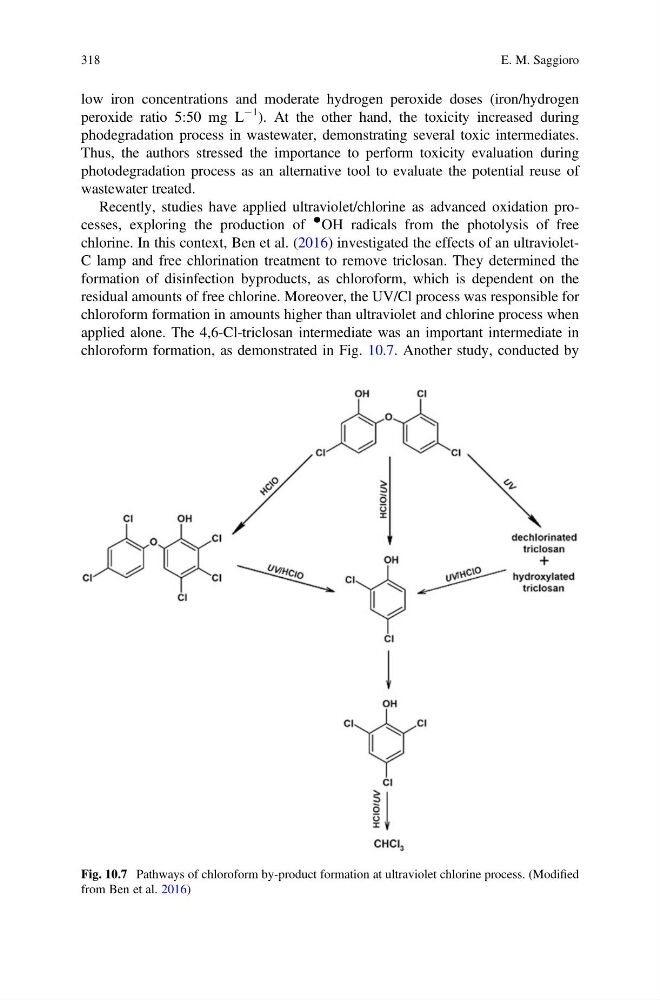
chlorine. In this context, Ben et al. (2016) investigated the effects of an ultravioletC lamp and free chlorination treatment to remove triclosan. They determined the
formation of disinfection byproducts, as chloroform, which is dependent on the
residual amounts of free chlorine. Moreover, the UV/Cl process was responsible for
chloroform formation in amounts higher than ultraviolet and chlorine process when
applied alone. The 4,6-Cl-triclosan intermediate was an important intermediate in
chloroform formation, as demonstrated in Fig. 10.7. Another study, conducted by
Fig. 10.7 Pathways of chloroform by-product formation at ultraviolet chlorine process. (Modified
from Ben et al. 2016)
318
E. M. Saggioro
peroxide ratio 5:50 mg L
À1 ). At the other hand, the toxicity increased during
phodegradation process in wastewater, demonstrating several toxic intermediates.
Thus, the authors stressed the importance to perform toxicity evaluation during
photodegradation process as an alternative tool to evaluate the potential reuse of
wastewater treated.
Recently, studies have applied ultraviolet/chlorine as advanced oxidation processes, exploring the production of
● OH radicals from the photolysis of free
chlorine. In this context, Ben et al. (2016) investigated the effects of an ultravioletC lamp and free chlorination treatment to remove triclosan. They determined the
formation of disinfection byproducts, as chloroform, which is dependent on the
residual amounts of free chlorine. Moreover, the UV/Cl process was responsible for
chloroform formation in amounts higher than ultraviolet and chlorine process when
applied alone. The 4,6-Cl-triclosan intermediate was an important intermediate in
chloroform formation, as demonstrated in Fig. 10.7. Another study, conducted by
Fig. 10.7 Pathways of chloroform by-product formation at ultraviolet chlorine process. (Modified
from Ben et al. 2016)
318
E. M. Saggioro