

compound, as well as for the generated
● OH species. Chen et al. (2012) investigated
triclosan ozonation and its degradation products formed, as well as the cytotoxicity
and genotoxicity of the system. Triclosan was completely mineralized at a molar
ratio of triclosan/ozone dose ¼ 1:5. The active metabolite 2,4-dichlorophenolwas
verified as the major metabolite during ozone process. However, the genotoxicity
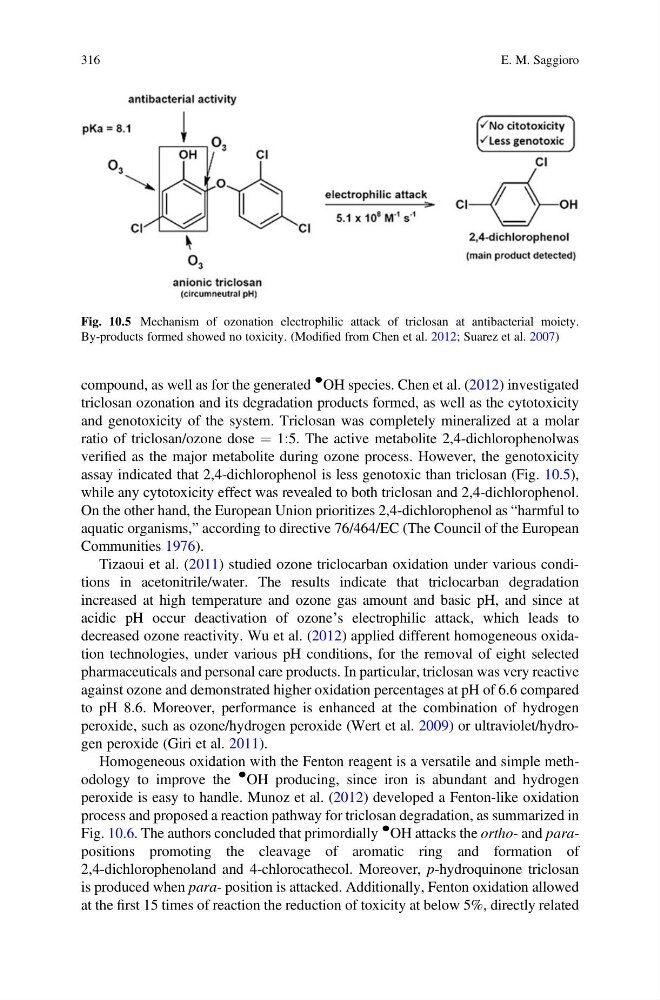
assay indicated that 2,4-dichlorophenol is less genotoxic than triclosan (Fig. 10.5),
while any cytotoxicity effect was revealed to both triclosan and 2,4-dichlorophenol.
On the other hand, the European Union prioritizes 2,4-dichlorophenol as “harmful to
aquatic organisms,” according to directive 76/464/EC (The Council of the European
Communities 1976).
Tizaoui et al. (2011) studied ozone triclocarban oxidation under various conditions in acetonitrile/water. The results indicate that triclocarban degradation
increased at high temperature and ozone gas amount and basic pH, and since at
acidic pH occur deactivation of ozone’s electrophilic attack, which leads to
decreased ozone reactivity. Wu et al. (2012) applied different homogeneous oxidation technologies, under various pH conditions, for the removal of eight selected
pharmaceuticals and personal care products. In particular, triclosan was very reactive
against ozone and demonstrated higher oxidation percentages at pH of 6.6 compared
to pH 8.6. Moreover, performance is enhanced at the combination of hydrogen
peroxide, such as ozone/hydrogen peroxide (Wert et al. 2009) or ultraviolet/hydrogen peroxide (Giri et al. 2011).
Homogeneous oxidation with the Fenton reagent is a versatile and simple methodology to improve the
●
OH producing, since iron is abundant and hydrogen
peroxide is easy to handle. Munoz et al. (2012) developed a Fenton-like oxidation
process and proposed a reaction pathway for triclosan degradation, as summarized in
Fig. 10.6. The authors concluded that primordially
●
OH attacks the ortho- and parapositions promoting the cleavage of aromatic ring and formation of
2,4-dichlorophenoland and 4-chlorocathecol. Moreover, p-hydroquinone triclosan
is produced when para- position is attacked. Additionally, Fenton oxidation allowed
at the first 15 times of reaction the reduction of toxicity at below 5%, directly related
Fig. 10.5 Mechanism of ozonation electrophilic attack of triclosan at antibacterial moiety.
By-products formed showed no toxicity. (Modified from Chen et al. 2012; Suarez et al. 2007)
316
E. M. Saggioro
● OH species. Chen et al. (2012) investigated
triclosan ozonation and its degradation products formed, as well as the cytotoxicity
and genotoxicity of the system. Triclosan was completely mineralized at a molar
ratio of triclosan/ozone dose ¼ 1:5. The active metabolite 2,4-dichlorophenolwas
verified as the major metabolite during ozone process. However, the genotoxicity
assay indicated that 2,4-dichlorophenol is less genotoxic than triclosan (Fig. 10.5),
while any cytotoxicity effect was revealed to both triclosan and 2,4-dichlorophenol.
On the other hand, the European Union prioritizes 2,4-dichlorophenol as “harmful to
aquatic organisms,” according to directive 76/464/EC (The Council of the European
Communities 1976).
Tizaoui et al. (2011) studied ozone triclocarban oxidation under various conditions in acetonitrile/water. The results indicate that triclocarban degradation
increased at high temperature and ozone gas amount and basic pH, and since at
acidic pH occur deactivation of ozone’s electrophilic attack, which leads to
decreased ozone reactivity. Wu et al. (2012) applied different homogeneous oxidation technologies, under various pH conditions, for the removal of eight selected
pharmaceuticals and personal care products. In particular, triclosan was very reactive
against ozone and demonstrated higher oxidation percentages at pH of 6.6 compared
to pH 8.6. Moreover, performance is enhanced at the combination of hydrogen
peroxide, such as ozone/hydrogen peroxide (Wert et al. 2009) or ultraviolet/hydrogen peroxide (Giri et al. 2011).
Homogeneous oxidation with the Fenton reagent is a versatile and simple methodology to improve the
●
OH producing, since iron is abundant and hydrogen
peroxide is easy to handle. Munoz et al. (2012) developed a Fenton-like oxidation
process and proposed a reaction pathway for triclosan degradation, as summarized in
Fig. 10.6. The authors concluded that primordially
●
OH attacks the ortho- and parapositions promoting the cleavage of aromatic ring and formation of
2,4-dichlorophenoland and 4-chlorocathecol. Moreover, p-hydroquinone triclosan
is produced when para- position is attacked. Additionally, Fenton oxidation allowed
at the first 15 times of reaction the reduction of toxicity at below 5%, directly related
Fig. 10.5 Mechanism of ozonation electrophilic attack of triclosan at antibacterial moiety.
By-products formed showed no toxicity. (Modified from Chen et al. 2012; Suarez et al. 2007)
316
E. M. Saggioro