

concentration, the presence of anions and humic acid, and several concentrations of
TiO 2 suspensions. The findings demonstrated that the initial triclocarban concentration and the presence of anions and humic acid negatively affect the degradation rate,
while increases in pH produce a substantial improvement in the photocatalysis
process. Unexpectedly, higher triclocarban degradation rates were observed by
direct photolysis compared to TiO 2 photocatalysis. This fact was assigned to the
negative effect of light scattering that was more pronounced than the hydroxyl
radical reaction. Moreover, triclocarban molecule has a chlorine atom that hinders
electrophilic attack of the
● OH to the benzene ring. Finally, the main degradation
products, as 4-chloroisocyanatobenzene, 3,4-dichloroaniline, 4-chloronitrobenzene,
and 4-chloroaniline, were detected and identified.
Homogeneous Oxidation Processes
A homogeneous advanced oxidation processes are a system in which both the
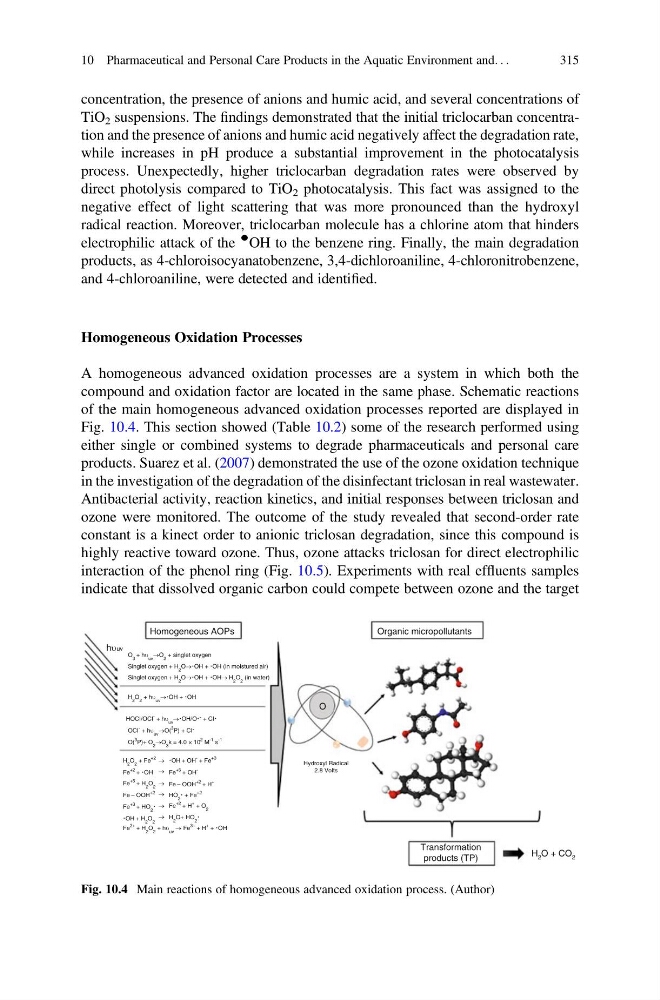
compound and oxidation factor are located in the same phase. Schematic reactions
of the main homogeneous advanced oxidation processes reported are displayed in
Fig. 10.4. This section showed (Table 10.2) some of the research performed using
either single or combined systems to degrade pharmaceuticals and personal care
products. Suarez et al. (2007) demonstrated the use of the ozone oxidation technique
in the investigation of the degradation of the disinfectant triclosan in real wastewater.
Antibacterial activity, reaction kinetics, and initial responses between triclosan and
ozone were monitored. The outcome of the study revealed that second-order rate
constant is a kinect order to anionic triclosan degradation, since this compound is
highly reactive toward ozone. Thus, ozone attacks triclosan for direct electrophilic
interaction of the phenol ring (Fig. 10.5). Experiments with real effluents samples
indicate that dissolved organic carbon could compete between ozone and the target
Homogeneous AOPs
O
Organic micropollutants
Transformation
products (TP)
H 2 O + CO 2
Hydroxyl Radical
2.8 Volts
huuv
O
3 + hu uv
®O 2 + singlet oxygen
H 2 O 2 + hu uv
®·OH + ·OH
H 2 O 2 + Fe +2
Fe +2 + ·OH
Fe
2+ + H 2 O 2 + hu uv
Fe +5 + H 2 O 2
Fe +5 + OH -
·OH + OH - + Fe +3
Fe – OOH +2
Fe – OOH +2 + H +
Fe +3 + HO 2
·
HO 2
· + Fe +2
Fe +2 + H + + O 2
Fe 3+ + H + + ·OH
·OH + H 2 O 2
H 2 O+ HO 2 ·
HOCI/OCI - + hu uv
®·OH/O·- + CI·
OCI - + hu uv ®O( 3 P) + CIO( 3 P)+ O 2
®O 3 k = 4.0 × 10 2 M -1 s -1
®
®
®
®
®
®
®
Singlet oxygen + H
2
O®·OH + ·OH (in moistured air)
Singlet oxygen + H 2 O®·OH + ·OH® H 2 O 2 (in water)
Fig. 10.4 Main reactions of homogeneous advanced oxidation process. (Author)
10 Pharmaceutical and Personal Care Products in the Aquatic Environment and. . .
315
TiO 2 suspensions. The findings demonstrated that the initial triclocarban concentration and the presence of anions and humic acid negatively affect the degradation rate,
while increases in pH produce a substantial improvement in the photocatalysis
process. Unexpectedly, higher triclocarban degradation rates were observed by
direct photolysis compared to TiO 2 photocatalysis. This fact was assigned to the
negative effect of light scattering that was more pronounced than the hydroxyl
radical reaction. Moreover, triclocarban molecule has a chlorine atom that hinders
electrophilic attack of the
● OH to the benzene ring. Finally, the main degradation
products, as 4-chloroisocyanatobenzene, 3,4-dichloroaniline, 4-chloronitrobenzene,
and 4-chloroaniline, were detected and identified.
Homogeneous Oxidation Processes
A homogeneous advanced oxidation processes are a system in which both the
compound and oxidation factor are located in the same phase. Schematic reactions
of the main homogeneous advanced oxidation processes reported are displayed in
Fig. 10.4. This section showed (Table 10.2) some of the research performed using
either single or combined systems to degrade pharmaceuticals and personal care
products. Suarez et al. (2007) demonstrated the use of the ozone oxidation technique
in the investigation of the degradation of the disinfectant triclosan in real wastewater.
Antibacterial activity, reaction kinetics, and initial responses between triclosan and
ozone were monitored. The outcome of the study revealed that second-order rate
constant is a kinect order to anionic triclosan degradation, since this compound is
highly reactive toward ozone. Thus, ozone attacks triclosan for direct electrophilic
interaction of the phenol ring (Fig. 10.5). Experiments with real effluents samples
indicate that dissolved organic carbon could compete between ozone and the target
Homogeneous AOPs
O
Organic micropollutants
Transformation
products (TP)
H 2 O + CO 2
Hydroxyl Radical
2.8 Volts
huuv
O
3 + hu uv
®O 2 + singlet oxygen
H 2 O 2 + hu uv
®·OH + ·OH
H 2 O 2 + Fe +2
Fe +2 + ·OH
Fe
2+ + H 2 O 2 + hu uv
Fe +5 + H 2 O 2
Fe +5 + OH -
·OH + OH - + Fe +3
Fe – OOH +2
Fe – OOH +2 + H +
Fe +3 + HO 2
·
HO 2
· + Fe +2
Fe +2 + H + + O 2
Fe 3+ + H + + ·OH
·OH + H 2 O 2
H 2 O+ HO 2 ·
HOCI/OCI - + hu uv
®·OH/O·- + CI·
OCI - + hu uv ®O( 3 P) + CIO( 3 P)+ O 2
®O 3 k = 4.0 × 10 2 M -1 s -1
®
®
®
®
®
®
®
Singlet oxygen + H
2
O®·OH + ·OH (in moistured air)
Singlet oxygen + H 2 O®·OH + ·OH® H 2 O 2 (in water)
Fig. 10.4 Main reactions of homogeneous advanced oxidation process. (Author)
10 Pharmaceutical and Personal Care Products in the Aquatic Environment and. . .
315