

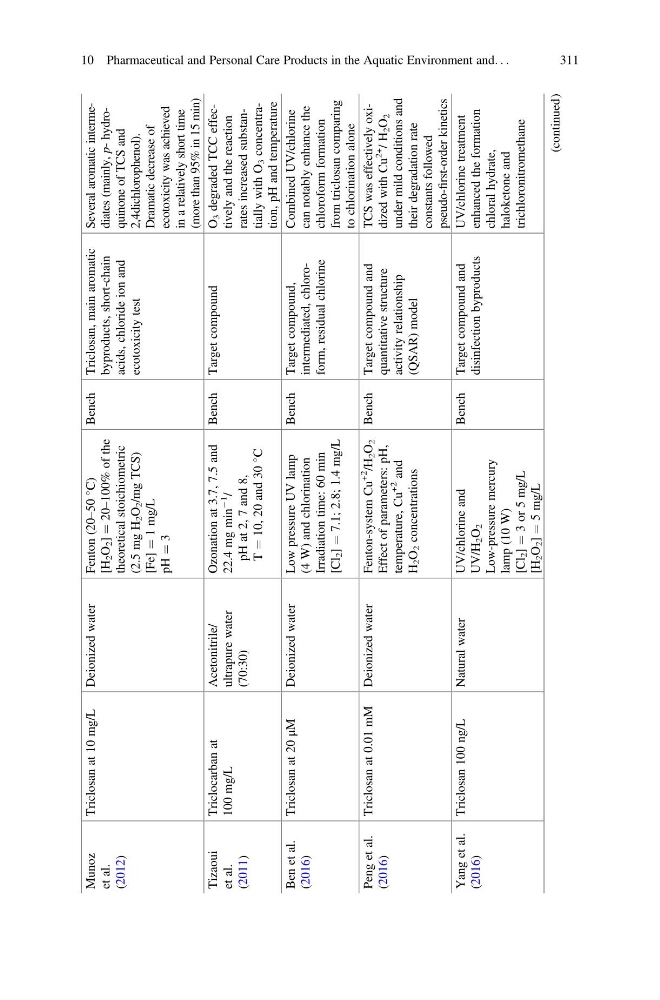
Munoz
et al.
(2012)
Triclosan at 10 mg/L
Deionized water
Fenton (20–50
C)
[H
2 O
2 ]
¼ 20–100% of the
theoretical stoichiometric
(2.5 mg H
2 O
2 /mg TCS)
[Fe]
¼ 1 mg/L
pH
¼ 3
Bench Triclosan, main aromatic
byproducts, short-chain
acids, chloride ion and
ecotoxicity test
Several aromatic intermediates
hydroquinone of TCS and
2,4dichlorophenol).
Dramatic decrease of
ecotoxicity was achieved
in a relatively short time
(more than 95% in 15 min)
Tizaoui
et al.
(2011)
Triclocarban at
100 mg/L
Acetonitrile/
ultrapure water
(70:30)
Ozonation at 3.7, 7.5 and
22.4 mg min
À1
/
pH at 2, 7 and 8,
T
¼ 10, 20 and 30
C
Bench Target compound
O
3 degraded TCC effectively and the reaction
rates increased substantially with O
3 concentration, pH and temperature
Ben et al.
(2016)
Triclosan at 20
μM
Deionized water
Low pressure UV lamp
(4 W) and chlorination
Irradiation time: 60 min
[Cl
2 ]
¼ 7.1; 2.8; 1.4 mg/L
Bench Target compound,
intermediated, chloroform, residual chlorine
Combined UV/chlorine
can notably enhance the
chloroform formation
from triclosan comparing
to chlorination alone
Peng et al.
(2016)
Triclosan at 0.01 mM Deionized water
Fenton-system Cu
+2
/H
2 O
2
Effect of parameters: pH,
temperature, Cu
+2
and
H
2 O
2 concentrations
Bench Target compound and
quantitative structure
activity relationship
(QSAR) model
TCS was effectively oxidized with Cu
2+
/ H
2 O
2
under mild conditions and
their degradation rate
constants followed
pseudo-first-order kinetics
Yang et al.
(2016)
Triclosan 100 ng/L
Natural water
UV/chlorine and
UV/H
2 O
2
Low-pressure mercury
lamp (10 W)
[Cl
2 ]
¼ 3 or 5 mg/L
[H
2 O
2 ]
¼ 5 mg/L
Bench Target compound and
disinfection byproducts
UV/chlorine treatment
enhanced the formation
chloral hydrate,
haloketone and
trichloronitromethane
(continued)
10 Pharmaceutical and Personal Care Products in the Aquatic Environment and. . .
311
et al.
(2012)
Triclosan at 10 mg/L
Deionized water
Fenton (20–50
C)
[H
2 O
2 ]
¼ 20–100% of the
theoretical stoichiometric
(2.5 mg H
2 O
2 /mg TCS)
[Fe]
¼ 1 mg/L
pH
¼ 3
Bench Triclosan, main aromatic
byproducts, short-chain
acids, chloride ion and
ecotoxicity test
Several aromatic intermediates
hydroquinone of TCS and
2,4dichlorophenol).
Dramatic decrease of
ecotoxicity was achieved
in a relatively short time
(more than 95% in 15 min)
Tizaoui
et al.
(2011)
Triclocarban at
100 mg/L
Acetonitrile/
ultrapure water
(70:30)
Ozonation at 3.7, 7.5 and
22.4 mg min
À1
/
pH at 2, 7 and 8,
T
¼ 10, 20 and 30
C
Bench Target compound
O
3 degraded TCC effectively and the reaction
rates increased substantially with O
3 concentration, pH and temperature
Ben et al.
(2016)
Triclosan at 20
μM
Deionized water
Low pressure UV lamp
(4 W) and chlorination
Irradiation time: 60 min
[Cl
2 ]
¼ 7.1; 2.8; 1.4 mg/L
Bench Target compound,
intermediated, chloroform, residual chlorine
Combined UV/chlorine
can notably enhance the
chloroform formation
from triclosan comparing
to chlorination alone
Peng et al.
(2016)
Triclosan at 0.01 mM Deionized water
Fenton-system Cu
+2
/H
2 O
2
Effect of parameters: pH,
temperature, Cu
+2
and
H
2 O
2 concentrations
Bench Target compound and
quantitative structure
activity relationship
(QSAR) model
TCS was effectively oxidized with Cu
2+
/ H
2 O
2
under mild conditions and
their degradation rate
constants followed
pseudo-first-order kinetics
Yang et al.
(2016)
Triclosan 100 ng/L
Natural water
UV/chlorine and
UV/H
2 O
2
Low-pressure mercury
lamp (10 W)
[Cl
2 ]
¼ 3 or 5 mg/L
[H
2 O
2 ]
¼ 5 mg/L
Bench Target compound and
disinfection byproducts
UV/chlorine treatment
enhanced the formation
chloral hydrate,
haloketone and
trichloronitromethane
(continued)
10 Pharmaceutical and Personal Care Products in the Aquatic Environment and. . .
311