

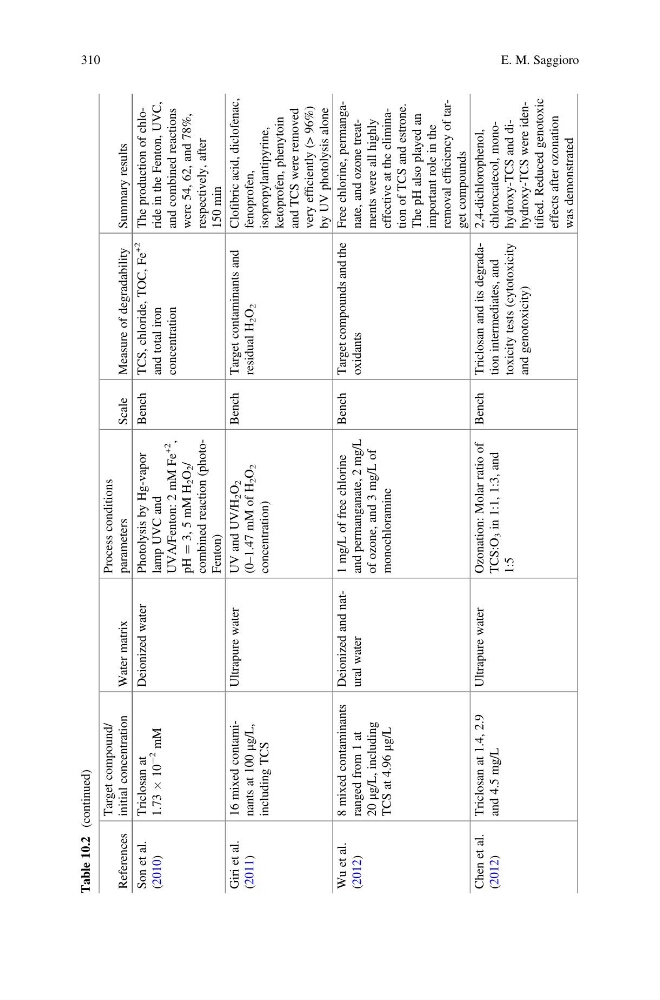
Table 10.2
(continued)
References
Target compound/
initial concentration
Water matrix
Process conditions
parameters
Scale
Measure of degradability
Summary results
Son et al.
(2010)
Triclosan at
1.73
 10
À2
mM
Deionized water
Photolysis by Hg-vapor
lamp UVC and
UVA/Fenton: 2 mM Fe
+2
,
pH
¼ 3, 5 mM H
2 O
2 /
combined reaction (photoFenton)
Bench TCS, chloride, TOC, Fe
+2
and total iron
concentration
The production of chloride in the Fenton, UVC,
and combined reactions
were 54, 62, and 78%,
respectively, after
150 min
Giri et al.
(2011)
16 mixed contaminants at 100
μg/L,
including TCS
Ultrapure water
UV and UV/H
2 O
2
(0–1.47 mM of H
2 O
2
concentration)
Bench Target contaminants and
residual H
2 O
2
Clofibric acid, diclofenac,
fenoprofen,
isopropylantipyrine,
ketoprofen, phenytoin
and TCS were removed
very efficiently (> 96%)
by UV photolysis alone
Wu et al.
(2012)
8 mixed contaminants
ranged from 1 at
20
μg/L, including
TCS at 4.96
μg/L
Deionized and natural water
1 mg/L of free chlorine
and permanganate, 2 mg/L
of ozone, and 3 mg/L of
monochloramine
Bench Target compounds and the
oxidants
Free chlorine, permanganate, and ozone treatments were all highly
effective at the elimination of TCS and estrone.
The pH also played an
important role in the
removal efficiency of target compounds
Chen et al.
(2012)
Triclosan at 1.4, 2.9
and 4.5 mg/L
Ultrapure water
Ozonation: Molar ratio of
TCS:O
3 in 1:1, 1:3, and
1:5
Bench Triclosan and its degradation intermediates, and
toxicity tests (cytotoxicity
and genotoxicity)
2,4-dichlorophenol,
chlorocatecol, monohydroxy-TCS and dihydroxy-TCS were identified. Reduced genotoxic
effects after ozonation
was demonstrated
310
E. M. Saggioro
(continued)
References
Target compound/
initial concentration
Water matrix
Process conditions
parameters
Scale
Measure of degradability
Summary results
Son et al.
(2010)
Triclosan at
1.73
 10
À2
mM
Deionized water
Photolysis by Hg-vapor
lamp UVC and
UVA/Fenton: 2 mM Fe
+2
,
pH
¼ 3, 5 mM H
2 O
2 /
combined reaction (photoFenton)
Bench TCS, chloride, TOC, Fe
+2
and total iron
concentration
The production of chloride in the Fenton, UVC,
and combined reactions
were 54, 62, and 78%,
respectively, after
150 min
Giri et al.
(2011)
16 mixed contaminants at 100
μg/L,
including TCS
Ultrapure water
UV and UV/H
2 O
2
(0–1.47 mM of H
2 O
2
concentration)
Bench Target contaminants and
residual H
2 O
2
Clofibric acid, diclofenac,
fenoprofen,
isopropylantipyrine,
ketoprofen, phenytoin
and TCS were removed
very efficiently (> 96%)
by UV photolysis alone
Wu et al.
(2012)
8 mixed contaminants
ranged from 1 at
20
μg/L, including
TCS at 4.96
μg/L
Deionized and natural water
1 mg/L of free chlorine
and permanganate, 2 mg/L
of ozone, and 3 mg/L of
monochloramine
Bench Target compounds and the
oxidants
Free chlorine, permanganate, and ozone treatments were all highly
effective at the elimination of TCS and estrone.
The pH also played an
important role in the
removal efficiency of target compounds
Chen et al.
(2012)
Triclosan at 1.4, 2.9
and 4.5 mg/L
Ultrapure water
Ozonation: Molar ratio of
TCS:O
3 in 1:1, 1:3, and
1:5
Bench Triclosan and its degradation intermediates, and
toxicity tests (cytotoxicity
and genotoxicity)
2,4-dichlorophenol,
chlorocatecol, monohydroxy-TCS and dihydroxy-TCS were identified. Reduced genotoxic
effects after ozonation
was demonstrated
310
E. M. Saggioro