

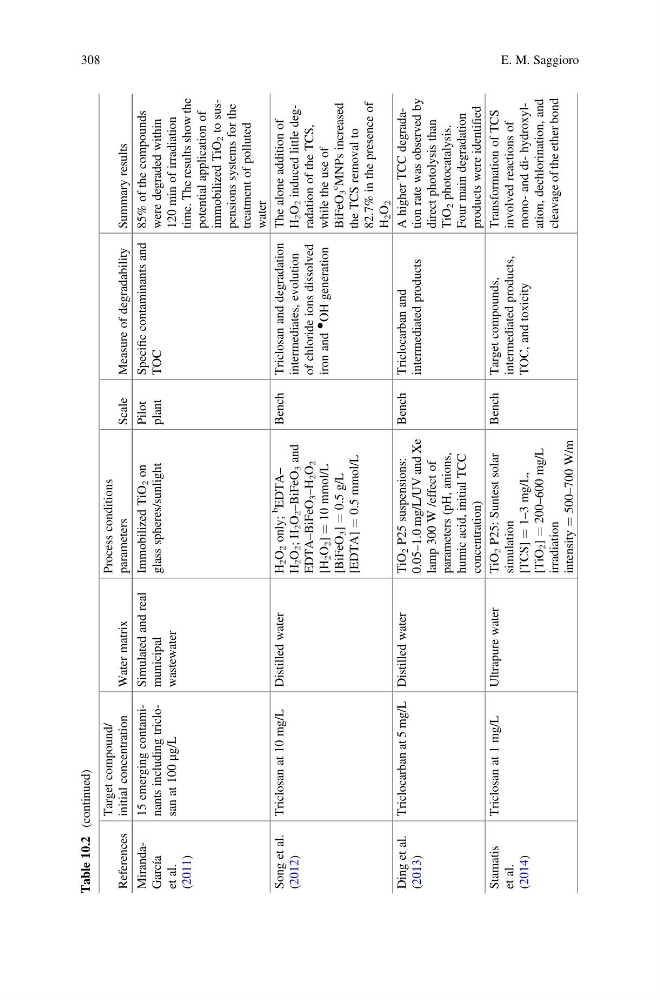
Table 10.2
(continued)
References
Target compound/
initial concentration
Water matrix
Process conditions
parameters
Scale
Measure of degradability
Summary results
MirandaGarcía
et al.
(2011)
15 emerging contaminants including triclosan at 100
μg/L
Simulated and real
municipal
wastewater
Immobilized TiO
2 on
glass spheres/sunlight
Pilot
plant
Specific contaminants and
TOC
85% of the compounds
were degraded within
120 min of irradiation
time. The results show the
potential application of
immobilized TiO
2 to suspensions systems for the
treatment of polluted
water
Song et al.
(2012)
Triclosan at 10 mg/L
Distilled water
H
2 O
2 only;
b
EDTA–
H
2 O
2 ; H
2 O
2
–BiFeO 3 and
EDTA–BiFeO
3
–H 2 O
2
[H
2 O
2 ]
¼ 10 mmol/L
[BiFeO
3 ]
¼ 0.5 g/L
[EDTA]
¼ 0.5 mmol/L
Bench Triclosan and degradation
intermediates, evolution
of chloride ions dissolved
iron and
●
OH generation
The alone addition of
H
2 O
2 induced little degradation of the TCS,
while the use of
BiFeO
3
c
MNPs increased
the TCS removal to
82.7% in the presence of
H
2 O
2
Ding et al.
(2013)
Triclocarban at 5 mg/L Distilled water
TiO
2 P25 suspensions:
0.05–1.0 mg/L/UV and Xe
lamp 300 W /effect of
parameters (pH, anions,
humic acid, initial TCC
concentration)
Bench Triclocarban and
intermediated products
A higher TCC degradation rate was observed by
direct photolysis than
TiO
2 photocatalysis.
Four main degradation
products were identified
Stamatis
et al.
(2014)
Triclosan at 1 mg/L
Ultrapure water
TiO
2 P25: Suntest solar
simulation
[TCS]
¼ 1–3 mg/L,
[TiO
2 ]
¼ 200–600 mg/L
irradiation
intensity
¼ 500–700 W/m
Bench Target compounds,
intermediated products,
TOC, and toxicity
Transformation of TCS
involved reactions of
mono- and di- hydroxylation, dechlorination, and
cleavage of the ether bond
308
E. M. Saggioro
(continued)
References
Target compound/
initial concentration
Water matrix
Process conditions
parameters
Scale
Measure of degradability
Summary results
MirandaGarcía
et al.
(2011)
15 emerging contaminants including triclosan at 100
μg/L
Simulated and real
municipal
wastewater
Immobilized TiO
2 on
glass spheres/sunlight
Pilot
plant
Specific contaminants and
TOC
85% of the compounds
were degraded within
120 min of irradiation
time. The results show the
potential application of
immobilized TiO
2 to suspensions systems for the
treatment of polluted
water
Song et al.
(2012)
Triclosan at 10 mg/L
Distilled water
H
2 O
2 only;
b
EDTA–
H
2 O
2 ; H
2 O
2
–BiFeO 3 and
EDTA–BiFeO
3
–H 2 O
2
[H
2 O
2 ]
¼ 10 mmol/L
[BiFeO
3 ]
¼ 0.5 g/L
[EDTA]
¼ 0.5 mmol/L
Bench Triclosan and degradation
intermediates, evolution
of chloride ions dissolved
iron and
●
OH generation
The alone addition of
H
2 O
2 induced little degradation of the TCS,
while the use of
BiFeO
3
c
MNPs increased
the TCS removal to
82.7% in the presence of
H
2 O
2
Ding et al.
(2013)
Triclocarban at 5 mg/L Distilled water
TiO
2 P25 suspensions:
0.05–1.0 mg/L/UV and Xe
lamp 300 W /effect of
parameters (pH, anions,
humic acid, initial TCC
concentration)
Bench Triclocarban and
intermediated products
A higher TCC degradation rate was observed by
direct photolysis than
TiO
2 photocatalysis.
Four main degradation
products were identified
Stamatis
et al.
(2014)
Triclosan at 1 mg/L
Ultrapure water
TiO
2 P25: Suntest solar
simulation
[TCS]
¼ 1–3 mg/L,
[TiO
2 ]
¼ 200–600 mg/L
irradiation
intensity
¼ 500–700 W/m
Bench Target compounds,
intermediated products,
TOC, and toxicity
Transformation of TCS
involved reactions of
mono- and di- hydroxylation, dechlorination, and
cleavage of the ether bond
308
E. M. Saggioro