

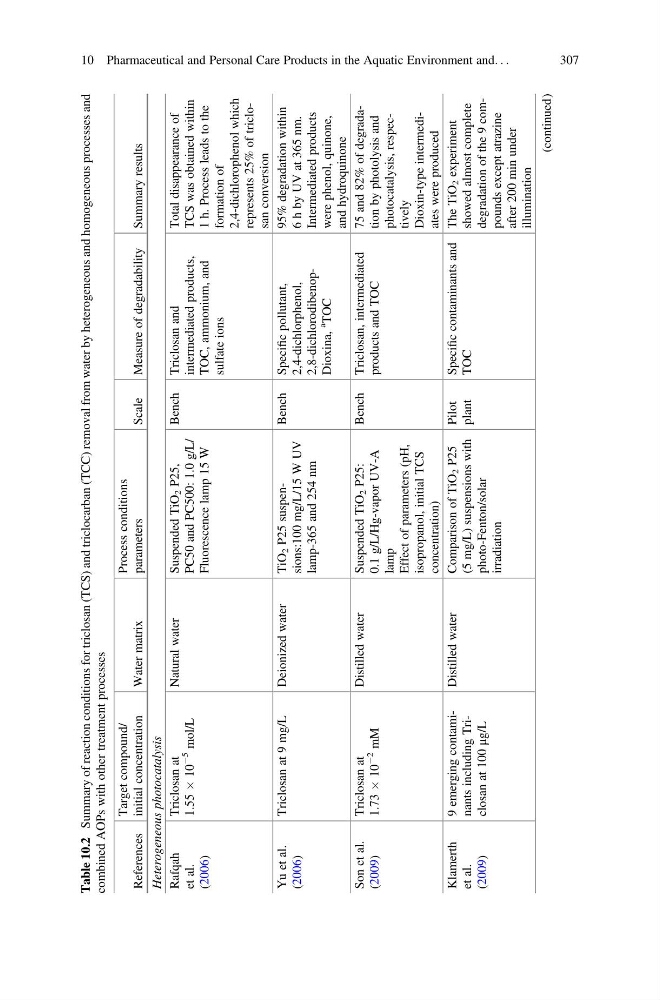
Table 10.2
Summary of reaction conditions for triclosan (TCS) and triclocarban (TCC) removal from water by heterogeneous and homogeneous processes and
combined AOPs with other treatment processes
References
Target compound/
initial concentration
Water matrix
Process conditions
parameters
Scale
Measure of degradability
Summary results
Heterogeneous photocatalysis
Rafqah
et al.
(2006)
Triclosan at
1.55
 10
À5
mol/L
Natural water
Suspended TiO
2 P25,
PC50 and PC500: 1.0 g/L/
Fluorescence lamp 15 W
Bench Triclosan and
intermediated products,
TOC, ammonium, and
sulfate ions
Total disappearance of
TCS was obtained within
1 h. Process leads to the
formation of
2,4-dichlorophenol which
represents 25% of triclosan conversion
Yu et al.
(2006)
Triclosan at 9 mg/L
Deionized water
TiO
2 P25 suspensions:100 mg/L/15 W UV
lamp-365 and 254 nm
Bench Specific pollutant,
2,4-dichlorphenol,
2,8-dichlorodibenopDioxina,
a
TOC
95% degradation within
6 h by UV at 365 nm.
Intermediated products
were phenol, quinone,
and hydroquinone
Son et al.
(2009)
Triclosan at
1.73
 10
À2
mM
Distilled water
Suspended TiO
2 P25:
0.1 g/L/Hg-vapor UV-A
lamp
Effect of parameters (pH,
isopropanol, initial TCS
concentration)
Bench Triclosan, intermediated
products and TOC
75 and 82% of degradation by photolysis and
photocatalysis, respectively
Dioxin-type intermediates were produced
Klamerth
et al.
(2009)
9 emerging contaminants including Triclosan at 100
μg/L
Distilled water
Comparison of TiO
2 P25
(5 mg/L) suspensions with
photo-Fenton/solar
irradiation
Pilot
plant
Specific contaminants and
TOC
The TiO
2 experiment
showed almost complete
degradation of the 9 compounds except atrazine
after 200 min under
illumination
(continued)
10 Pharmaceutical and Personal Care Products in the Aquatic Environment and. . .
307
Summary of reaction conditions for triclosan (TCS) and triclocarban (TCC) removal from water by heterogeneous and homogeneous processes and
combined AOPs with other treatment processes
References
Target compound/
initial concentration
Water matrix
Process conditions
parameters
Scale
Measure of degradability
Summary results
Heterogeneous photocatalysis
Rafqah
et al.
(2006)
Triclosan at
1.55
 10
À5
mol/L
Natural water
Suspended TiO
2 P25,
PC50 and PC500: 1.0 g/L/
Fluorescence lamp 15 W
Bench Triclosan and
intermediated products,
TOC, ammonium, and
sulfate ions
Total disappearance of
TCS was obtained within
1 h. Process leads to the
formation of
2,4-dichlorophenol which
represents 25% of triclosan conversion
Yu et al.
(2006)
Triclosan at 9 mg/L
Deionized water
TiO
2 P25 suspensions:100 mg/L/15 W UV
lamp-365 and 254 nm
Bench Specific pollutant,
2,4-dichlorphenol,
2,8-dichlorodibenopDioxina,
a
TOC
95% degradation within
6 h by UV at 365 nm.
Intermediated products
were phenol, quinone,
and hydroquinone
Son et al.
(2009)
Triclosan at
1.73
 10
À2
mM
Distilled water
Suspended TiO
2 P25:
0.1 g/L/Hg-vapor UV-A
lamp
Effect of parameters (pH,
isopropanol, initial TCS
concentration)
Bench Triclosan, intermediated
products and TOC
75 and 82% of degradation by photolysis and
photocatalysis, respectively
Dioxin-type intermediates were produced
Klamerth
et al.
(2009)
9 emerging contaminants including Triclosan at 100
μg/L
Distilled water
Comparison of TiO
2 P25
(5 mg/L) suspensions with
photo-Fenton/solar
irradiation
Pilot
plant
Specific contaminants and
TOC
The TiO
2 experiment
showed almost complete
degradation of the 9 compounds except atrazine
after 200 min under
illumination
(continued)
10 Pharmaceutical and Personal Care Products in the Aquatic Environment and. . .
307