

decreased during the photolysis and photocatalytic processes in the presence of
scavenger. The use of 2-propanol during the photocatalytic process are important
to investigate detailed mechanisms to evaluate the contribution of reactive species
such as
●
OH, O 2
-●
, positive holes. Stamatis et al. (2014) evaluated the contribution
of reactive species on triclosan degradation and found that the hydroxyl radical was
the main reactive species acting on triclosan degradation, while positive holes
contribute indirectly to produce
●
OH. The hydroxyl radical species is, thus, vital
to prevent p-dioxin derivatives during triclosan photocatalysis. Son et al. (2009)
detected dibenzo-dichloro-p-dioxin when
● OH scavenger (e.g., 2-propanol) was
employed in TiO 2 photocatalyis, while p-dioxin intermediates were not found during
photocatalysis without 2-propanol, as displayed in Fig. 10.2.
Triclosan oxidation by ultraviolet light produce a highly toxic compounds, such
as p-dioxin derivatives such as 2,8-dichloro-dibenzo p-dioxin, since their anionic
form is involved a ring closure process (Rafqah et al. 2006). These harmful derivate
compounds are exclusively formed below 300 nm of ultraviolet irradiation (Latch
et al. 2003). According to the triclocarban structure, several chlorine atoms are
present, and the dechlorination process promotes the formation of several isomer
products. The first step is by a hydroxyl radical attack of the carbons atoms with the
highest electron density, preferentially in the ortho and para positions in the
chlorophenol ring. The homolytic scission of the carbon–oxygen bond promotes
OH-adduct formation (Rafqah et al. 2006). An unstable semi-quinone radical is then
formed, where its deprotonation generates p-hydroquinone and p-quinone from
triclosan (Yu et al. 2006). Therefore, 2,4-dichlorophenol is the major detected
intermediary and the dechlorination reaction is not a major step during triclocarban
photodegradation, as observed in Fig. 10.3 (Behar and Behar 1991). Rafqah et al.
E
e
-
h
+
CB
VB
“Band gap”
(e
-
CB )+o 2
Tio 2
Tio 2
Tio 2
Tio 2
Tio 2
Tio 2
Tio 2
Tio 2
Tio 2
Tio 2
+O 2
(e -
CB )+H 2 o 2
+OH
-
+OH
-
-
Catalystic
particle
VC
e -
Internal
recombination
Band-gap
excitation
VB
hv
h +
surface
recombination
O 2
O 2
O 2
H 2
H 2
O/OH
H 2
Reduction
reaction
Oxidation
reaction
,
Solution
, R
(h+ VB) +
(h+ VB) +
(h+ VB) + RX
RX
OH
OH
OH
o
+
+
+
+
+
+ H
OH, R +
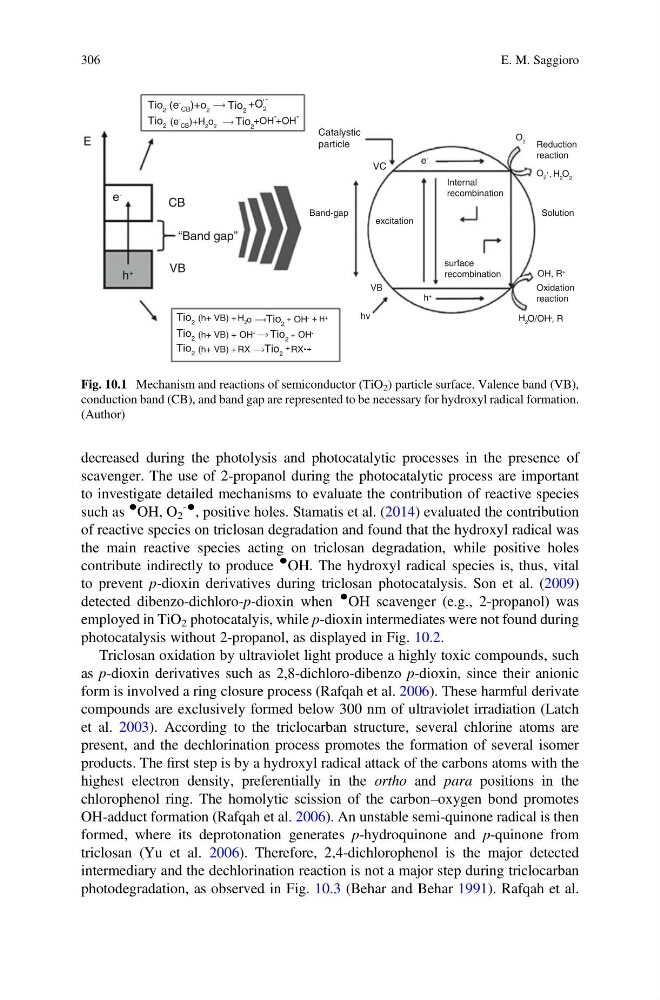
Fig. 10.1 Mechanism and reactions of semiconductor (TiO 2 ) particle surface. Valence band (VB),
conduction band (CB), and band gap are represented to be necessary for hydroxyl radical formation.
(Author)
306
E. M. Saggioro
scavenger. The use of 2-propanol during the photocatalytic process are important
to investigate detailed mechanisms to evaluate the contribution of reactive species
such as
●
OH, O 2
-●
, positive holes. Stamatis et al. (2014) evaluated the contribution
of reactive species on triclosan degradation and found that the hydroxyl radical was
the main reactive species acting on triclosan degradation, while positive holes
contribute indirectly to produce
●
OH. The hydroxyl radical species is, thus, vital
to prevent p-dioxin derivatives during triclosan photocatalysis. Son et al. (2009)
detected dibenzo-dichloro-p-dioxin when
● OH scavenger (e.g., 2-propanol) was
employed in TiO 2 photocatalyis, while p-dioxin intermediates were not found during
photocatalysis without 2-propanol, as displayed in Fig. 10.2.
Triclosan oxidation by ultraviolet light produce a highly toxic compounds, such
as p-dioxin derivatives such as 2,8-dichloro-dibenzo p-dioxin, since their anionic
form is involved a ring closure process (Rafqah et al. 2006). These harmful derivate
compounds are exclusively formed below 300 nm of ultraviolet irradiation (Latch
et al. 2003). According to the triclocarban structure, several chlorine atoms are
present, and the dechlorination process promotes the formation of several isomer
products. The first step is by a hydroxyl radical attack of the carbons atoms with the
highest electron density, preferentially in the ortho and para positions in the
chlorophenol ring. The homolytic scission of the carbon–oxygen bond promotes
OH-adduct formation (Rafqah et al. 2006). An unstable semi-quinone radical is then
formed, where its deprotonation generates p-hydroquinone and p-quinone from
triclosan (Yu et al. 2006). Therefore, 2,4-dichlorophenol is the major detected
intermediary and the dechlorination reaction is not a major step during triclocarban
photodegradation, as observed in Fig. 10.3 (Behar and Behar 1991). Rafqah et al.
E
e
-
h
+
CB
VB
“Band gap”
(e
-
CB )+o 2
Tio 2
Tio 2
Tio 2
Tio 2
Tio 2
Tio 2
Tio 2
Tio 2
Tio 2
Tio 2
+O 2
(e -
CB )+H 2 o 2
+OH
-
+OH
-
-
Catalystic
particle
VC
e -
Internal
recombination
Band-gap
excitation
VB
hv
h +
surface
recombination
O 2
O 2
O 2
H 2
H 2
O/OH
H 2
Reduction
reaction
Oxidation
reaction
,
Solution
, R
(h+ VB) +
(h+ VB) +
(h+ VB) + RX
RX
OH
OH
OH
o
+
+
+
+
+
+ H
OH, R +
Fig. 10.1 Mechanism and reactions of semiconductor (TiO 2 ) particle surface. Valence band (VB),
conduction band (CB), and band gap are represented to be necessary for hydroxyl radical formation.
(Author)
306
E. M. Saggioro