

10.3.1 Degradation of Personal Care Products
Heterogeneous Photocatalysis
Photocatalytic degradation via photo-generated TiO 2 has been extensively studied
for wastewater treatment. Under near ultraviolet or sunlight irradiation, aqueous
TiO 2 solutions are photoexcited to promote electron transfer to generate valence
band holes (e.g., valence band holes) and conduction band electrons (e.g., conduction band electrons) (Klavarioti et al. 2009). Valence band holes can react with water
and the hydrogen ion to form reactive oxygen species. On the other hand, electrons
react with oxygen, reducing it to the superoxide radical anion that, in turn, reacts
with protons to form peroxide radicals (Mohapatra et al. 2014), as displayed in
Fig. 10.1. Some heterogeneous photocatalysis studies involving personal care products are listed in Table 10.2.
Operational photocatalysis parameter evaluations are a crucial step in obtaining
satisfactory results. The pH medium is essential for catalyst and pollutant adsorption.
For example, regarding triclosan photodegradation by TiO 2 , a neutral pH range
(6.5–7.5) is the optimum condition, due to higher adsorption of undissociated
triclosan to the TiO 2 surface (Stamatis et al. 2014). Triclosan is resistant to ionization, since its pKa ranges from 7.9 to 8.1 and can be formed into the triclosan anion
at pH > 8. On the other hand, at acidic media, the catalyst is positively charged,
whereas it is negatively charged under alkaline medium (Pemberton and Hart 1999).
Thus, at pH > 8, a repulsive force exists between triclosan and TiO 2 , while acidic
conditions significantly inhibit the generation of the hydroxyl radical (Son et al.
2004). Son et al. (2009) evaluated the optimal operational parameters such as pH,
triclosan amount, and presence of scavenger under photolysis and TiO 2
photocatalysis employing ultraviolet radiation. The authors found that the best
condition for triclosan adsorption was a neutral pH, where photocatalysis decreased
as the initial triclosan concentration increased and the triclosan degradation rate was
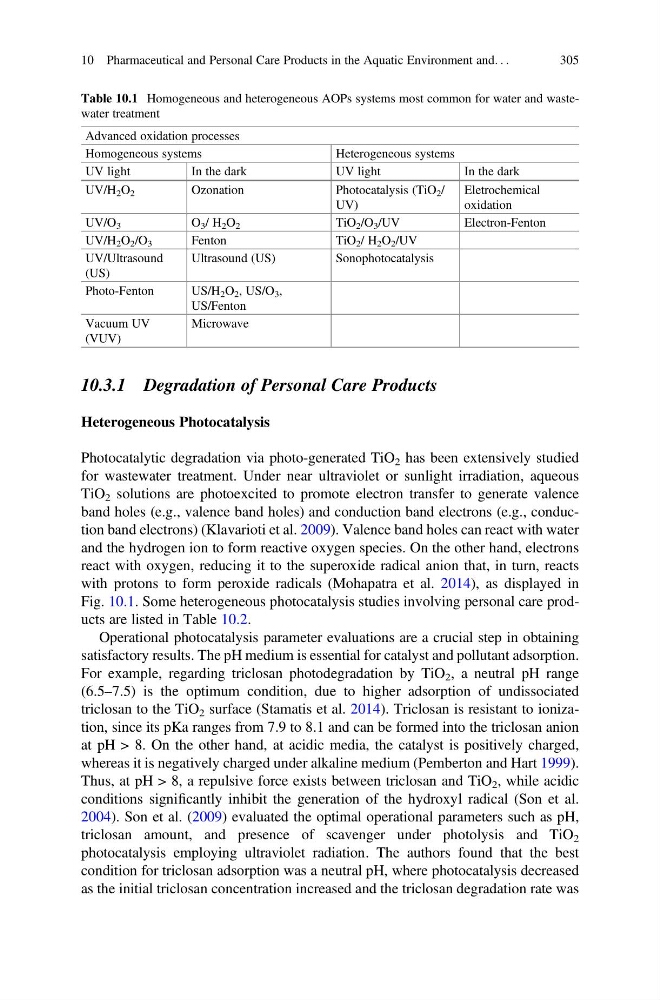
Table 10.1 Homogeneous and heterogeneous AOPs systems most common for water and wastewater treatment
Advanced oxidation processes
Homogeneous systems
Heterogeneous systems
UV light
In the dark
UV light
In the dark
UV/H 2 O 2
Ozonation
Photocatalysis (TiO 2 /
UV)
Eletrochemical
oxidation
UV/O 3
O 3 / H 2 O 2
TiO 2 /O 3 /UV
Electron-Fenton
UV/H 2 O 2 /O 3
Fenton
TiO 2 / H 2 O 2 /UV
UV/Ultrasound
(US)
Ultrasound (US)
Sonophotocatalysis
Photo-Fenton
US/H 2 O 2 , US/O 3 ,
US/Fenton
Vacuum UV
(VUV)
Microwave
10 Pharmaceutical and Personal Care Products in the Aquatic Environment and. . .
305
Heterogeneous Photocatalysis
Photocatalytic degradation via photo-generated TiO 2 has been extensively studied
for wastewater treatment. Under near ultraviolet or sunlight irradiation, aqueous
TiO 2 solutions are photoexcited to promote electron transfer to generate valence
band holes (e.g., valence band holes) and conduction band electrons (e.g., conduction band electrons) (Klavarioti et al. 2009). Valence band holes can react with water
and the hydrogen ion to form reactive oxygen species. On the other hand, electrons
react with oxygen, reducing it to the superoxide radical anion that, in turn, reacts
with protons to form peroxide radicals (Mohapatra et al. 2014), as displayed in
Fig. 10.1. Some heterogeneous photocatalysis studies involving personal care products are listed in Table 10.2.
Operational photocatalysis parameter evaluations are a crucial step in obtaining
satisfactory results. The pH medium is essential for catalyst and pollutant adsorption.
For example, regarding triclosan photodegradation by TiO 2 , a neutral pH range
(6.5–7.5) is the optimum condition, due to higher adsorption of undissociated
triclosan to the TiO 2 surface (Stamatis et al. 2014). Triclosan is resistant to ionization, since its pKa ranges from 7.9 to 8.1 and can be formed into the triclosan anion
at pH > 8. On the other hand, at acidic media, the catalyst is positively charged,
whereas it is negatively charged under alkaline medium (Pemberton and Hart 1999).
Thus, at pH > 8, a repulsive force exists between triclosan and TiO 2 , while acidic
conditions significantly inhibit the generation of the hydroxyl radical (Son et al.
2004). Son et al. (2009) evaluated the optimal operational parameters such as pH,
triclosan amount, and presence of scavenger under photolysis and TiO 2
photocatalysis employing ultraviolet radiation. The authors found that the best
condition for triclosan adsorption was a neutral pH, where photocatalysis decreased
as the initial triclosan concentration increased and the triclosan degradation rate was
Table 10.1 Homogeneous and heterogeneous AOPs systems most common for water and wastewater treatment
Advanced oxidation processes
Homogeneous systems
Heterogeneous systems
UV light
In the dark
UV light
In the dark
UV/H 2 O 2
Ozonation
Photocatalysis (TiO 2 /
UV)
Eletrochemical
oxidation
UV/O 3
O 3 / H 2 O 2
TiO 2 /O 3 /UV
Electron-Fenton
UV/H 2 O 2 /O 3
Fenton
TiO 2 / H 2 O 2 /UV
UV/Ultrasound
(US)
Ultrasound (US)
Sonophotocatalysis
Photo-Fenton
US/H 2 O 2 , US/O 3 ,
US/Fenton
Vacuum UV
(VUV)
Microwave
10 Pharmaceutical and Personal Care Products in the Aquatic Environment and. . .
305