

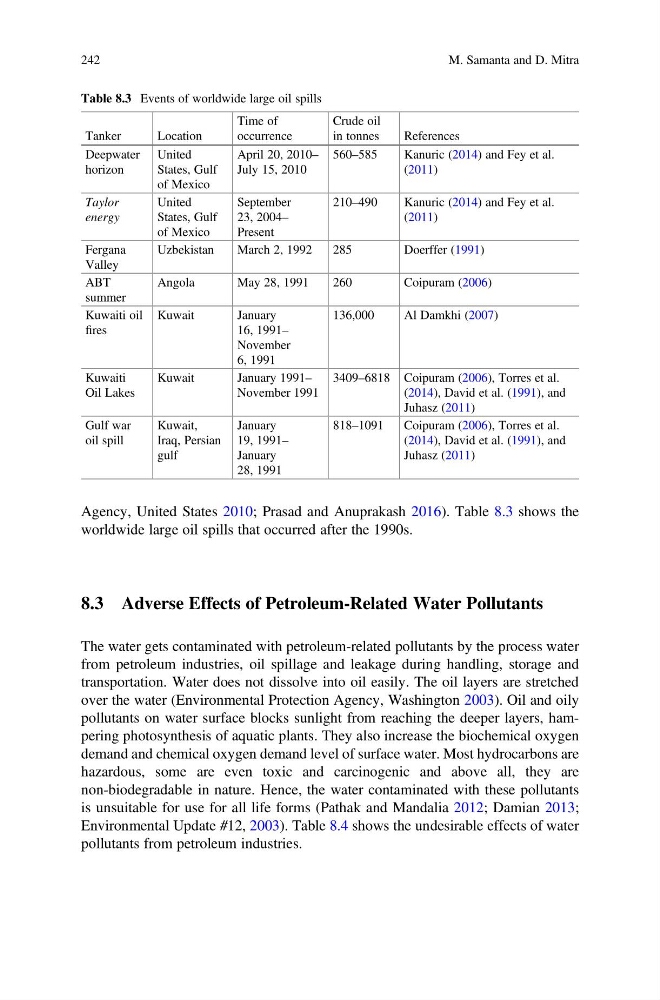
Agency, United States 2010; Prasad and Anuprakash 2016). Table 8.3 shows the
worldwide large oil spills that occurred after the 1990s.
8.3 Adverse Effects of Petroleum-Related Water Pollutants
The water gets contaminated with petroleum-related pollutants by the process water
from petroleum industries, oil spillage and leakage during handling, storage and
transportation. Water does not dissolve into oil easily. The oil layers are stretched
over the water (Environmental Protection Agency, Washington 2003). Oil and oily
pollutants on water surface blocks sunlight from reaching the deeper layers, hampering photosynthesis of aquatic plants. They also increase the biochemical oxygen
demand and chemical oxygen demand level of surface water. Most hydrocarbons are
hazardous, some are even toxic and carcinogenic and above all, they are
non-biodegradable in nature. Hence, the water contaminated with these pollutants
is unsuitable for use for all life forms (Pathak and Mandalia 2012; Damian 2013;
Environmental Update #12, 2003). Table 8.4 shows the undesirable effects of water
pollutants from petroleum industries.
Table 8.3 Events of worldwide large oil spills
Tanker
Location
Time of
occurrence
Crude oil
in tonnes
References
Deepwater
horizon
United
States, Gulf
of Mexico
April 20, 2010–
July 15, 2010
560–585
Kanuric (2014) and Fey et al.
(2011)
Taylor
energy
United
States, Gulf
of Mexico
September
23, 2004–
Present
210–490
Kanuric (2014) and Fey et al.
(2011)
Fergana
Valley
Uzbekistan
March 2, 1992
285
Doerffer (1991)
ABT
summer
Angola
May 28, 1991
260
Coipuram (2006)
Kuwaiti oil
fires
Kuwait
January
16, 1991–
November
6, 1991
136,000
Al Damkhi (2007)
Kuwaiti
Oil Lakes
Kuwait
January 1991–
November 1991
3409–6818 Coipuram (2006), Torres et al.
(2014), David et al. (1991), and
Juhasz (2011)
Gulf war
oil spill
Kuwait,
Iraq, Persian
gulf
January
19, 1991–
January
28, 1991
818–1091
Coipuram (2006), Torres et al.
(2014), David et al. (1991), and
Juhasz (2011)
242
M. Samanta and D. Mitra
worldwide large oil spills that occurred after the 1990s.
8.3 Adverse Effects of Petroleum-Related Water Pollutants
The water gets contaminated with petroleum-related pollutants by the process water
from petroleum industries, oil spillage and leakage during handling, storage and
transportation. Water does not dissolve into oil easily. The oil layers are stretched
over the water (Environmental Protection Agency, Washington 2003). Oil and oily
pollutants on water surface blocks sunlight from reaching the deeper layers, hampering photosynthesis of aquatic plants. They also increase the biochemical oxygen
demand and chemical oxygen demand level of surface water. Most hydrocarbons are
hazardous, some are even toxic and carcinogenic and above all, they are
non-biodegradable in nature. Hence, the water contaminated with these pollutants
is unsuitable for use for all life forms (Pathak and Mandalia 2012; Damian 2013;
Environmental Update #12, 2003). Table 8.4 shows the undesirable effects of water
pollutants from petroleum industries.
Table 8.3 Events of worldwide large oil spills
Tanker
Location
Time of
occurrence
Crude oil
in tonnes
References
Deepwater
horizon
United
States, Gulf
of Mexico
April 20, 2010–
July 15, 2010
560–585
Kanuric (2014) and Fey et al.
(2011)
Taylor
energy
United
States, Gulf
of Mexico
September
23, 2004–
Present
210–490
Kanuric (2014) and Fey et al.
(2011)
Fergana
Valley
Uzbekistan
March 2, 1992
285
Doerffer (1991)
ABT
summer
Angola
May 28, 1991
260
Coipuram (2006)
Kuwaiti oil
fires
Kuwait
January
16, 1991–
November
6, 1991
136,000
Al Damkhi (2007)
Kuwaiti
Oil Lakes
Kuwait
January 1991–
November 1991
3409–6818 Coipuram (2006), Torres et al.
(2014), David et al. (1991), and
Juhasz (2011)
Gulf war
oil spill
Kuwait,
Iraq, Persian
gulf
January
19, 1991–
January
28, 1991
818–1091
Coipuram (2006), Torres et al.
(2014), David et al. (1991), and
Juhasz (2011)
242
M. Samanta and D. Mitra