

formed various smaller by-products such as but-3-ene-1,1,2-triol, acrylic acid, and
prop-2-en-1-ol (4c; m/z ¼ 59). On the other hand, benzo[a]pyrene being comparatively stable formed intermediates of m/z values 246 and 273. However, since
functionalized nanomaterials had better semiconducting properties, large number
of hydroxyl radicals was fabricated. The presence of these radicals helped in
degradation of huge rings into smaller products such propionic acid. The doping
enhanced the photocatalytic activity through the charge transfer mechanism and
suppression of charge recombination process (Rachna et al. 2019). Chrysene
known as persistent carcinogenic polycyclic aromatic hydrocarbon was degraded
under sunlight with the iron oxide@zinc hexacyanoferrate nanocomposite up to 92%
owing to the remarkably enhanced surface area (around 350 m
2 g
À1 ) as well as
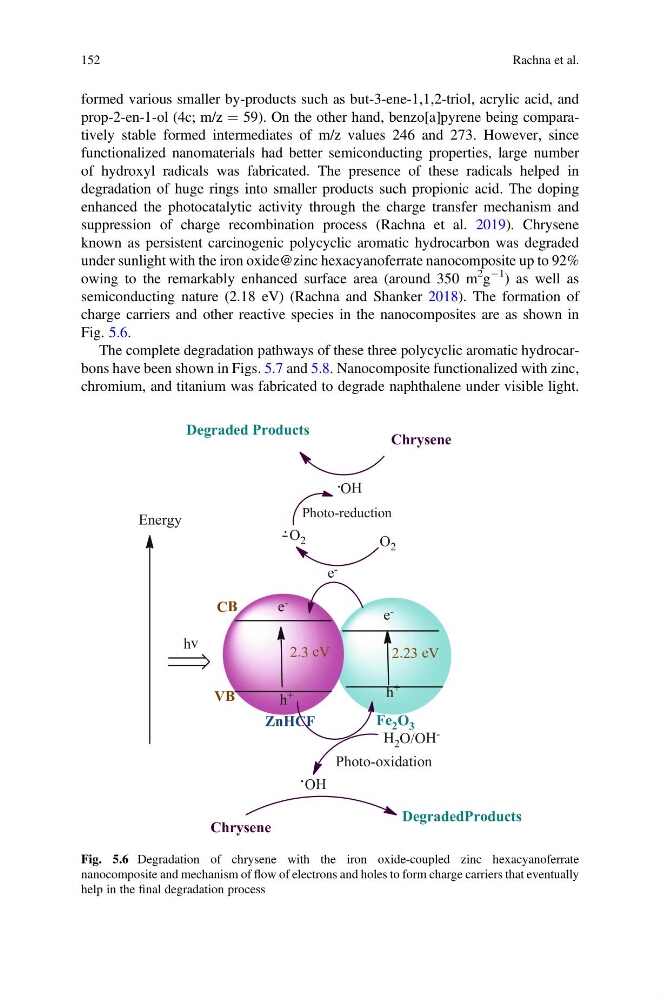
semiconducting nature (2.18 eV) (Rachna and Shanker 2018). The formation of
charge carriers and other reactive species in the nanocomposites are as shown in
Fig. 5.6.
The complete degradation pathways of these three polycyclic aromatic hydrocarbons have been shown in Figs. 5.7 and 5.8. Nanocomposite functionalized with zinc,
chromium, and titanium was fabricated to degrade naphthalene under visible light.
Energy
hv
O 2
O 2
OH
Photo-reduction
H 2 O/OH
-
Chrysene
DegradedProducts
Photo-oxidation
OH
VB
CB
e -
h
+
e -
h
+
e -
Chrysene
Degraded Products
ZnHCF
Fe 2 O 3
2.3 eV
2.23 eV
Fig. 5.6 Degradation of chrysene with the iron oxide-coupled zinc hexacyanoferrate
nanocomposite and mechanism of flow of electrons and holes to form charge carriers that eventually
help in the final degradation process
152
Rachna et al.
prop-2-en-1-ol (4c; m/z ¼ 59). On the other hand, benzo[a]pyrene being comparatively stable formed intermediates of m/z values 246 and 273. However, since
functionalized nanomaterials had better semiconducting properties, large number
of hydroxyl radicals was fabricated. The presence of these radicals helped in
degradation of huge rings into smaller products such propionic acid. The doping
enhanced the photocatalytic activity through the charge transfer mechanism and
suppression of charge recombination process (Rachna et al. 2019). Chrysene
known as persistent carcinogenic polycyclic aromatic hydrocarbon was degraded
under sunlight with the iron oxide@zinc hexacyanoferrate nanocomposite up to 92%
owing to the remarkably enhanced surface area (around 350 m
2 g
À1 ) as well as
semiconducting nature (2.18 eV) (Rachna and Shanker 2018). The formation of
charge carriers and other reactive species in the nanocomposites are as shown in
Fig. 5.6.
The complete degradation pathways of these three polycyclic aromatic hydrocarbons have been shown in Figs. 5.7 and 5.8. Nanocomposite functionalized with zinc,
chromium, and titanium was fabricated to degrade naphthalene under visible light.
Energy
hv
O 2
O 2
OH
Photo-reduction
H 2 O/OH
-
Chrysene
DegradedProducts
Photo-oxidation
OH
VB
CB
e -
h
+
e -
h
+
e -
Chrysene
Degraded Products
ZnHCF
Fe 2 O 3
2.3 eV
2.23 eV
Fig. 5.6 Degradation of chrysene with the iron oxide-coupled zinc hexacyanoferrate
nanocomposite and mechanism of flow of electrons and holes to form charge carriers that eventually
help in the final degradation process
152
Rachna et al.