

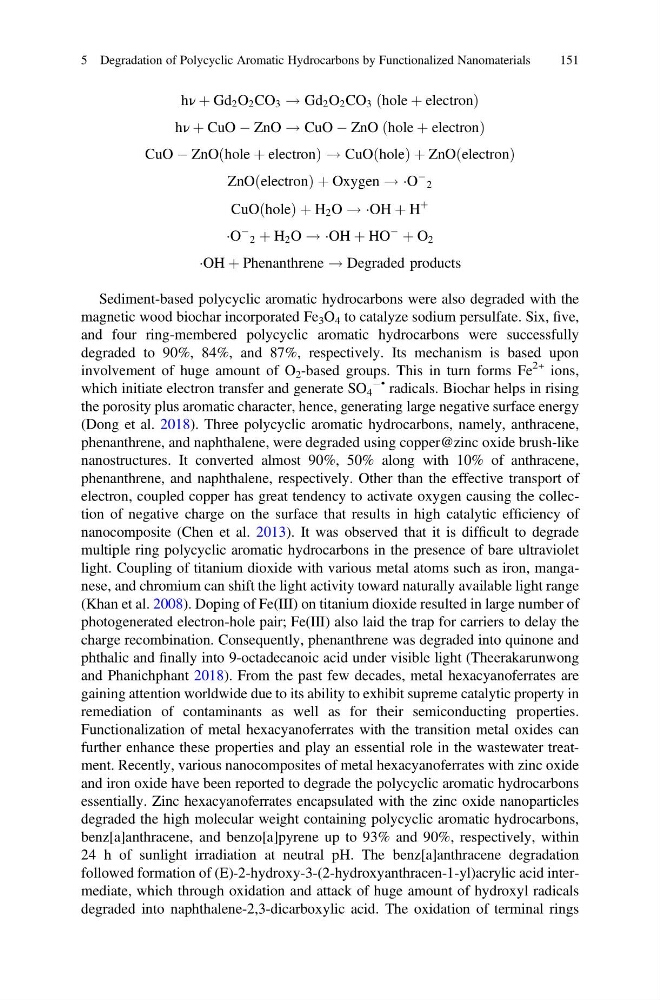
hν þ Gd 2 O 2 CO 3 ! Gd 2 O 2 CO 3 hole þ electron
ð
Þ
hν þ CuO À ZnO ! CuO À ZnO hole þ electron
ð
Þ
CuO À ZnO hole þ electron
ð
Þ ! CuO hole
ð
ÞþZnO electron
ð
Þ
ZnO electron
ð
ÞþOxygen ! ÁO
À
2
CuO hole
ð
ÞþH 2 O ! ÁOH þ H
þ
ÁO
À
2 þ H 2 O ! ÁOH þ HO
À
þ O 2
ÁOH þ Phenanthrene ! Degraded products
Sediment-based polycyclic aromatic hydrocarbons were also degraded with the
magnetic wood biochar incorporated Fe 3 O 4 to catalyze sodium persulfate. Six, five,
and four ring-membered polycyclic aromatic hydrocarbons were successfully
degraded to 90%, 84%, and 87%, respectively. Its mechanism is based upon
involvement of huge amount of O 2 -based groups. This in turn forms Fe
2+ ions,
which initiate electron transfer and generate SO 4
À• radicals. Biochar helps in rising
the porosity plus aromatic character, hence, generating large negative surface energy
(Dong et al. 2018). Three polycyclic aromatic hydrocarbons, namely, anthracene,
phenanthrene, and naphthalene, were degraded using copper@zinc oxide brush-like
nanostructures. It converted almost 90%, 50% along with 10% of anthracene,
phenanthrene, and naphthalene, respectively. Other than the effective transport of
electron, coupled copper has great tendency to activate oxygen causing the collection of negative charge on the surface that results in high catalytic efficiency of
nanocomposite (Chen et al. 2013). It was observed that it is difficult to degrade
multiple ring polycyclic aromatic hydrocarbons in the presence of bare ultraviolet
light. Coupling of titanium dioxide with various metal atoms such as iron, manganese, and chromium can shift the light activity toward naturally available light range
(Khan et al. 2008). Doping of Fe(III) on titanium dioxide resulted in large number of
photogenerated electron-hole pair; Fe(III) also laid the trap for carriers to delay the
charge recombination. Consequently, phenanthrene was degraded into quinone and
phthalic and finally into 9-octadecanoic acid under visible light (Theerakarunwong
and Phanichphant 2018). From the past few decades, metal hexacyanoferrates are
gaining attention worldwide due to its ability to exhibit supreme catalytic property in
remediation of contaminants as well as for their semiconducting properties.
Functionalization of metal hexacyanoferrates with the transition metal oxides can
further enhance these properties and play an essential role in the wastewater treatment. Recently, various nanocomposites of metal hexacyanoferrates with zinc oxide
and iron oxide have been reported to degrade the polycyclic aromatic hydrocarbons
essentially. Zinc hexacyanoferrates encapsulated with the zinc oxide nanoparticles
degraded the high molecular weight containing polycyclic aromatic hydrocarbons,
benz[a]anthracene, and benzo[a]pyrene up to 93% and 90%, respectively, within
24 h of sunlight irradiation at neutral pH. The benz[a]anthracene degradation
followed formation of (E)-2-hydroxy-3-(2-hydroxyanthracen-1-yl)acrylic acid intermediate, which through oxidation and attack of huge amount of hydroxyl radicals
degraded into naphthalene-2,3-dicarboxylic acid. The oxidation of terminal rings
5 Degradation of Polycyclic Aromatic Hydrocarbons by Functionalized Nanomaterials
151
ð
Þ
hν þ CuO À ZnO ! CuO À ZnO hole þ electron
ð
Þ
CuO À ZnO hole þ electron
ð
Þ ! CuO hole
ð
ÞþZnO electron
ð
Þ
ZnO electron
ð
ÞþOxygen ! ÁO
À
2
CuO hole
ð
ÞþH 2 O ! ÁOH þ H
þ
ÁO
À
2 þ H 2 O ! ÁOH þ HO
À
þ O 2
ÁOH þ Phenanthrene ! Degraded products
Sediment-based polycyclic aromatic hydrocarbons were also degraded with the
magnetic wood biochar incorporated Fe 3 O 4 to catalyze sodium persulfate. Six, five,
and four ring-membered polycyclic aromatic hydrocarbons were successfully
degraded to 90%, 84%, and 87%, respectively. Its mechanism is based upon
involvement of huge amount of O 2 -based groups. This in turn forms Fe
2+ ions,
which initiate electron transfer and generate SO 4
À• radicals. Biochar helps in rising
the porosity plus aromatic character, hence, generating large negative surface energy
(Dong et al. 2018). Three polycyclic aromatic hydrocarbons, namely, anthracene,
phenanthrene, and naphthalene, were degraded using copper@zinc oxide brush-like
nanostructures. It converted almost 90%, 50% along with 10% of anthracene,
phenanthrene, and naphthalene, respectively. Other than the effective transport of
electron, coupled copper has great tendency to activate oxygen causing the collection of negative charge on the surface that results in high catalytic efficiency of
nanocomposite (Chen et al. 2013). It was observed that it is difficult to degrade
multiple ring polycyclic aromatic hydrocarbons in the presence of bare ultraviolet
light. Coupling of titanium dioxide with various metal atoms such as iron, manganese, and chromium can shift the light activity toward naturally available light range
(Khan et al. 2008). Doping of Fe(III) on titanium dioxide resulted in large number of
photogenerated electron-hole pair; Fe(III) also laid the trap for carriers to delay the
charge recombination. Consequently, phenanthrene was degraded into quinone and
phthalic and finally into 9-octadecanoic acid under visible light (Theerakarunwong
and Phanichphant 2018). From the past few decades, metal hexacyanoferrates are
gaining attention worldwide due to its ability to exhibit supreme catalytic property in
remediation of contaminants as well as for their semiconducting properties.
Functionalization of metal hexacyanoferrates with the transition metal oxides can
further enhance these properties and play an essential role in the wastewater treatment. Recently, various nanocomposites of metal hexacyanoferrates with zinc oxide
and iron oxide have been reported to degrade the polycyclic aromatic hydrocarbons
essentially. Zinc hexacyanoferrates encapsulated with the zinc oxide nanoparticles
degraded the high molecular weight containing polycyclic aromatic hydrocarbons,
benz[a]anthracene, and benzo[a]pyrene up to 93% and 90%, respectively, within
24 h of sunlight irradiation at neutral pH. The benz[a]anthracene degradation
followed formation of (E)-2-hydroxy-3-(2-hydroxyanthracen-1-yl)acrylic acid intermediate, which through oxidation and attack of huge amount of hydroxyl radicals
degraded into naphthalene-2,3-dicarboxylic acid. The oxidation of terminal rings
5 Degradation of Polycyclic Aromatic Hydrocarbons by Functionalized Nanomaterials
151