

activity of the nanocomposite was attributed to superior mass transfer mechanism
along with the diffusion of contaminants upon TiO 2 (Grover et al. 2017). Mukwevho
and his co-workers synthesized multi-metal oxide nanocomposite (gadolinium, zinc,
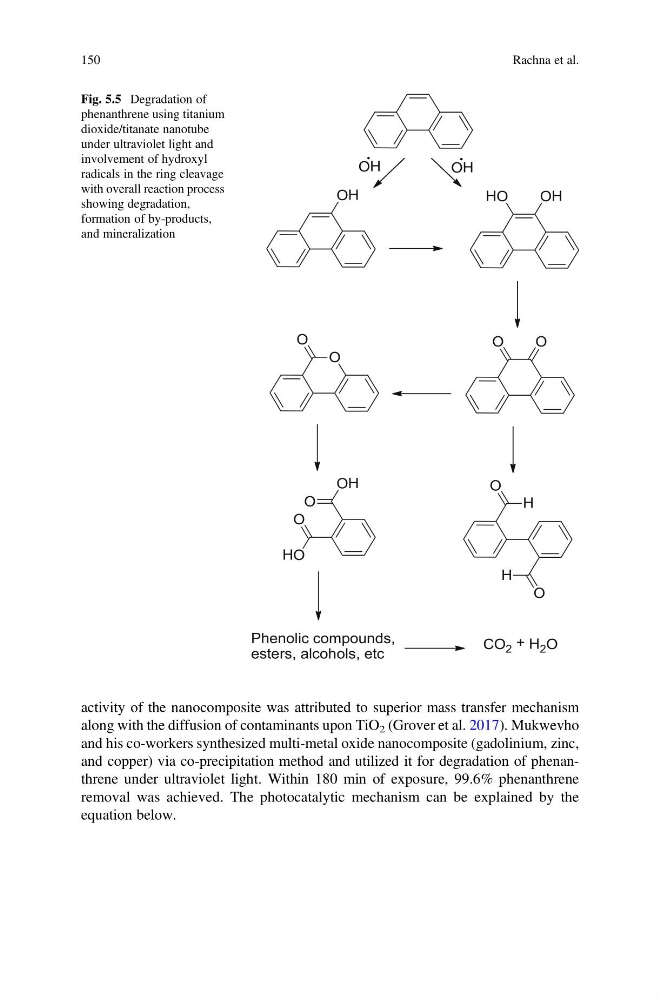
and copper) via co-precipitation method and utilized it for degradation of phenanthrene under ultraviolet light. Within 180 min of exposure, 99.6% phenanthrene
removal was achieved. The photocatalytic mechanism can be explained by the
equation below.
OH
OH
OH
OH
HO
O
O
O
O
O
HO
O
OH
O
H
O
H
Phenolic compounds,
esters, alcohols, etc
CO 2 + H 2 O
Fig. 5.5 Degradation of
phenanthrene using titanium
dioxide/titanate nanotube
under ultraviolet light and
involvement of hydroxyl
radicals in the ring cleavage
with overall reaction process
showing degradation,
formation of by-products,
and mineralization
150
Rachna et al.
along with the diffusion of contaminants upon TiO 2 (Grover et al. 2017). Mukwevho
and his co-workers synthesized multi-metal oxide nanocomposite (gadolinium, zinc,
and copper) via co-precipitation method and utilized it for degradation of phenanthrene under ultraviolet light. Within 180 min of exposure, 99.6% phenanthrene
removal was achieved. The photocatalytic mechanism can be explained by the
equation below.
OH
OH
OH
OH
HO
O
O
O
O
O
HO
O
OH
O
H
O
H
Phenolic compounds,
esters, alcohols, etc
CO 2 + H 2 O
Fig. 5.5 Degradation of
phenanthrene using titanium
dioxide/titanate nanotube
under ultraviolet light and
involvement of hydroxyl
radicals in the ring cleavage
with overall reaction process
showing degradation,
formation of by-products,
and mineralization
150
Rachna et al.