

amount of data available on these as it makes the further exploration a bit easy.
Recently, metal oxides of iron, zinc, and titanium-based nanomaterials have been
explored vastly for the degradation of polycyclic aromatic hydrocarbons (Wang
et al. 2016; Gupta and Gupta 2015; Liu et al. 2009a, b). Anthracene degradation was
reported with the zinc oxide and manganese oxide-coupled nanocatalyst under
ultraviolet irradiation. The nanocatalyst degraded the polycyclic aromatic hydrocarbons into anthraquinone based upon the high transient time constant at n-zinc oxide
and p-manganese oxide junction (Martínez-Vargas et al. 2019). Coupling of cobalt
oxide with bismuth oxycarbonate was achieved to study visible light-irradiated
degradation of naphthalene. Within 150 min of reaction, 91.02% degradation was
achieved owing to the excellent interaction between the constituents through the
formation of heterojunction and suppressed merging of active species (Guo et al.
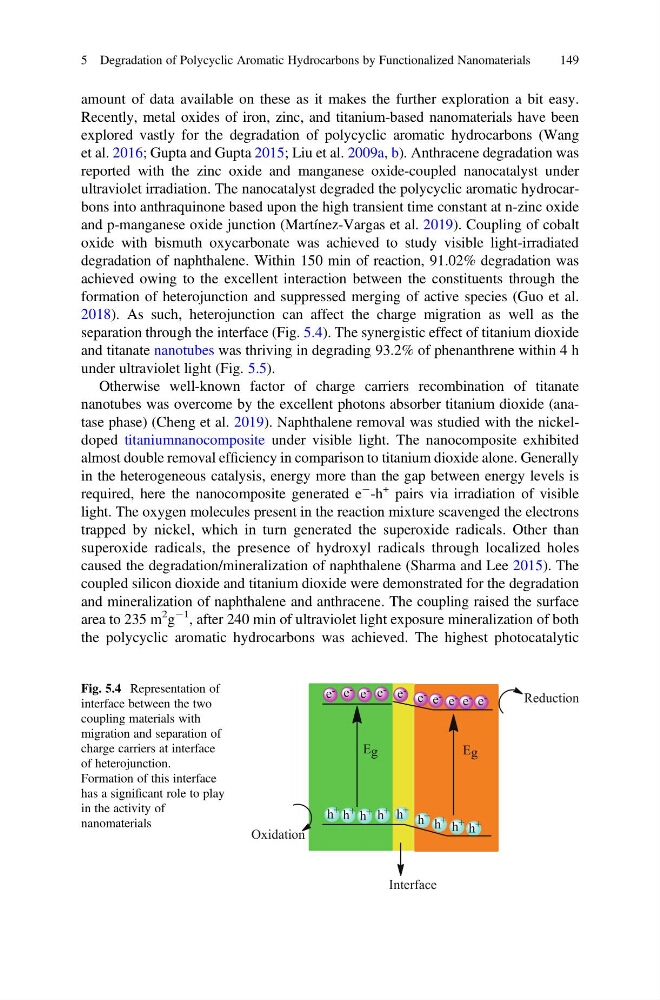
2018). As such, heterojunction can affect the charge migration as well as the
separation through the interface (Fig. 5.4). The synergistic effect of titanium dioxide
and titanate nanotubes was thriving in degrading 93.2% of phenanthrene within 4 h
under ultraviolet light (Fig. 5.5).
Otherwise well-known factor of charge carriers recombination of titanate
nanotubes was overcome by the excellent photons absorber titanium dioxide (anatase phase) (Cheng et al. 2019). Naphthalene removal was studied with the nickeldoped titaniumnanocomposite under visible light. The nanocomposite exhibited
almost double removal efficiency in comparison to titanium dioxide alone. Generally
in the heterogeneous catalysis, energy more than the gap between energy levels is
required, here the nanocomposite generated e
À -h
+ pairs via irradiation of visible
light. The oxygen molecules present in the reaction mixture scavenged the electrons
trapped by nickel, which in turn generated the superoxide radicals. Other than
superoxide radicals, the presence of hydroxyl radicals through localized holes
caused the degradation/mineralization of naphthalene (Sharma and Lee 2015). The
coupled silicon dioxide and titanium dioxide were demonstrated for the degradation
and mineralization of naphthalene and anthracene. The coupling raised the surface
area to 235 m
2 g
À1 , after 240 min of ultraviolet light exposure mineralization of both
the polycyclic aromatic hydrocarbons was achieved. The highest photocatalytic
e - e - e - e - e - e - e - e - e - e -
h
+ h
+ h
+ h
+ h
+ h
+ h
+ h
+ h
+
Reduction
Oxidation
E g
E g
Interface
Fig. 5.4 Representation of
interface between the two
coupling materials with
migration and separation of
charge carriers at interface
of heterojunction.
Formation of this interface
has a significant role to play
in the activity of
nanomaterials
5 Degradation of Polycyclic Aromatic Hydrocarbons by Functionalized Nanomaterials
149
Recently, metal oxides of iron, zinc, and titanium-based nanomaterials have been
explored vastly for the degradation of polycyclic aromatic hydrocarbons (Wang
et al. 2016; Gupta and Gupta 2015; Liu et al. 2009a, b). Anthracene degradation was
reported with the zinc oxide and manganese oxide-coupled nanocatalyst under
ultraviolet irradiation. The nanocatalyst degraded the polycyclic aromatic hydrocarbons into anthraquinone based upon the high transient time constant at n-zinc oxide
and p-manganese oxide junction (Martínez-Vargas et al. 2019). Coupling of cobalt
oxide with bismuth oxycarbonate was achieved to study visible light-irradiated
degradation of naphthalene. Within 150 min of reaction, 91.02% degradation was
achieved owing to the excellent interaction between the constituents through the
formation of heterojunction and suppressed merging of active species (Guo et al.
2018). As such, heterojunction can affect the charge migration as well as the
separation through the interface (Fig. 5.4). The synergistic effect of titanium dioxide
and titanate nanotubes was thriving in degrading 93.2% of phenanthrene within 4 h
under ultraviolet light (Fig. 5.5).
Otherwise well-known factor of charge carriers recombination of titanate
nanotubes was overcome by the excellent photons absorber titanium dioxide (anatase phase) (Cheng et al. 2019). Naphthalene removal was studied with the nickeldoped titaniumnanocomposite under visible light. The nanocomposite exhibited
almost double removal efficiency in comparison to titanium dioxide alone. Generally
in the heterogeneous catalysis, energy more than the gap between energy levels is
required, here the nanocomposite generated e
À -h
+ pairs via irradiation of visible
light. The oxygen molecules present in the reaction mixture scavenged the electrons
trapped by nickel, which in turn generated the superoxide radicals. Other than
superoxide radicals, the presence of hydroxyl radicals through localized holes
caused the degradation/mineralization of naphthalene (Sharma and Lee 2015). The
coupled silicon dioxide and titanium dioxide were demonstrated for the degradation
and mineralization of naphthalene and anthracene. The coupling raised the surface
area to 235 m
2 g
À1 , after 240 min of ultraviolet light exposure mineralization of both
the polycyclic aromatic hydrocarbons was achieved. The highest photocatalytic
e - e - e - e - e - e - e - e - e - e -
h
+ h
+ h
+ h
+ h
+ h
+ h
+ h
+ h
+
Reduction
Oxidation
E g
E g
Interface
Fig. 5.4 Representation of
interface between the two
coupling materials with
migration and separation of
charge carriers at interface
of heterojunction.
Formation of this interface
has a significant role to play
in the activity of
nanomaterials
5 Degradation of Polycyclic Aromatic Hydrocarbons by Functionalized Nanomaterials
149