

It will be the best step towards the development of ecofriendly and sustainable
products if we focus on natural polymers such as wool from Angora rabbit, Alpaca,
and Mohair to produce keratin, which is a natural polymer and can be used to
produce different types of plastics. Similarly, biomass feedstock from plant, fungi,
algae, and other microbes can help us to accomplish sustainable goals. One such goal
as proposed by United Nations is the use of sustainable materials such as biopolymers and biomass so that we can ensure a proper sanitation of water (Haward
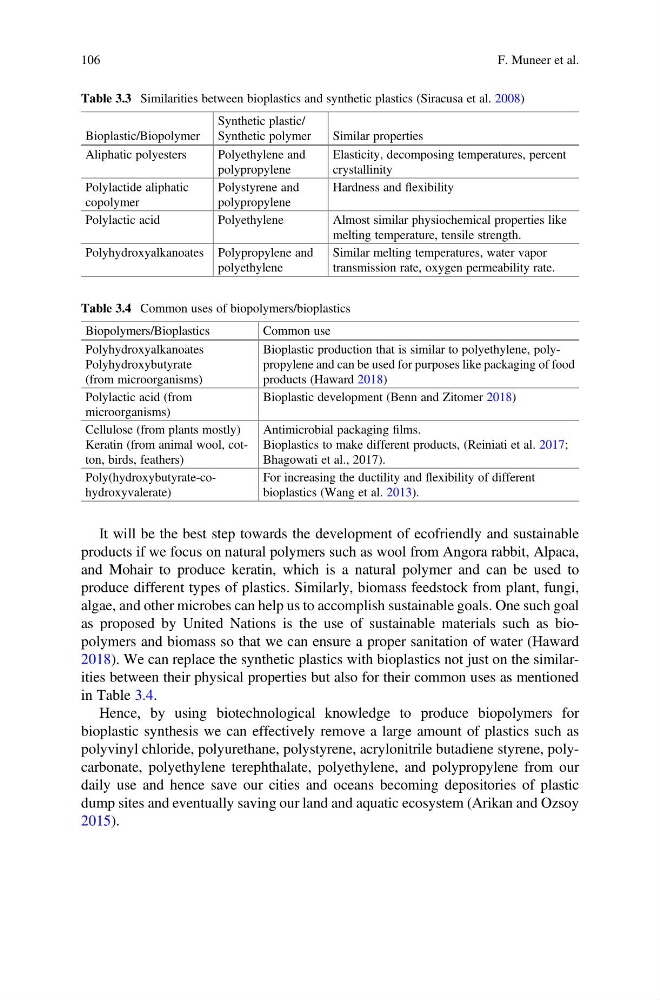
2018). We can replace the synthetic plastics with bioplastics not just on the similarities between their physical properties but also for their common uses as mentioned
in Table 3.4.
Hence, by using biotechnological knowledge to produce biopolymers for
bioplastic synthesis we can effectively remove a large amount of plastics such as
polyvinyl chloride, polyurethane, polystyrene, acrylonitrile butadiene styrene, polycarbonate, polyethylene terephthalate, polyethylene, and polypropylene from our
daily use and hence save our cities and oceans becoming depositories of plastic
dump sites and eventually saving our land and aquatic ecosystem (Arikan and Ozsoy
2015).
Table 3.3 Similarities between bioplastics and synthetic plastics (Siracusa et al. 2008)
Bioplastic/Biopolymer
Synthetic plastic/
Synthetic polymer
Similar properties
Aliphatic polyesters
Polyethylene and
polypropylene
Elasticity, decomposing temperatures, percent
crystallinity
Polylactide aliphatic
copolymer
Polystyrene and
polypropylene
Hardness and flexibility
Polylactic acid
Polyethylene
Almost similar physiochemical properties like
melting temperature, tensile strength.
Polyhydroxyalkanoates Polypropylene and
polyethylene
Similar melting temperatures, water vapor
transmission rate, oxygen permeability rate.
Table 3.4 Common uses of biopolymers/bioplastics
Biopolymers/Bioplastics
Common use
Polyhydroxyalkanoates
Polyhydroxybutyrate
(from microorganisms)
Bioplastic production that is similar to polyethylene, polypropylene and can be used for purposes like packaging of food
products (Haward 2018)
Polylactic acid (from
microorganisms)
Bioplastic development (Benn and Zitomer 2018)
Cellulose (from plants mostly)
Keratin (from animal wool, cotton, birds, feathers)
Antimicrobial packaging films.
Bioplastics to make different products, (Reiniati et al. 2017;
Bhagowati et al., 2017).
Poly(hydroxybutyrate-cohydroxyvalerate)
For increasing the ductility and flexibility of different
bioplastics (Wang et al. 2013).
106
F. Muneer et al.
products if we focus on natural polymers such as wool from Angora rabbit, Alpaca,
and Mohair to produce keratin, which is a natural polymer and can be used to
produce different types of plastics. Similarly, biomass feedstock from plant, fungi,
algae, and other microbes can help us to accomplish sustainable goals. One such goal
as proposed by United Nations is the use of sustainable materials such as biopolymers and biomass so that we can ensure a proper sanitation of water (Haward
2018). We can replace the synthetic plastics with bioplastics not just on the similarities between their physical properties but also for their common uses as mentioned
in Table 3.4.
Hence, by using biotechnological knowledge to produce biopolymers for
bioplastic synthesis we can effectively remove a large amount of plastics such as
polyvinyl chloride, polyurethane, polystyrene, acrylonitrile butadiene styrene, polycarbonate, polyethylene terephthalate, polyethylene, and polypropylene from our
daily use and hence save our cities and oceans becoming depositories of plastic
dump sites and eventually saving our land and aquatic ecosystem (Arikan and Ozsoy
2015).
Table 3.3 Similarities between bioplastics and synthetic plastics (Siracusa et al. 2008)
Bioplastic/Biopolymer
Synthetic plastic/
Synthetic polymer
Similar properties
Aliphatic polyesters
Polyethylene and
polypropylene
Elasticity, decomposing temperatures, percent
crystallinity
Polylactide aliphatic
copolymer
Polystyrene and
polypropylene
Hardness and flexibility
Polylactic acid
Polyethylene
Almost similar physiochemical properties like
melting temperature, tensile strength.
Polyhydroxyalkanoates Polypropylene and
polyethylene
Similar melting temperatures, water vapor
transmission rate, oxygen permeability rate.
Table 3.4 Common uses of biopolymers/bioplastics
Biopolymers/Bioplastics
Common use
Polyhydroxyalkanoates
Polyhydroxybutyrate
(from microorganisms)
Bioplastic production that is similar to polyethylene, polypropylene and can be used for purposes like packaging of food
products (Haward 2018)
Polylactic acid (from
microorganisms)
Bioplastic development (Benn and Zitomer 2018)
Cellulose (from plants mostly)
Keratin (from animal wool, cotton, birds, feathers)
Antimicrobial packaging films.
Bioplastics to make different products, (Reiniati et al. 2017;
Bhagowati et al., 2017).
Poly(hydroxybutyrate-cohydroxyvalerate)
For increasing the ductility and flexibility of different
bioplastics (Wang et al. 2013).
106
F. Muneer et al.