

3.7.2 Microbial Degradation of Plastics or Biodegradation
Unfortunately, we cannot replace all the available plastics with bioplastics because
of different prevailing limitations. Production of biomass can be a problem as huge
amount of land is required if we use agropolymers that are produced by plants and
this much of land is turning into a dream because of the population big bang and
industrialization. If microorganisms are used to produce bioplastics using polyesters
such as polyhydroxyalkonates and polylactic acid maintaining these cultures on
large scale or on industrial level where bioplastic is to be produced is very difficult
and expensive further more isolation and purification of these polyesters is not an
easy job.
For what we have discussed briefly in the above paragraph we can say that
bioplastics to replace the synthetic plastics is not a sufficient strategy to overcome
plastic pollution in the environment, either on land or in oceans. Scientists have
therefore adopted a more straightforward approach rather than swapping synthetic
plastics with naturally available biopolymers; they are now trying to discover new
sustainable methods to degrade plastics using enzymes present in microbes such as
bacteria and algae. A large number of bacterial strains have been studied to degrade
plastics so that these plastics don’t turn into pollutants of the environment, saving
land and water habitats and reversing its negative effects on the atmosphere.
Palm et al. 2019 has recently shown that polyethylene terephthalate debris that
has been known as an environmental pollutant because of its extreme durability can
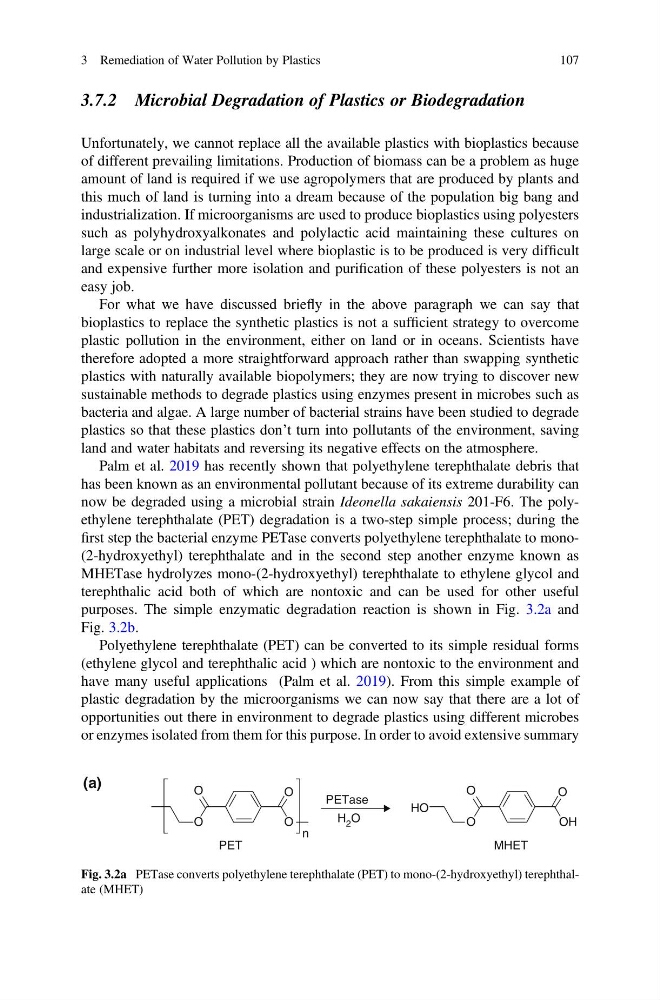
now be degraded using a microbial strain Ideonella sakaiensis 201-F6. The polyethylene terephthalate (PET) degradation is a two-step simple process; during the
first step the bacterial enzyme PETase converts polyethylene terephthalate to mono(2-hydroxyethyl) terephthalate and in the second step another enzyme known as
MHETase hydrolyzes mono-(2-hydroxyethyl) terephthalate to ethylene glycol and
terephthalic acid both of which are nontoxic and can be used for other useful
purposes. The simple enzymatic degradation reaction is shown in Fig. 3.2a and
Fig. 3.2b.
Polyethylene terephthalate (PET) can be converted to its simple residual forms
(ethylene glycol and terephthalic acid ) which are nontoxic to the environment and
have many useful applications (Palm et al. 2019). From this simple example of
plastic degradation by the microorganisms we can now say that there are a lot of
opportunities out there in environment to degrade plastics using different microbes
or enzymes isolated from them for this purpose. In order to avoid extensive summary
O
O
O
O
O
O
OH
MHET
O
PETase
HO
PET
H 2 O
n
(a)
Fig. 3.2a PETase converts polyethylene terephthalate (PET) to mono-(2-hydroxyethyl) terephthalate (MHET)
3 Remediation of Water Pollution by Plastics
107
Unfortunately, we cannot replace all the available plastics with bioplastics because
of different prevailing limitations. Production of biomass can be a problem as huge
amount of land is required if we use agropolymers that are produced by plants and
this much of land is turning into a dream because of the population big bang and
industrialization. If microorganisms are used to produce bioplastics using polyesters
such as polyhydroxyalkonates and polylactic acid maintaining these cultures on
large scale or on industrial level where bioplastic is to be produced is very difficult
and expensive further more isolation and purification of these polyesters is not an
easy job.
For what we have discussed briefly in the above paragraph we can say that
bioplastics to replace the synthetic plastics is not a sufficient strategy to overcome
plastic pollution in the environment, either on land or in oceans. Scientists have
therefore adopted a more straightforward approach rather than swapping synthetic
plastics with naturally available biopolymers; they are now trying to discover new
sustainable methods to degrade plastics using enzymes present in microbes such as
bacteria and algae. A large number of bacterial strains have been studied to degrade
plastics so that these plastics don’t turn into pollutants of the environment, saving
land and water habitats and reversing its negative effects on the atmosphere.
Palm et al. 2019 has recently shown that polyethylene terephthalate debris that
has been known as an environmental pollutant because of its extreme durability can
now be degraded using a microbial strain Ideonella sakaiensis 201-F6. The polyethylene terephthalate (PET) degradation is a two-step simple process; during the
first step the bacterial enzyme PETase converts polyethylene terephthalate to mono(2-hydroxyethyl) terephthalate and in the second step another enzyme known as
MHETase hydrolyzes mono-(2-hydroxyethyl) terephthalate to ethylene glycol and
terephthalic acid both of which are nontoxic and can be used for other useful
purposes. The simple enzymatic degradation reaction is shown in Fig. 3.2a and
Fig. 3.2b.
Polyethylene terephthalate (PET) can be converted to its simple residual forms
(ethylene glycol and terephthalic acid ) which are nontoxic to the environment and
have many useful applications (Palm et al. 2019). From this simple example of
plastic degradation by the microorganisms we can now say that there are a lot of
opportunities out there in environment to degrade plastics using different microbes
or enzymes isolated from them for this purpose. In order to avoid extensive summary
O
O
O
O
O
O
OH
MHET
O
PETase
HO
PET
H 2 O
n
(a)
Fig. 3.2a PETase converts polyethylene terephthalate (PET) to mono-(2-hydroxyethyl) terephthalate (MHET)
3 Remediation of Water Pollution by Plastics
107