

Domestic Laundry and Microfiber Shedding of Synthetic Textiles
141
noted in all the research showed a reduction in microfiber shedding with increment
in the number of cycles. The first study on the effect of washing cycle or time on
the microfiber shedding was performed by Napper and Thompson. They examined
the acrylics, polyester, and polyester/cotton fabric for 4 consecutive laundries. The
researcher noted a decrease in the microfiber in all the cases. In the case of polyester,
the first wash shed 2.79 mg of polyester and at 4th wash, it was noted as 1.63 mg.
Compared to the polyester, for acrylic fabric, shedding reduced more but followed
a similar pattern. The acrylic fiber count has been noted as 2.63 mg initially and
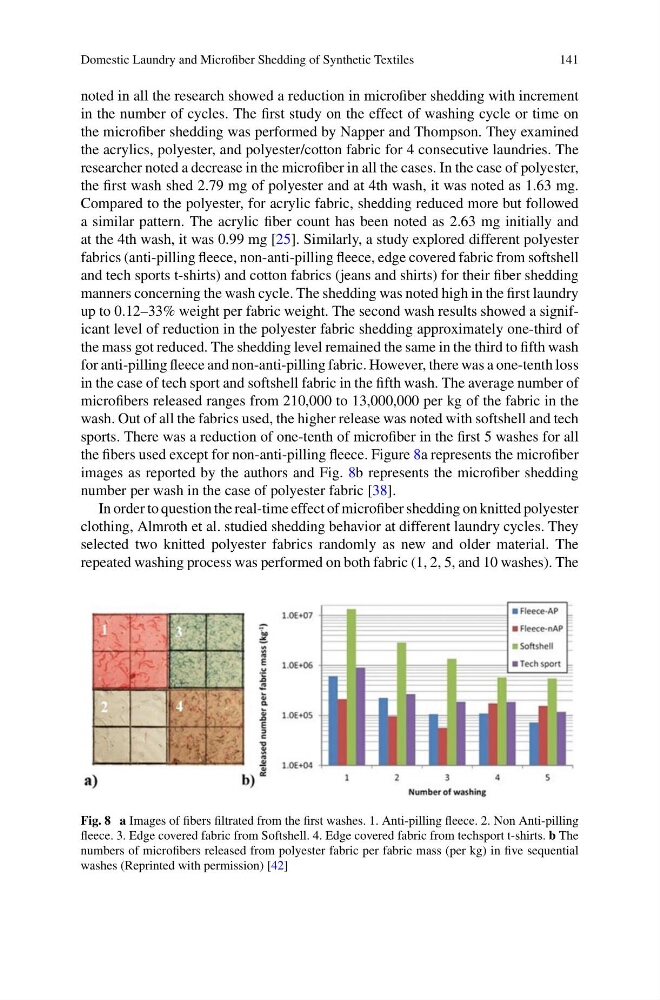
at the 4th wash, it was 0.99 mg [25]. Similarly, a study explored different polyester
fabrics (anti-pilling fleece, non-anti-pilling fleece, edge covered fabric from softshell
and tech sports t-shirts) and cotton fabrics (jeans and shirts) for their fiber shedding
manners concerning the wash cycle. The shedding was noted high in the first laundry
up to 0.12–33% weight per fabric weight. The second wash results showed a significant level of reduction in the polyester fabric shedding approximately one-third of
the mass got reduced. The shedding level remained the same in the third to fifth wash
for anti-pilling fleece and non-anti-pilling fabric. However, there was a one-tenth loss
in the case of tech sport and softshell fabric in the fifth wash. The average number of
microfibers released ranges from 210,000 to 13,000,000 per kg of the fabric in the
wash. Out of all the fabrics used, the higher release was noted with softshell and tech
sports. There was a reduction of one-tenth of microfiber in the first 5 washes for all
the fibers used except for non-anti-pilling fleece. Figure 8a represents the microfiber
images as reported by the authors and Fig. 8b represents the microfiber shedding
number per wash in the case of polyester fabric [38].
In order to question the real-time effect of microfiber shedding on knitted polyester
clothing, Almroth et al. studied shedding behavior at different laundry cycles. They
selected two knitted polyester fabrics randomly as new and older material. The
repeated washing process was performed on both fabric (1, 2, 5, and 10 washes). The
Fig. 8 a Images of fibers filtrated from the first washes. 1. Anti-pilling fleece. 2. Non Anti-pilling
fleece. 3. Edge covered fabric from Softshell. 4. Edge covered fabric from techsport t-shirts. b The
numbers of microfibers released from polyester fabric per fabric mass (per kg) in five sequential
washes (Reprinted with permission) [42]
141
noted in all the research showed a reduction in microfiber shedding with increment
in the number of cycles. The first study on the effect of washing cycle or time on
the microfiber shedding was performed by Napper and Thompson. They examined
the acrylics, polyester, and polyester/cotton fabric for 4 consecutive laundries. The
researcher noted a decrease in the microfiber in all the cases. In the case of polyester,
the first wash shed 2.79 mg of polyester and at 4th wash, it was noted as 1.63 mg.
Compared to the polyester, for acrylic fabric, shedding reduced more but followed
a similar pattern. The acrylic fiber count has been noted as 2.63 mg initially and
at the 4th wash, it was 0.99 mg [25]. Similarly, a study explored different polyester
fabrics (anti-pilling fleece, non-anti-pilling fleece, edge covered fabric from softshell
and tech sports t-shirts) and cotton fabrics (jeans and shirts) for their fiber shedding
manners concerning the wash cycle. The shedding was noted high in the first laundry
up to 0.12–33% weight per fabric weight. The second wash results showed a significant level of reduction in the polyester fabric shedding approximately one-third of
the mass got reduced. The shedding level remained the same in the third to fifth wash
for anti-pilling fleece and non-anti-pilling fabric. However, there was a one-tenth loss
in the case of tech sport and softshell fabric in the fifth wash. The average number of
microfibers released ranges from 210,000 to 13,000,000 per kg of the fabric in the
wash. Out of all the fabrics used, the higher release was noted with softshell and tech
sports. There was a reduction of one-tenth of microfiber in the first 5 washes for all
the fibers used except for non-anti-pilling fleece. Figure 8a represents the microfiber
images as reported by the authors and Fig. 8b represents the microfiber shedding
number per wash in the case of polyester fabric [38].
In order to question the real-time effect of microfiber shedding on knitted polyester
clothing, Almroth et al. studied shedding behavior at different laundry cycles. They
selected two knitted polyester fabrics randomly as new and older material. The
repeated washing process was performed on both fabric (1, 2, 5, and 10 washes). The
Fig. 8 a Images of fibers filtrated from the first washes. 1. Anti-pilling fleece. 2. Non Anti-pilling
fleece. 3. Edge covered fabric from Softshell. 4. Edge covered fabric from techsport t-shirts. b The
numbers of microfibers released from polyester fabric per fabric mass (per kg) in five sequential
washes (Reprinted with permission) [42]