

142
R. Rathinamoorthy and S. Raja Balasaraswathi
results indicated that the new garment sheds more number of fibers than the older
garment. The older garment did not show a reduction in microfiber shedding after 2, 5,
and 10 washing cycles. Whereas, in the new garments, shedding significantly reduced
in the subsequent washes [13]. Similar research performed three laundry cycles to
evaluate the microfiber shedding of polyester, rayon, a polyester-cotton blend, and
cotton fabric. The results showed a significant reduction in the microfiber shedding
than the preceding wash until the third wash. However, even after the third wash,
the fabric shed a reasonable amount of microfibers [33]. Researchers also calculated
the microfiber detachment rate using different polyester fabric. They evaluated the
shedding nature in the preliminary trial and found that after the 5th wash the shedding was stabilized. Hence the researcher measured the microfiber shedding at the
5th wash as the long-term release quantity. The researcher evaluated the shedding of
polyester fluffy fabric, polyester normal fabric, polyester/elastane, and polyacrylic
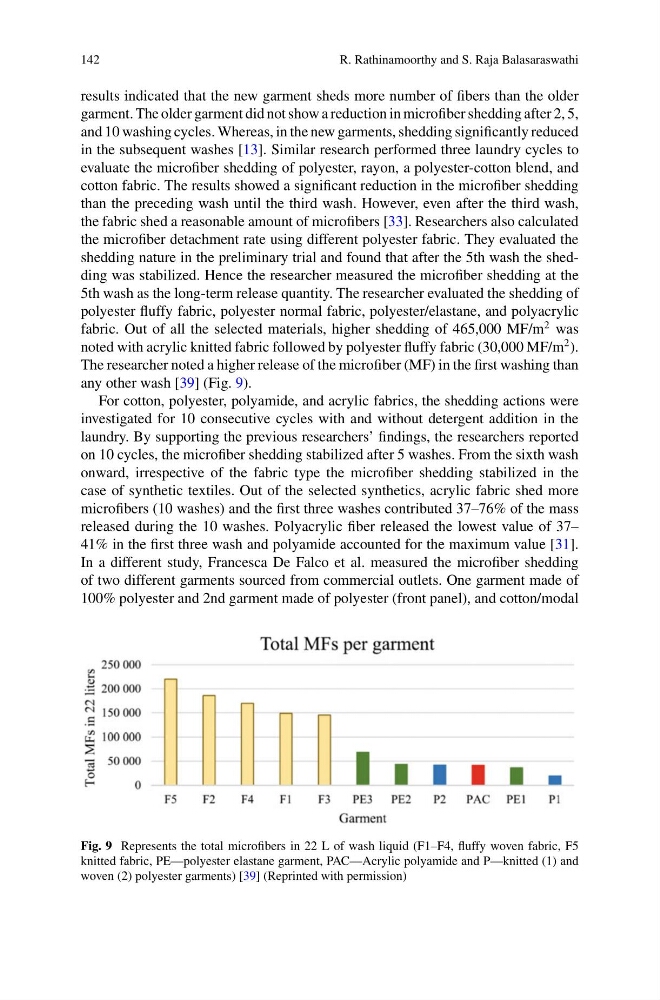
fabric. Out of all the selected materials, higher shedding of 465,000 MF/m
2 was
noted with acrylic knitted fabric followed by polyester fluffy fabric (30,000 MF/m
2 ).
The researcher noted a higher release of the microfiber (MF) in the first washing than
any other wash [39] (Fig. 9).
For cotton, polyester, polyamide, and acrylic fabrics, the shedding actions were
investigated for 10 consecutive cycles with and without detergent addition in the
laundry. By supporting the previous researchers’ findings, the researchers reported
on 10 cycles, the microfiber shedding stabilized after 5 washes. From the sixth wash
onward, irrespective of the fabric type the microfiber shedding stabilized in the
case of synthetic textiles. Out of the selected synthetics, acrylic fabric shed more
microfibers (10 washes) and the first three washes contributed 37–76% of the mass
released during the 10 washes. Polyacrylic fiber released the lowest value of 37–
41% in the first three wash and polyamide accounted for the maximum value [31].
In a different study, Francesca De Falco et al. measured the microfiber shedding
of two different garments sourced from commercial outlets. One garment made of
100% polyester and 2nd garment made of polyester (front panel), and cotton/modal
Fig. 9 Represents the total microfibers in 22 L of wash liquid (F1–F4, fluffy woven fabric, F5
knitted fabric, PE—polyester elastane garment, PAC—Acrylic polyamide and P—knitted (1) and
woven (2) polyester garments) [39] (Reprinted with permission)
R. Rathinamoorthy and S. Raja Balasaraswathi
results indicated that the new garment sheds more number of fibers than the older
garment. The older garment did not show a reduction in microfiber shedding after 2, 5,
and 10 washing cycles. Whereas, in the new garments, shedding significantly reduced
in the subsequent washes [13]. Similar research performed three laundry cycles to
evaluate the microfiber shedding of polyester, rayon, a polyester-cotton blend, and
cotton fabric. The results showed a significant reduction in the microfiber shedding
than the preceding wash until the third wash. However, even after the third wash,
the fabric shed a reasonable amount of microfibers [33]. Researchers also calculated
the microfiber detachment rate using different polyester fabric. They evaluated the
shedding nature in the preliminary trial and found that after the 5th wash the shedding was stabilized. Hence the researcher measured the microfiber shedding at the
5th wash as the long-term release quantity. The researcher evaluated the shedding of
polyester fluffy fabric, polyester normal fabric, polyester/elastane, and polyacrylic
fabric. Out of all the selected materials, higher shedding of 465,000 MF/m
2 was
noted with acrylic knitted fabric followed by polyester fluffy fabric (30,000 MF/m
2 ).
The researcher noted a higher release of the microfiber (MF) in the first washing than
any other wash [39] (Fig. 9).
For cotton, polyester, polyamide, and acrylic fabrics, the shedding actions were
investigated for 10 consecutive cycles with and without detergent addition in the
laundry. By supporting the previous researchers’ findings, the researchers reported
on 10 cycles, the microfiber shedding stabilized after 5 washes. From the sixth wash
onward, irrespective of the fabric type the microfiber shedding stabilized in the
case of synthetic textiles. Out of the selected synthetics, acrylic fabric shed more
microfibers (10 washes) and the first three washes contributed 37–76% of the mass
released during the 10 washes. Polyacrylic fiber released the lowest value of 37–
41% in the first three wash and polyamide accounted for the maximum value [31].
In a different study, Francesca De Falco et al. measured the microfiber shedding
of two different garments sourced from commercial outlets. One garment made of
100% polyester and 2nd garment made of polyester (front panel), and cotton/modal
Fig. 9 Represents the total microfibers in 22 L of wash liquid (F1–F4, fluffy woven fabric, F5
knitted fabric, PE—polyester elastane garment, PAC—Acrylic polyamide and P—knitted (1) and
woven (2) polyester garments) [39] (Reprinted with permission)