

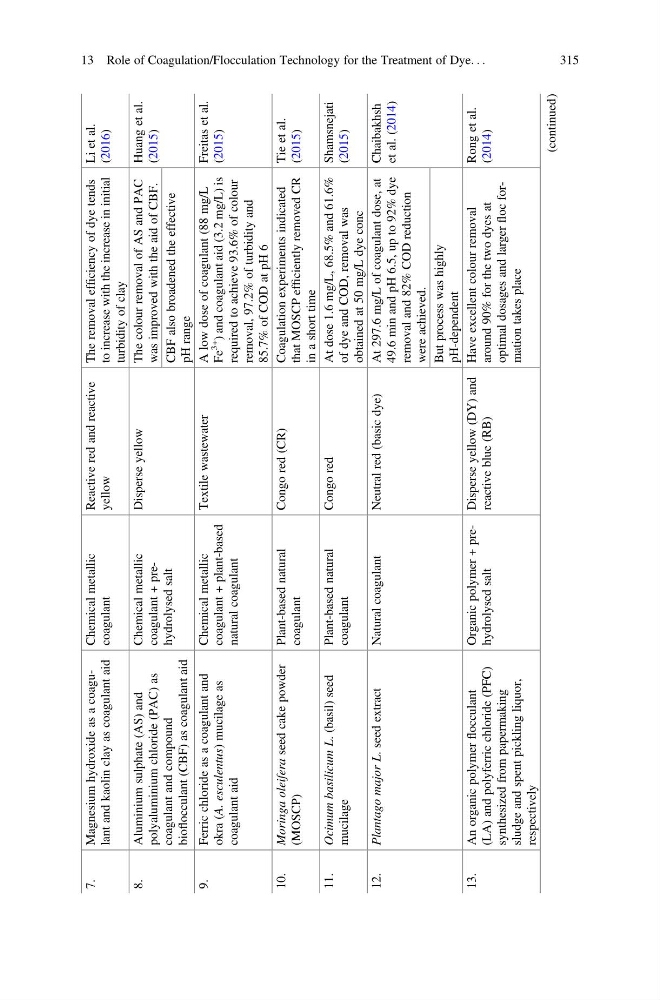
7.
Magnesium hydroxide as a coagulant and kaolin clay as coagulant aid
Chemical metallic
coagulant
Reactive red and reactive
yellow
The removal efficiency of dye tends
to increase with the increase in initial
turbidity of clay
Li et al.
(2016)
8.
Aluminium sulphate (AS) and
polyaluminium chloride (PAC) as
coagulant and compound
bioflocculant (CBF) as coagulant aid
Chemical metallic
coagulant + prehydrolysed salt
Disperse yellow
The colour removal of AS and PAC
was improved with the aid of CBF.
Huang et al.
(2015)
CBF also broadened the effective
pH range
9.
Ferric chloride as a coagulant and
okra (A. esculentus)
mucilage as
coagulant aid
Chemical metallic
coagulant + plant-based
natural coagulant
Textile wastewater
A low dose of coagulant (88 mg/L
Fe
3+
) and coagulant aid (3.2 mg/L) is
required to achieve 93.6% of colour
removal, 97.2% of turbidity and
85.7% of COD at pH 6
Freitas et al.
(2015)
10.
Moringa oleifera
seed cake powder
(MOSCP)
Plant-based natural
coagulant
Congo red (CR)
Coagulation experiments indicated
that MOSCP efficiently removed CR
in a short time
Tie et al.
(2015)
11.
Ocimum basilicum L.
(basil) seed
mucilage
Plant-based natural
coagulant
Congo red
At dose 1.6 mg/L, 68.5% and 61.6%
of dye and COD, removal was
obtained at 50 mg/L dye conc
Shamsnejati
(2015)
12.
Plantago major L.
seed extract
Natural coagulant
Neutral red (basic dye)
At 297.6 mg/L of coagulant dose, at
49.6 min and pH 6.5, up to 92% dye
removal and 82% COD reduction
were achieved.
Chaibakhsh
et al. (2014)
But process was highly
pH-dependent
13.
An organic polymer
flocculant
(LA) and polyferric chloride (PFC)
synthesized from papermaking
sludge and spent pickling liquor,
respectively
Organic polymer + prehydrolysed salt
Disperse yellow (DY) and
reactive blue (RB)
Have excellent colour removal
around 90% for the two dyes at
optimal dosages and larger
floc formation takes place
Rong et al.
(2014)
(continued)
13 Role of Coagulation/Flocculation Technology for the Treatment of Dye. . .
315
Magnesium hydroxide as a coagulant and kaolin clay as coagulant aid
Chemical metallic
coagulant
Reactive red and reactive
yellow
The removal efficiency of dye tends
to increase with the increase in initial
turbidity of clay
Li et al.
(2016)
8.
Aluminium sulphate (AS) and
polyaluminium chloride (PAC) as
coagulant and compound
bioflocculant (CBF) as coagulant aid
Chemical metallic
coagulant + prehydrolysed salt
Disperse yellow
The colour removal of AS and PAC
was improved with the aid of CBF.
Huang et al.
(2015)
CBF also broadened the effective
pH range
9.
Ferric chloride as a coagulant and
okra (A. esculentus)
mucilage as
coagulant aid
Chemical metallic
coagulant + plant-based
natural coagulant
Textile wastewater
A low dose of coagulant (88 mg/L
Fe
3+
) and coagulant aid (3.2 mg/L) is
required to achieve 93.6% of colour
removal, 97.2% of turbidity and
85.7% of COD at pH 6
Freitas et al.
(2015)
10.
Moringa oleifera
seed cake powder
(MOSCP)
Plant-based natural
coagulant
Congo red (CR)
Coagulation experiments indicated
that MOSCP efficiently removed CR
in a short time
Tie et al.
(2015)
11.
Ocimum basilicum L.
(basil) seed
mucilage
Plant-based natural
coagulant
Congo red
At dose 1.6 mg/L, 68.5% and 61.6%
of dye and COD, removal was
obtained at 50 mg/L dye conc
Shamsnejati
(2015)
12.
Plantago major L.
seed extract
Natural coagulant
Neutral red (basic dye)
At 297.6 mg/L of coagulant dose, at
49.6 min and pH 6.5, up to 92% dye
removal and 82% COD reduction
were achieved.
Chaibakhsh
et al. (2014)
But process was highly
pH-dependent
13.
An organic polymer
flocculant
(LA) and polyferric chloride (PFC)
synthesized from papermaking
sludge and spent pickling liquor,
respectively
Organic polymer + prehydrolysed salt
Disperse yellow (DY) and
reactive blue (RB)
Have excellent colour removal
around 90% for the two dyes at
optimal dosages and larger
floc formation takes place
Rong et al.
(2014)
(continued)
13 Role of Coagulation/Flocculation Technology for the Treatment of Dye. . .
315