

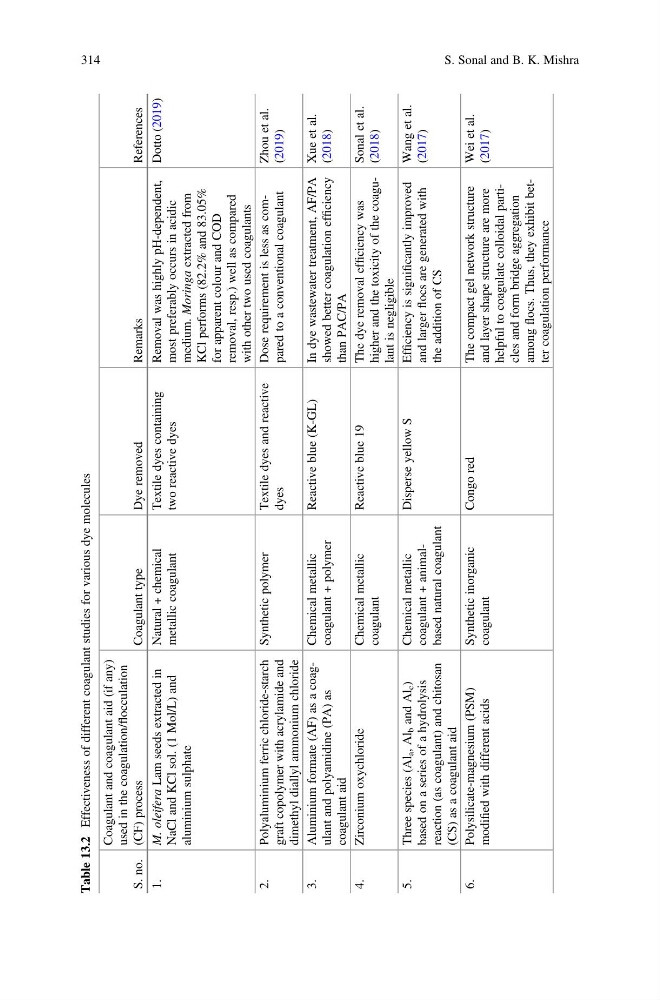
Table 13.2
Effectiveness of different coagulant studies for various dye molecules
S. no.
Coagulant and coagulant aid (if any)
used in the coagulation/flocculation
(CF) process
Coagulant type
Dye removed
Remarks
References
1.
M. oleifera
Lam seeds extracted in
NaCl and KCl sol. (1 Mol/L) and
aluminium sulphate
Natural + chemical
metallic coagulant
Textile dyes containing
two reactive dyes
Removal was highly pH-dependent,
most preferably occurs in acidic
medium. Moringa
extracted from
KCl performs (82.2% and 83.05%
for apparent colour and COD
removal, resp.) well as compared
with other two used coagulants
Dotto (2019)
2.
Polyaluminium ferric chloride-starch
graft copolymer with acrylamide and
dimethyl diallyl ammonium chloride
Synthetic polymer
Textile dyes and reactive
dyes
Dose requirement is less as compared to a conventional coagulant
Zhou et al.
(2019)
3.
Aluminium formate (AF) as a coagulant and polyamidine (PA) as
coagulant aid
Chemical metallic
coagulant + polymer
Reactive blue (K-GL)
In dye wastewater treatment, AF/PA
showed better coagulation efficiency
than PAC/PA
Xue et al.
(2018)
4.
Zirconium oxychloride
Chemical metallic
coagulant
Reactive blue 19
The dye removal efficiency was
higher and the toxicity of the coagulant is negligible
Sonal et al.
(2018)
5.
Three species (Al
a , Al
b and Al
c )
based on a series of a hydrolysis
reaction (as coagulant) and chitosan
(CS) as a coagulant aid
Chemical metallic
coagulant + animalbased natural coagulant
Disperse yellow S
Efficiency is significantly improved
and larger
flocs are generated with
the addition of CS
Wang et al.
(2017)
6.
Polysilicate-magnesium (PSM)
modified with different acids
Synthetic inorganic
coagulant
Congo red
The compact gel network structure
and layer shape structure are more
helpful to coagulate colloidal particles and form bridge aggregation
among
flocs. Thus, they exhibit better coagulation performance
Wei et al.
(2017)
314
S. Sonal and B. K. Mishra
Effectiveness of different coagulant studies for various dye molecules
S. no.
Coagulant and coagulant aid (if any)
used in the coagulation/flocculation
(CF) process
Coagulant type
Dye removed
Remarks
References
1.
M. oleifera
Lam seeds extracted in
NaCl and KCl sol. (1 Mol/L) and
aluminium sulphate
Natural + chemical
metallic coagulant
Textile dyes containing
two reactive dyes
Removal was highly pH-dependent,
most preferably occurs in acidic
medium. Moringa
extracted from
KCl performs (82.2% and 83.05%
for apparent colour and COD
removal, resp.) well as compared
with other two used coagulants
Dotto (2019)
2.
Polyaluminium ferric chloride-starch
graft copolymer with acrylamide and
dimethyl diallyl ammonium chloride
Synthetic polymer
Textile dyes and reactive
dyes
Dose requirement is less as compared to a conventional coagulant
Zhou et al.
(2019)
3.
Aluminium formate (AF) as a coagulant and polyamidine (PA) as
coagulant aid
Chemical metallic
coagulant + polymer
Reactive blue (K-GL)
In dye wastewater treatment, AF/PA
showed better coagulation efficiency
than PAC/PA
Xue et al.
(2018)
4.
Zirconium oxychloride
Chemical metallic
coagulant
Reactive blue 19
The dye removal efficiency was
higher and the toxicity of the coagulant is negligible
Sonal et al.
(2018)
5.
Three species (Al
a , Al
b and Al
c )
based on a series of a hydrolysis
reaction (as coagulant) and chitosan
(CS) as a coagulant aid
Chemical metallic
coagulant + animalbased natural coagulant
Disperse yellow S
Efficiency is significantly improved
and larger
flocs are generated with
the addition of CS
Wang et al.
(2017)
6.
Polysilicate-magnesium (PSM)
modified with different acids
Synthetic inorganic
coagulant
Congo red
The compact gel network structure
and layer shape structure are more
helpful to coagulate colloidal particles and form bridge aggregation
among
flocs. Thus, they exhibit better coagulation performance
Wei et al.
(2017)
314
S. Sonal and B. K. Mishra